

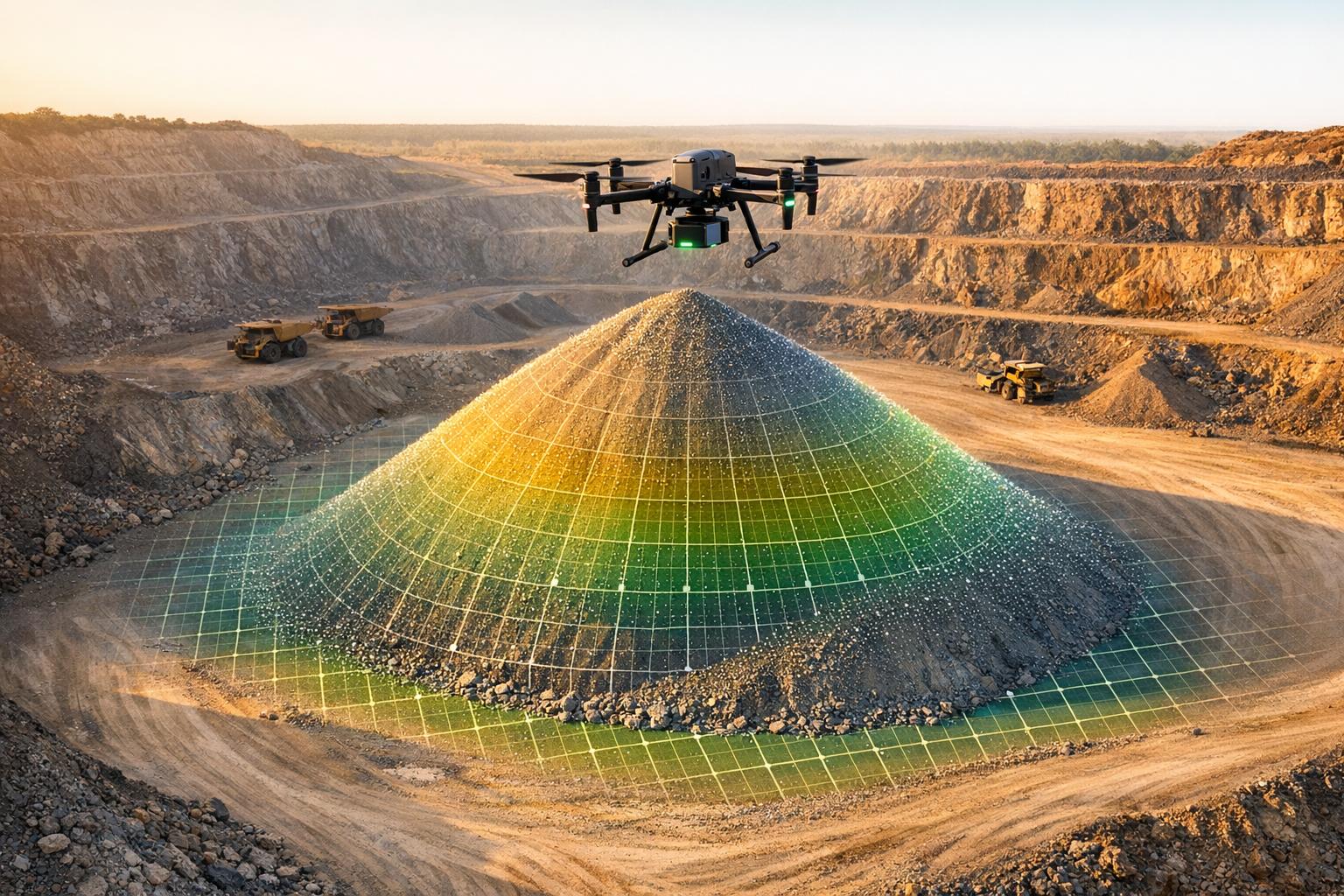
LiDAR technology has reshaped mining volume calculations by offering up to 99% accuracy, faster surveys, and improved safety. Unlike older methods prone to 20–30% errors, LiDAR uses laser pulses to create precise 3D models of stockpiles and excavation sites. This allows mining operations to:
- Measure volumes accurately, reducing financial discrepancies.
- Complete surveys faster, such as cutting a two-shift survey to 30 minutes with drones.
- Eliminate safety risks by avoiding hazardous site access.
Key LiDAR methods include Aerial Laser Scanning (ALS) for large open-pit areas, Terrestrial Laser Scanning (TLS) for smaller, detailed measurements, and Mobile LiDAR for underground environments. Data processing tools like DJI Terra, Trimble Business Center, and LP360 further streamline calculations by automating noise filtering and volume modeling.
While challenges like weather interference and dust exist, advanced techniques and software mitigate these issues, making LiDAR a reliable solution for mining operations. The result? Faster, safer, and more precise volume tracking for better decision-making.
LiDAR Accuracy and Precision in Mining
Research Studies on Accuracy Improvements
LiDAR technology has proven its ability to deliver highly precise volume calculations in mining projects. A standout example comes from August 2024, when researchers Erdenechimeg Purevjav and Khosbayar Orosoo carried out a meticulous control survey at the Oyu Tolgoi underground mine. Using Trimble X7 and SX12 laser scanners, they gathered over 42 billion data points from 905 stations and 829 ground control marks across seven underground levels. Their findings revealed an actual excavation volume of 441,128.80 m³ compared to a planned volume of 422,837.50 m³. This translated to a horizontal relative error of 1:26,000 and an impressive vertical relative error of 1:22,000,000.
Further studies have pushed accuracy even further. For instance, an improved point cloud slicing method applied to open-pit mines achieved an average relative error of just 1.17% in volume calculations. Additionally, for grain bulk surfaces, a denoising method based on Discrete Wavelet Threshold (DWT) brought the relative volume error down to an astonishingly low 0.086%.
Technical Factors Affecting LiDAR Precision
Several technical elements contribute to LiDAR's ability to achieve sub-centimeter accuracy. One major factor is point density. Modern terrestrial laser scanners (TLS) can capture between 10,000 and 1,000,000 points per second, generating detailed 3D models with beam divergences as small as 0.2 mrad.
Noise filtering is another essential component. Algorithms like Statistical Outlier Removal (SOR) are designed to remove inaccuracies caused by machinery, dust, or human movement, ensuring the final point cloud represents the terrain or stockpile with high fidelity. Advanced techniques, such as enhanced point cloud slicing that uses Euclidean clustering and concave hull algorithms, further refine the data by accurately distinguishing complex boundaries on irregular ore bodies.
Integration with Real-Time Kinematic (RTK) systems also elevates precision. RTK combines LiDAR data with high-accuracy GNSS and IMU readings, enabling aerial surveys to maintain centimeter-level accuracy. Meanwhile, underground handheld SLAM scanners can achieve precision up to 2mm without relying on satellite signals. As Inertial Labs explains:
The combination of LiDAR and an inertial navigation system (INS) forms a system that determines the coordinates of each point, resulting in a georeferenced point cloud with centimeter accuracy.
sbb-itb-ac6e058
Volume calculation in Mining using LiDAR
Comparing LiDAR Survey Methods for Mining Sites

Comparison of LiDAR Survey Methods for Mining: Aerial, Terrestrial, and Mobile
LiDAR technology has brought precision to mining surveys, and the choice of method often depends on the specific needs of the site.
Mining operations typically rely on three main LiDAR survey methods: Aerial Laser Scanning (ALS), Terrestrial Laser Scanning (TLS), and Mobile LiDAR. Each serves a distinct purpose. For instance, ALS uses drones to efficiently map large open-pit areas from above, covering up to 0.5 km² (approximately 0.19 mi²) in just 20 minutes while keeping personnel at a safe distance from unstable terrain. TLS, on the other hand, excels in accuracy for smaller, focused areas like ore heaps or stockpiles, though it requires multiple tripod setups, which can slow down surveys of larger spaces. Mobile LiDAR, equipped with SLAM technology, is ideal for underground environments where GNSS signals are unavailable, achieving accuracies as fine as 2 mm (about 0.08 in).
A great example of combining these methods comes from GEOS3D, a Polish surveying company. In February 2025, they demonstrated how integrating aerial scanning with a DJI Matrice 350 RTK and Zenmuse L2, alongside terrestrial data from a Leica RTC360, could streamline operations. By merging these datasets using 3Dsurvey software, they reduced survey time from several days to just one day in the field, plus a few hours of office processing. This approach not only sped up the process but also improved the accuracy of ore volume calculations.
Advantages and Limitations of Each Method
Each LiDAR method has its strengths and challenges, balancing factors like precision, speed, and safety. Here's a quick comparison:
| Method | Accuracy | Time Requirements | Safety Risk | Point Density | Best Application |
|---|---|---|---|---|---|
| Aerial (ALS/Drone) | Centimeter-level | Very fast (scans 0.5 km² in ~20 mins) | Very low (remote operation) | High | Open pits, large surface stockpiles, inaccessible highwalls |
| Terrestrial (TLS) | Millimeter to centimeter-level | Moderate (requires multiple setups) | Medium (requires on-site access) | High (100,000–1,000,000 points/sec) | Indoor sheds, high-precision ore heaps, covered stockpiles |
| Mobile (SLAM) | High (up to 2 mm) | Fast (real-time data acquisition) | Low (can be vehicle-mounted) | High | Underground tunnels, active roadways, GPS-denied areas |
These differences highlight the importance of selecting the right method for the job. For example, ALS ensures rapid data collection with minimal risk, as noted by Trail Surveys:
Surveys that once took weeks can now be completed in hours.
Meanwhile, underground surveys demand specialized equipment, such as explosion-proof Mobile LiDAR systems, to ensure safety in environments with combustible gases. For sites that combine open-pit and indoor areas, integrating ALS and TLS provides a complete 3D model.
Processing Techniques for LiDAR Data in Volume Calculations
LiDAR's precision makes it indispensable for calculating volumes in industries like mining. But raw data alone isn’t enough - it needs to be processed systematically to deliver accurate results. The process typically begins with importing raw data files, such as .LAS, .LAZ, or .PCD, into specialized software. From there, the data undergoes cleaning to remove noise caused by dust, machinery, or other interferences. Once cleaned, the software classifies points into ground and non-ground categories to create a reliable Digital Terrain Model (DTM).
Next, the stockpile’s perimeter (often called the "toe") is defined, and a surface mesh is generated using methods like Delaunay triangulation. This mesh helps calculate the volume between the stockpile’s surface and a predefined base plane.
For example, engineers at HMARA in Australia used UAV LiDAR data with an average density of 485.2 points per square meter. Using Terrasolid software, they measured the volumes of 19 stockpiles (totaling about 238,743 cubic feet) and created contours at intervals of approximately 0.82 feet - all within a single day. These processed datasets are then ready for further refinement using specialized software to streamline volume calculations.
Software and Tools for LiDAR Data Processing
Different software tools are tailored for specific tasks in LiDAR data processing. Here are a few examples:
- DJI Terra: Designed for seamless integration with the Zenmuse L2 sensor, this software processes data locally at impressive speeds. For instance, version 3.7 can handle a 500-photo survey in just 25 minutes, a significant improvement over earlier versions.
- Trimble Business Center: Offers an "Extract Stockpile" feature that automatically defines boundaries and calculates grid-based volumes.
- LP360: Includes a "Toe Extractor" tool, which drastically reduces processing time. For a 10-acre site with around 50 stockpiles, the processing time can drop from 8 hours to under 1 hour.
- MATLAB: Provides advanced algorithmic tools like
pcreadfor loading data anddelaunayTriangulationfor creating surface meshes. - 3Dsurvey: Known for its flexibility, this tool combines drone and terrestrial datasets without requiring specific hardware.
Selecting the right software depends on your operational needs. Tools like DJI Terra and LP360 are ideal for offline use at remote locations, provided you have a powerful workstation with a high-end GPU. In contrast, cloud-based platforms like Propeller or DroneDeploy eliminate the need for expensive hardware, offering browser-based collaboration. However, these platforms require reliable, high-speed internet to upload large datasets.
On-Device and Cloud-Based Point Cloud Processing
Modern workflows often integrate on-device and cloud-based processing to enhance efficiency. The choice between these methods depends on factors like site conditions and the need for collaboration. For example, at a rail-ballast yard, Balfour Beatty transitioned from manual tape-and-pole surveys to a drone-based workflow. This switch reduced survey time from an entire day to a 15-minute drone flight, followed by two hours of cloud processing. Cloud platforms streamline the process by automating data uploads and enabling real-time reporting. This allows teams in finance, logistics, and operations to access inventory metrics from anywhere.
On the other hand, local processing is better suited for handling large LiDAR datasets (50+ GB) that are difficult to upload or when immediate results are needed offline. Platforms like Anvil Labs support LiDAR point clouds alongside 3D models and orthomosaics. Their cloud-based hosting enables secure sharing and collaboration, allowing teams to annotate, measure, and work together on processed data without the hassle of transferring files manually.
Efficiency and Challenges in LiDAR-Based Volume Calculations
Efficiency Gains Through Automation
LiDAR has transformed the way mining operations handle inventory tracking and volume calculations. Drone-based LiDAR systems, in particular, have made surveys up to 10 times faster compared to the older walk-and-shoot methods. For example, at the Event 38 quarry, switching to drone-based stockpile measurements cut crew time from 40 hours to just 16 hours per month - a 60% reduction in labor hours. Similarly, the Idaho Forest Group adopted a WingtraOne drone program and saw an 80% reduction in field time for volume measurements, recovering their investment in under six months.
"LiDAR's ability to generate precise, three-dimensional information about the earth's surface... significantly enhances mining operations. This technology offers a leap in accuracy and efficiency, providing a detailed analysis of the mining environment that traditional methods cannot match." - CHC Navigation
LiDAR's benefits go beyond speed. It significantly improves safety by keeping personnel out of hazardous areas. Fixed LiDAR systems can run autonomously around the clock, tracking real-time volume changes without the need for daily manual surveys. Surveyors no longer have to climb unstable stockpiles or enter dangerous blasting zones, reducing the risk of falls and injuries. While these advantages are substantial, LiDAR still encounters some operational hurdles in the challenging conditions of mining environments.
Challenges and Limitations of LiDAR in Mining
Mining sites often deal with harsh conditions that can affect LiDAR performance. Rain, fog, or heavy dust can scatter the laser pulses, which may lead to less accurate measurements. Dense vegetation can also block the laser from reaching the ground, while covered storage areas with roofs or dust can introduce noise into the point cloud data.
Another limitation is that standard LiDAR systems, which use red-range electromagnetic waves, cannot penetrate water. This makes them unsuitable for measuring materials extracted below the water table. For underwater mining, operators need to pair LiDAR with bathymetric echo sounders and GPS to fully map excavation profiles.
To maintain data accuracy, operators should regularly clean LiDAR optics to prevent dust or debris from creating noisy points in the data. Multi-echo sensors can help overcome vegetation interference by allowing the laser to penetrate foliage and reach the ground. Additionally, advanced software can filter out noise caused by vegetation, dust, or temporary structures during post-processing. Tackling these challenges will allow LiDAR to further streamline mining operations and enhance its overall effectiveness.
Conclusion
LiDAR has reshaped how mining volume calculations are performed. Drone-based LiDAR surveys can be up to 10 times faster than traditional walk-and-shoot methods, while achieving volume accuracy within ±2.6% of conventional tape-and-total-station techniques.
Beyond speed, LiDAR greatly enhances safety. Surveyors can work from a safe distance, avoiding unstable slopes or other hazardous areas, all while capturing millions of data points per second. This data creates detailed 3D models that far surpass what traditional methods can offer.
"3D laser scanning technique can effectively be applied to ore output volume measurement since it satisfies the requirement of ore volume measurement." - Scientific.Net
The mining industry is also embracing automation powered by LiDAR’s capabilities. Automated LiDAR systems now operate continuously, providing real-time tracking to improve compliance and efficiency. With approximately 98% availability in various weather conditions, these systems are reliable and consistent. This shift toward automation highlights LiDAR's growing role in modern mining.
As mining operations strive for greater efficiency and stricter compliance, LiDAR stands out as a tool that delivers measurable improvements in accuracy, safety, and productivity.
FAQs
How do I choose ALS, TLS, or mobile LiDAR for my mine?
When deciding between ALS, TLS, or mobile LiDAR, the choice hinges on your project's specific requirements, the site characteristics, and the level of accuracy you need.
- ALS (Airborne LiDAR): Perfect for large-scale surveys, especially in open-pit mines where aerial coverage is essential. While it excels at mapping broad areas, it may struggle with precision in complex or uneven terrains.
- TLS (Terrestrial LiDAR): Designed for situations requiring highly detailed and accurate mapping, such as structures, tunnels, or other confined spaces where precision is critical.
- Mobile LiDAR: Offers speed and adaptability, making it a great fit for diverse terrains, including underground environments or areas with dense vegetation.
Each method has strengths tailored to specific scenarios, so understanding your project's demands is key to making the right choice.
What ground control or RTK setup do I need for accurate volumes?
To ensure precise volume calculations using LiDAR, it's crucial that your ground control or RTK setup includes accurate GNSS base stations positioned within about 6.2 miles of the site. This proximity helps maintain proper calibration and positioning accuracy, leading to dependable results.
How do dust, rain, or fog affect LiDAR volume results?
Dust, rain, and fog can mess with LiDAR accuracy by adding noise and interfering with the laser pulses. This interference can skew the data, leading to less precise volume calculations. To minimize these issues, it's crucial to consider weather and environmental conditions when collecting and processing LiDAR data.

.svg)


