

Wireless protocols are the backbone of how drones communicate - whether it’s for control, telemetry, or transmitting high-quality video. Choosing the right protocol depends on your mission needs, balancing factors like range, bandwidth, latency, and interference resistance. Here’s what you need to know:
- Control vs. Telemetry: Onboard protocols like I²C, SPI, and CAN handle internal drone communication, while air-to-ground systems like MAVLink manage telemetry and commands.
- Frequency Bands: Lower frequencies (e.g., 433 MHz, 915 MHz) offer long range but less bandwidth, while higher frequencies (2.4 GHz, 5.8 GHz) support HD video but have shorter range.
- Latency Matters: For precise control, protocols with low latency (e.g., Flysky i6X at 13.7ms) are essential.
- Video Links: Analog systems have minimal delay but low resolution, while digital options (e.g., DJI Ocusync) deliver HD video with better interference handling.
Security and reliability features like frequency hopping, CRC checks, and encryption ensure stable communication, even in challenging environments. By understanding these protocols, you can optimize your drone’s performance for industrial applications like mapping, inspections, and more.
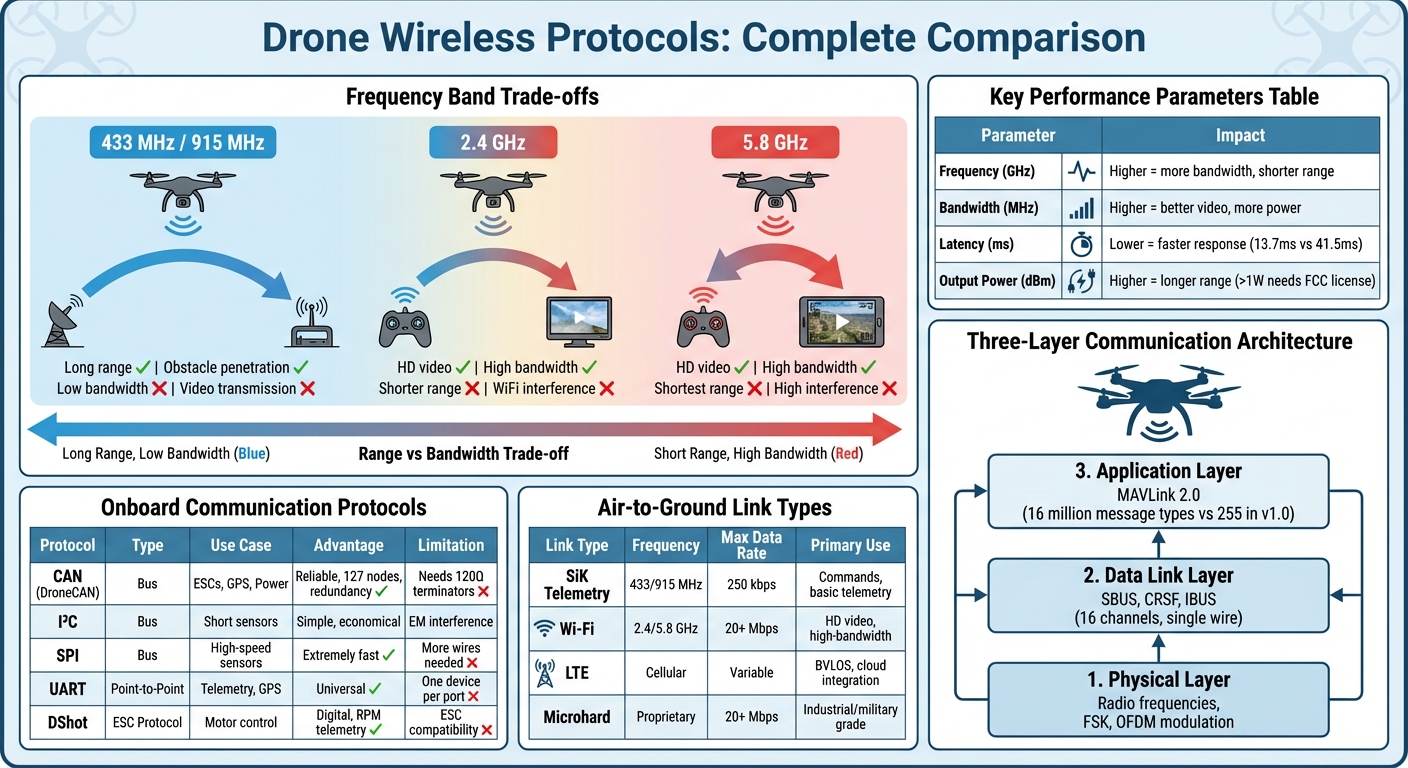
Drone Wireless Protocol Comparison: Frequency Bands, Data Rates, and Use Cases
Wireless Communication Basics for Drones
Key Parameters and Tradeoffs
Drone wireless systems rely on specific frequency bands, each offering distinct benefits. Among the most commonly used are 433 MHz, 915 MHz, 2.4 GHz, and 5.8 GHz, all part of the ISM (Industrial, Scientific, and Medical) spectrum. Lower frequencies like 433 MHz and 915 MHz are excellent for long-range communication and can penetrate obstacles effectively. However, they fall short when it comes to bandwidth, making them less suitable for high-quality video transmission. On the other hand, higher frequencies like 2.4 GHz and 5.8 GHz provide the bandwidth needed for HD video streams but suffer from shorter ranges and increased vulnerability to interference from WiFi networks and other devices.
Another critical factor is latency, which determines how quickly a drone responds to commands. Latency can vary widely - for example, the Flysky i6X offers a latency of 13.7ms, while the Spektrum DX6i reaches 41.5ms. For tasks requiring precise control, such as industrial operations or real-time FPV (First Person View) applications, lower latency is essential. Additionally, the FCC regulates transmission power - any output above 1W (30 dBm) requires special licenses, directly impacting the communication range while ensuring compliance.
| Parameter | Impact on Performance |
|---|---|
| Frequency (GHz) | Higher frequency = higher bandwidth, but shorter range |
| Bandwidth (MHz) | Higher bandwidth = better video quality, but higher power use |
| Latency (ms) | Lower latency = quicker response times for commands |
| Output Power (dBm) | Higher power = longer range, but must meet FCC regulations |
These factors are the foundation for understanding how drone communication systems are designed and optimized.
Communication Layers and Protocols
Drone communication operates through a structured system of layered protocols, ensuring efficient data transmission and handling. It is divided into three primary layers:
- Physical Layer: This manages radio frequencies and modulation techniques, such as Frequency Shift Keying (FSK) and Orthogonal Frequency Division Multiplexing (OFDM). Wideband OFDM signals are typically used for video feeds, while control commands rely on narrowband bursts that hop across frequencies to avoid interference.
- Data Link Layer: This layer organizes data into formats like SBUS, CRSF, and IBUS. These digital serial protocols use a single wire to transmit up to 16 channels, offering lower latency and greater precision compared to older PWM systems, which require one wire per channel.
- Application Layer: This layer handles telemetry, mission commands, and payload data. Protocols like MAVLink are commonly used here. MAVLink 2.0, for instance, supports over 16 million unique message types, a substantial upgrade from the 255 available in version 1.0, thanks to its 24-bit message ID field.
Reliability Mechanisms
Ensuring reliable communication is critical for drone operations, especially in challenging environments. Several mechanisms are employed to secure and validate data transmission:
- Frequency Hopping Spread Spectrum (FHSS): This technique minimizes interference by rapidly switching frequencies.
- MIMO 2x2 Antenna Diversity: This system selects the strongest signal to maintain a stable connection.
- CRC Checks: Each data packet includes a Cyclic Redundancy Check (CRC) to detect any corruption during transmission.
Advanced telemetry systems boast receiver sensitivities as low as -124 dBm at 1,000 bps FSK, enabling communication over distances greater than 40 km. MAVLink 2.0 also includes a 13-byte signature field to guard against tampering and replay attacks. For critical operations, a combination of multicast telemetry streams and point-to-point delivery ensures that essential data reaches its destination, even under poor RF conditions.
Onboard Communication Protocols and Digital Buses
Common Onboard Digital Buses
Inside a drone, the constant exchange of data between sensors, flight controllers, ESCs, and power systems happens through digital buses. The most widely used protocols include I²C, SPI, UART, CAN, and SMBus, each tailored for specific needs like range, speed, and reliability.
I²C and SPI are ideal for short-distance communication, often connecting the flight controller to onboard sensors like IMUs and barometers. While they’re fast and straightforward, they can be prone to electromagnetic interference. For setups requiring longer cable runs, CAN nodes are often added to bridge sensors to a more durable CAN bus, improving both range and reliability. UART, on the other hand, is commonly used for point-to-point connections like GPS modules or telemetry radios. However, its main downside is the limited number of available ports.
CAN (Controller Area Network) is particularly useful in industrial applications due to its differential signaling, which makes it reliable over longer distances. As noted in PX4 documentation:
CAN has been specifically designed to deliver robust and reliable connectivity over relatively large distances. It enables safe use of ESCs on bigger vehicles and communication redundancy.
Building on CAN’s strengths, DroneCAN (formerly UAVCAN v0) supports up to 127 unique node IDs, allowing bi-directional communication for tasks like health monitoring, diagnostics, and RPM telemetry. To maintain signal integrity, CAN networks require a 120Ω termination resistor at each end of the daisy-chain.
For ESC communication, DShot has become the go-to digital protocol. Unlike older PWM signals, which rely on pulse widths between 1,000µs and 2,000µs, DShot provides precise control and enables ESCs to send back motor RPM data.
| Protocol | Type | Typical Use Case | Key Advantage | Key Limitation |
|---|---|---|---|---|
| CAN (DroneCAN) | Bus | ESCs, GPS, Power Modules | Reliable, supports daisy-chaining, redundancy | Requires termination resistors |
| I²C | Bus | Short-range sensors, Memory | Simple and economical | Susceptible to electromagnetic noise |
| SPI | Bus | High-speed sensor data | Extremely fast data rates | Needs more wires (CS per device) |
| UART | Point-to-Point | Telemetry, Companion PCs | Straightforward and universal | Limited to one device per port |
| DShot | ESC Protocol | Flight Controller to Motor | No calibration, digital RPM telemetry | Requires compatible ESCs |
These protocols form the backbone of onboard communication, ensuring seamless integration with power management and other systems.
Battery and Power Management Communication
Drones rely on SMBus (System Management Bus), a protocol derived from I²C, to communicate with "Smart Batteries." This allows the flight controller to receive crucial information like cell voltage, temperature, and remaining capacity. For longer distances, CAN-based power modules provide more robust monitoring, offering telemetry data like voltage, current, and overall health directly to the flight controller.
DroneCAN enhances power management by enabling subscription-based battery monitoring. For example, the flight controller can subscribe to specific feeds like UAVCAN_SUB_BAT to receive battery-related data. This modular setup allows for redundant monitoring - each battery pack can report its data independently, enabling the flight controller to combine this information and make better decisions about flight time and power distribution.
Flight Controller Integration
Flight controllers act as the central hub, merging sensor data from various onboard buses. DroneCAN simplifies this process with Dynamic Node Allocation (DNA), which automatically assigns unique IDs to non-critical components during startup. For critical systems, static IDs ensure predictable behavior during boot-up.
The bi-directional nature of protocols like DroneCAN allows for real-time health monitoring and centralized firmware updates. Flight controllers can push firmware updates to all connected CAN peripherals using an SD card, eliminating the hassle of manually updating individual components. This capability is especially important in industrial applications, where precise synchronization of IMU, GPS, and barometer data is critical for creating 3D models and orthomosaics. Platforms like Anvil Labs rely on this level of precision to host and process spatial data from drone missions, enabling teams to analyze 3D models, thermal imagery, and LiDAR scans with confidence in the data’s accuracy.
To prevent motor telemetry from overwhelming critical sensor data, separate DroneCAN ESC interfaces are used. This ensures that navigation, power monitoring, and payload communication maintain consistent update rates, even during demanding flight maneuvers.
Understanding UAV Communication - Kalyan Sriram & Vincent Wang
sbb-itb-ac6e058
Air-to-Ground Wireless Protocols
Once onboard data is managed, the next hurdle is transmitting that data between the drone and ground systems. Air-to-ground links play a vital role in handling everything from manual control inputs to real-time telemetry and high-bandwidth video feeds. The choice of protocol depends on your needs - whether it's low latency for piloting, reliable command delivery for autonomous missions, or high bandwidth for streaming sensor data.
Remote Control Protocols
Remote control (RC) protocols are the backbone of communication between a pilot's transmitter and a drone's receiver. Modern systems such as ExpressLRS, TBS Crossfire, FrSky (ACCST/ACCESS), and Spektrum (DSMX) have largely replaced older analog PWM/PPM protocols. These digital protocols are more efficient, offering lossless communication, support for multiple channels on a single wire, and significantly reduced latency.
Latency can vary widely across RC systems, and for industrial applications requiring precise manual control, even small delays can make a big difference during critical maneuvers.
A standout feature in some protocols, like DSMX and Crossfire, is frequency-hopping spread spectrum (FHSS). As Oscar Liang explains:
DSMX signal is able to switch to a new frequency channel in case of cut out within a couple of milliseconds, so in theory you wouldn't even notice the glitch.
Protocols like CRSF (Crossfire) also enable two-way communication, allowing telemetry data to flow back to the transmitter without extra hardware. This reduces complexity and cuts down on the number of radios required on the drone. However, some systems, such as SBUS (common in FrSky and Futaba setups), use inverted signals, which may necessitate specific inverters on certain flight controllers.
While RC protocols handle manual control, telemetry and command links ensure seamless drone operations.
Telemetry and Command Links
With RC protocols in place, telemetry and command systems complete the communication chain. MAVLink is the go-to standard for bidirectional telemetry between drones and ground control stations. It’s designed to work efficiently even with limited resources, managing both streaming data and critical commands. MAVLink employs a hybrid approach: multicast mode for high-rate telemetry and point-to-point communication with retransmission for mission-critical data.
MAVLink 2.0 includes an optional 13-byte signature field to safeguard packets against tampering, a key feature for industrial missions where unauthorized commands could compromise safety or data integrity.
Telemetry radios typically operate in the 433 MHz or 915 MHz bands, depending on regional regulations (915 MHz in the U.S., 433 MHz in the EU). Widely used SiK-based modems support air data rates up to 250 kbps, with RX sensitivity as low as -124 dBm at 1,000 bps FSK. These lower frequencies provide better range and penetration through obstacles compared to 2.4 GHz or 5.8 GHz, though they lack the bandwidth necessary for HD video.
For extended missions spanning several kilometers, systems like DragonLink or advanced SiK modems provide reliable links. However, the FCC often requires special licenses for transmitting power above 1W (30 dBm), so operators should check local regulations before deploying high-power systems.
Video and High-Bandwidth Payload Links
When it comes to real-time video and sensor data, the need for bandwidth skyrockets. Analog FPV systems offer near-zero latency, making them a favorite for racing and manual piloting. However, their lower resolution and vulnerability to static and interference limit their use in industrial settings. For applications requiring high-resolution imagery or detailed spatial data, digital transmission is the better option.
Early consumer drones often relied on Wi-Fi (802.11) for video streaming. While sufficient for casual use, Wi-Fi's limited range (typically under 500 meters) and susceptibility to interference in congested 2.4 GHz or 5.8 GHz bands make it less suitable for industrial missions. Urban environments, in particular, can see significant signal interference.
Proprietary RF systems like DJI Ocusync and Lightbridge address these challenges with advanced OFDM signals. These systems offer longer ranges (up to 10 km or more) and better resistance to interference than standard Wi-Fi. They use techniques like frequency hopping and error correction to maintain stable video feeds, even in noisy RF environments. This reliability is crucial for industrial tasks where real-time high-definition data supports tasks like digital twin creation. For even higher performance, industrial-grade data links such as Microhard modems can provide downlink speeds of up to 20 Mbps, accommodating HD video and high-bandwidth payloads like LiDAR or thermal imaging.
For beyond-visual-line-of-sight (BVLOS) operations, LTE and 5G modules can connect to companion computers, routing MAVLink traffic and video streams over cellular networks. This setup is especially useful for large-scale surveys or infrastructure inspections where traditional RF links fall short. Platforms like Anvil Labs can process and host this data, enabling teams to analyze 3D models, orthomosaics, and thermal imagery captured during these missions.
| Link Type | Typical Frequency | Max Data Rate | Primary Use Case |
|---|---|---|---|
| SiK Telemetry | 433 / 915 MHz | 250 kbps | Command, Control, Basic Telemetry |
| Wi-Fi | 2.4 / 5.8 GHz | 20+ Mbps | HD Video, High-bandwidth Payload |
| LTE | Cellular Bands | Variable | BVLOS, Cloud Integration, Video |
| Microhard | Proprietary | 20+ Mbps | Industrial/Military Grade Data Links |
Proper antenna placement is essential for maintaining reliable links. Omnidirectional antennas should never point tip-first at the drone, as this creates a "null point" with weak signal strength. For missions beyond 1 km, directional antennas can focus the radio signal but may require tracking systems to stay aligned with the drone. Ground station antennas should also be elevated to minimize interference and maintain a clear line of sight.
Designing Wireless Architectures for Industrial Use
Mapping Mission Requirements to Wireless Specifications
Before diving into hardware or protocol choices, it's crucial to define your mission requirements. Regulatory compliance is a key consideration for most industrial operations. For example, in the U.S., the FAA mandates Remote ID (RID) for drone identification and tracking. If your mission involves local line-of-sight operations - typically within 1 km - Broadcast RID using Bluetooth or Wi-Fi will suffice. However, for beyond visual line of sight (BVLOS) missions, you'll need Network RID, which relies on internet-connected links like LTE or 5G to transmit identification data.
When it comes to data transmission, different modes suit different tasks. High-rate telemetry, such as position, attitude, and sensor data, is best handled with multicast or publish-subscribe modes. This approach conserves bandwidth and allows multiple receivers - like ground control stations, onboard systems, or cloud platforms - to access the same data stream. On the other hand, critical commands like parameter updates or waypoint uploads require point-to-point protocols with guaranteed delivery and retransmission to ensure reliability. For challenging environments with high noise levels or the need for extended range, hardware should include features like Frequency Hopping Spread Spectrum (FHSS), adaptive Time Division Multiplexing (TDM), and high receiver sensitivity.
Security is another essential factor. Missions requiring verifiable identity can use cryptographic identifiers such as Hierarchical Host Identity Tags (HHITs). These self-asserting IDs allow drones to authenticate themselves without needing constant internet access. For example, Ed25519 signatures can compress a drone’s identity into just 88 bytes, making them ideal for constrained communication environments.
End-to-End Data Flow and Optimization
Once data is collected, transmitting it efficiently from the drone to the analysis platform is the next step. Protocols like MAVLink are specifically designed to work in bandwidth-limited and resource-constrained systems. To avoid issues with data alignment, arranging message fields from largest to smallest can help.
A hybrid communication strategy often works best for industrial missions. Use Topic Mode (multicast) for telemetry streaming to reduce overhead by skipping target system and component IDs. For critical tasks like mission planning or parameter updates, rely on Point-to-Point Mode with retransmission to ensure data delivery. This combination keeps high-rate data flowing smoothly while ensuring essential commands are transmitted reliably.
Optimizing hardware is just as important as choosing the right protocols. Components like Surface Acoustic Wave (SAW) filters and Low Noise Amplifiers (LNA) provide strong noise immunity, especially in environments with signal jammers or high RF congestion. Dual antenna diversity (MIMO 2x2), combined with FHSS, enhances long-range communication and interference resistance. For missions involving high-resolution imagery, LiDAR, or thermal data, platforms like Anvil Labs offer tools to process and host this information. Teams can analyze 3D models, orthomosaics, and thermal imagery through customizable, secure viewing options. Efficient data flow and robust hardware are essential to meet regulatory demands.
Reliability and Compliance
To ensure mission integrity, compliance with regulations is non-negotiable. Industrial drone operations in the U.S. must adhere to FCC and FAA standards. The 5030-5091 MHz band is dedicated to UAS services under FCC Part 88, with the 5040-5050 MHz range reserved for Non-Networked Access (NNA) users. This spectrum is strictly for Control and Non-payload Communications (CNPC), which are critical for flight safety. Any hardware operating in this band must meet the technical specifications outlined in RTCA DO-362A.
To avoid interference, operators must register with a Dynamic Frequency Management System (DFMS). This system assigns temporary, interference-free frequencies tailored to the mission's location and duration. FAA Part 107 also requires pilots to ensure the drone is safe for flight, including a mandatory preflight check of the communication link between the control station and the aircraft. For flights in controlled airspace (Classes B, C, D, and E), the Low Altitude Authorization and Notification Capability (LAANC) provides near real-time authorization.
If your mission takes place in the National Radio Quiet Zone (NRQZ), you’ll need to notify the NRQZ Administrator in writing, including technical details like antenna height and maximum altitude. Additionally, all transmitters used for UAS services must be FCC-certified. For certification in the 5030-5091 MHz band, applicants must notify the FAA Spectrum Engineering Service Group. Keep in mind, the FAA generally takes up to 90 days to process regulatory waiver requests, so plan ahead if special authorization is required.
Conclusion
Choosing the right wireless protocols for industrial drone operations plays a crucial role in ensuring smooth operations, reliable data transmission, and adherence to regulations. Low-latency protocols are vital for precise control, while reliable telemetry systems like MAVLink ensure critical mission commands reach the drone without errors or interruptions. These decisions often involve balancing trade-offs, which are important to understand.
Finding the right balance between bandwidth, range, and resistance to interference is essential for selecting protocols that align with specific mission needs. For instance, Wi‑Fi delivers high data rates, making it ideal for streaming video, but it comes with limitations in range and vulnerability to interference. The challenge lies in tailoring these protocols to fit the unique demands of each mission.
Equally important are data integrity and security. MAVLink 2.0 incorporates checksums and optional signatures to safeguard against tampering. Using a hybrid communication setup - such as multicast for high-rate telemetry and point-to-point retransmission for critical commands - ensures both efficiency and reliability. These well-designed protocols pave the way for seamless integration with industrial data platforms.
Once your drone collects high-resolution imagery, LiDAR scans, or thermal data, platforms like Anvil Labs turn this raw data into actionable insights. By hosting 3D models, orthomosaics, and thermal imagery with customizable viewing and measurement tools, teams can make informed decisions on maintenance planning and site safety. In this way, the wireless protocols you select form the backbone of a workflow that spans from data collection to analysis.
A strong wireless setup reduces failures, improves data quality, and simplifies compliance - no matter the mission.
FAQs
What should I look for when selecting a wireless protocol for my drone?
When picking a wireless protocol for your drone, there are several factors to keep in mind. Start with the operating frequency - lower frequencies can cover longer distances, while higher frequencies deliver more bandwidth. Make sure the protocol adheres to your country’s radio regulations, including whether the frequency band is licensed or unlicensed.
Think about the data rate and latency your drone needs. For example, high-definition video streaming demands a higher data rate, while low-latency control is crucial for precise maneuvers. Check the range and power consumption to ensure the protocol aligns with your drone’s operational needs. You’ll also want to account for potential interference in your environment and prioritize connection security to safeguard your data. Finally, confirm the protocol’s compatibility with your drone’s hardware and software to guarantee smooth integration.
How do frequency bands impact drone communication and performance?
Frequency bands are crucial for how drones stay connected to controllers, ground stations, or video receivers. Each band has its own strengths and weaknesses, balancing factors like range, signal strength, data speed, and resistance to interference.
- Low-frequency bands (e.g., 900 MHz) are perfect for long-distance communication or missions that require navigating through obstacles like trees or walls. They offer excellent range and signal penetration, but their limited bandwidth means lower video quality and slower data transfer.
- Mid-range bands (e.g., 2.4 GHz) strike a balance between range and data speed. These bands can support distances up to 6 miles in open areas and provide enough bandwidth for standard-definition video. However, they’re often crowded in urban environments due to interference from Wi-Fi and Bluetooth devices.
- High-frequency bands (e.g., 5.2 GHz and 5.8 GHz) excel at delivering high-definition video and faster data speeds. While they offer clear, low-latency connections and face less interference, their range is shorter, and they struggle to penetrate obstacles.
The best frequency band depends on your mission. If you need long-range communication, 900 MHz is ideal. For a more balanced option, 2.4 GHz is a reliable choice. And if high-quality video or quick responsiveness is your priority, go with 5.2 GHz or 5.8 GHz. Selecting the right band ensures dependable communication while staying within U.S. regulations.
What are the advantages of using digital protocols like MAVLink for drone telemetry?
Digital protocols such as MAVLink bring several advantages to drone telemetry. One standout feature is its efficient binary messaging, which keeps overhead low - approximately 14 bytes - ensuring dependable communication even in challenging conditions like noisy or high-latency environments. It also supports up to 255 devices at the same time and operates smoothly across various types of vehicles.
Another major plus is MAVLink’s cross-platform compatibility, allowing seamless integration with both onboard and offboard systems. It supports multiple programming languages, making it adaptable to diverse development needs. This combination of flexibility and reliability has made MAVLink a go-to solution for handling drone telemetry data.

.svg)


