

Operating drones in the U.S. requires strict adherence to FAA and TSA regulations. Here's what you need to know:
- Remote Pilot Certificate: Mandatory for UAV operators under 14 CFR Part 107.
- Remote ID: Drones must broadcast identification and location data. Compliance became mandatory on March 16, 2024.
- Registration: Drones over 0.55 lbs must be registered with the FAA for $5.
- Part 108: Focuses on accountability for operators, enabling Beyond Visual Line of Sight (BVLOS) missions.
- TSA Security Checks: Required for personnel in key roles, including Operations Supervisors and Flight Coordinators.
Non-compliance can lead to penalties, fines, or suspension of operating certificates. Stay informed to ensure safe and legal UAV operations.
UAS (Drone) - Compliance Overview
sbb-itb-ac6e058
FAA Part 108: Operator Requirements and Authentication
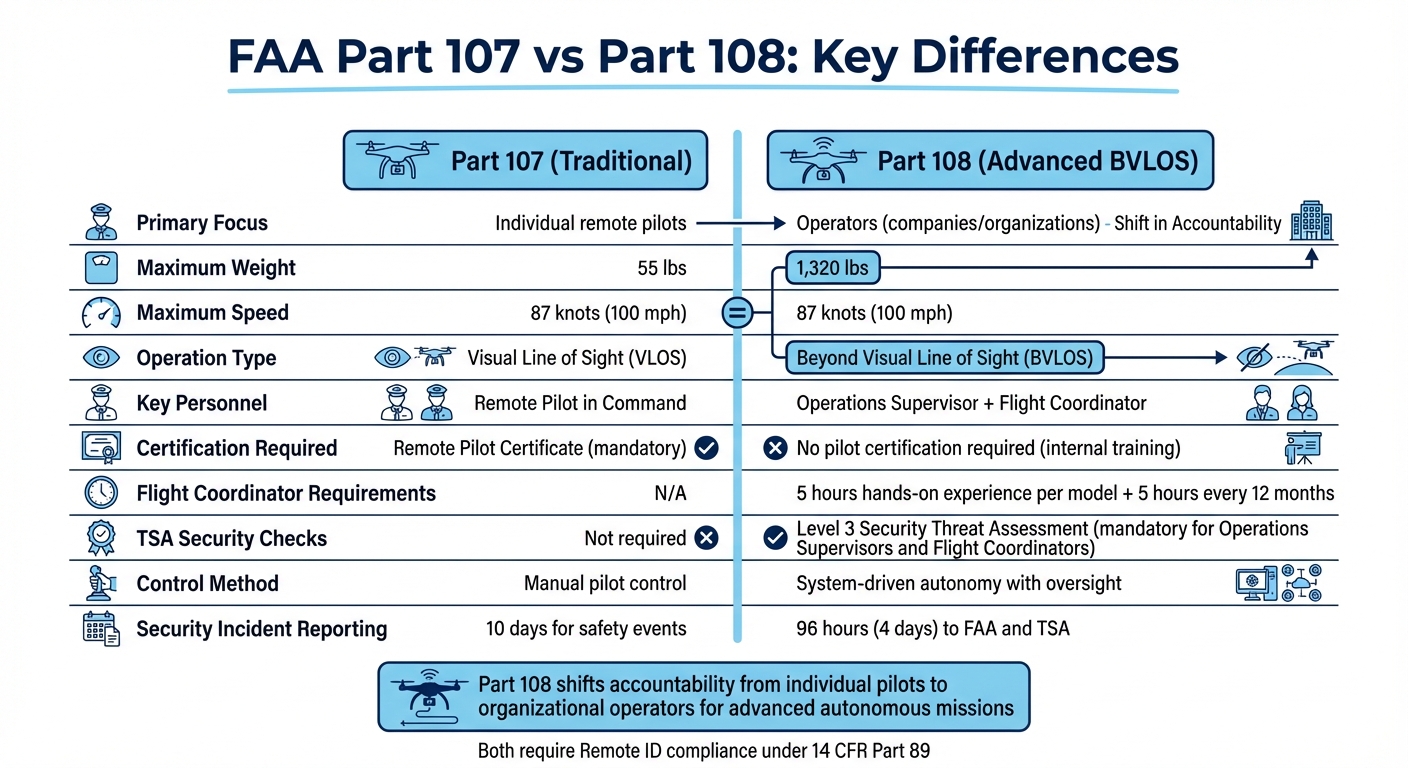
FAA Part 107 vs Part 108 UAV Regulations Comparison Chart
FAA Part 108 marks a shift in UAV regulation by placing accountability on operators rather than individual pilots. Unlike Part 107, which focuses on remote pilots, Part 108 assigns primary responsibility to the "Operator" - often a company or organization managing the flights. This operator-focused model is tailored for advanced Beyond Visual Line of Sight (BVLOS) missions, allowing drones up to 1,320 lbs to fly at speeds reaching 87 knots (about 100 mph). The framework tightens oversight for BVLOS operations by expanding on earlier authentication protocols.
Two key roles under this regulation require authentication. The Operations Supervisor is the ultimate authority for unmanned aircraft operations, overseeing safety, logistics, and compliance. Meanwhile, the Flight Coordinator monitors multiple automated drones in real-time using Simplified User Interaction (SUI) systems. As the FAA explains:
An Operations Supervisor is the person who is 'directly responsible for and the final authority as to the safe and secure operation of all unmanned aircraft'.
Interestingly, neither role requires traditional pilot certification. Instead, the Operator ensures these individuals are qualified through internal training. Flight Coordinators, however, must log at least five hours of hands-on experience with the specific drone model they will oversee. To stay current, they need to log an additional five hours of flight time on the same model within every 12-month period.
TSA Security Threat Assessments for Personnel
Given the heightened responsibilities, stringent TSA security checks are mandatory for both Operations Supervisors and Flight Coordinators. These checks, known as TSA Security Threat Assessments (STAs), are Level 3 screenings - the most thorough available. They include checks against government watchlists, immigration status verification, and fingerprint-based criminal history reviews conducted by the FBI and DHS.
The TSA's involvement highlights the increased security risks tied to BVLOS operations. As stated in the Part 108 NPRM:
An individual with bad intent performing such functions could cause great harm to the public by using UAS to conduct attacks or strikes on civilian populations or transporting prohibited cargo.
In January 2025, the TSA conducted a security drill at San Francisco International Airport using a Skydio X10 drone to assess potential attack scenarios and identify vulnerabilities, underscoring the need for these rigorous measures.
All personnel involved in operations - including maintenance teams and ground handlers - must pass TSA background checks and receive approval before working with Part 108 aircraft. Ongoing watchlist monitoring ensures that even after initial clearance, individuals can be disqualified if later flagged. Organizations aiming to provide package delivery services face additional hurdles, including obtaining TSA approval for a tailored security program and appointing a dedicated security coordinator.
Authentication for Beyond Visual Line of Sight Operations
While personnel vetting ensures trustworthy operations, technology plays a crucial role in authenticating BVLOS flights. Remote ID, as required under 14 CFR Part 89, acts as a "digital license plate", enabling the FAA and law enforcement to verify the identity and location of every flight.
Part 108 also introduces automated detection systems, referred to as Electronic Conspicuity, which allow drones to detect and avoid other aircraft autonomously. This marks a departure from traditional aviation rules, where drones typically yield to manned aircraft. Under the “shielded operations” concept, drones equipped with these systems and flying within 50 feet of structures - like power lines or bridges - may have right-of-way over non-equipped manned aircraft in areas where manned aircraft cannot safely operate.
The regulation leans heavily on system-driven autonomy rather than manual control. As noted by the FAA in the Part 108 preamble:
With the increasing autonomy of UAS, particularly those anticipated for use under this proposal, the role of the pilot has and will continue to decrease.
Flight Coordinators are tasked with overseeing automated systems rather than piloting drones directly. To ensure safety, personnel duty hours are capped to prevent fatigue. Additionally, any security incidents must be reported to both the FAA and TSA within 96 hours (4 days).
Remote ID and UAV Registration Standards
Remote ID serves as a system for broadcasting identification and location data, ensuring drones can be reliably tracked. According to 14 CFR Part 89, all drones that require registration must transmit Remote ID information from the moment they take off until they shut down. This system allows the FAA, law enforcement, and other federal agencies to identify drones in flight and locate their control stations when a drone is operating unsafely or entering restricted areas.
The Remote ID system mandates that messages are broadcast every second, with position data transmitted within 1.0 second. Both position and altitude data must adhere to strict accuracy requirements.
The FAA emphasizes the importance of this system, stating:
"The remote identification of unmanned aircraft in the airspace of the United States will address safety, national security, and law enforcement concerns regarding the further integration of these aircraft into the airspace."
– Federal Aviation Administration
For registration under 14 CFR Part 48, drone operators must include the Remote ID serial number in their FAA registration. Drones weighing more than 0.55 lbs must be registered. Standard Remote ID drones are not permitted to take off unless their Remote ID equipment is functioning properly. If the broadcast system fails mid-flight, operators are required to land the drone as soon as it is practical to do so.
Remote ID Compliance Requirements
Operators have three options to meet compliance standards: using a Standard Remote ID drone, attaching a Remote ID broadcast module to older drones, or flying within an FAA-Recognized Identification Area (FRIA).
- Standard Remote ID drones broadcast the drone's serial number (or a "Session ID" in the future for enhanced privacy) along with data such as latitude, longitude, altitude, velocity, time stamp, emergency status, and the real-time location of the control station.
- Remote ID broadcast modules transmit the drone's current position and its takeoff location, but not the moving control station. Operators using these modules must maintain a visual line of sight (VLOS) at all times.
All Remote ID serial numbers must comply with the ANSI/CTA-2063-A standard. Operators should verify their equipment in the FAA's Declaration of Compliance (DOC) database before flying. Additionally, under 14 CFR § 89.5, providing false or fraudulent information regarding Remote ID compliance can lead to civil penalties or the suspension or revocation of FAA-issued certificates.
These requirements also influence how operators register and manage multiple drones.
Multi-Drone Operation Updates
Registration processes vary depending on whether the operator is flying commercially or recreationally. Part 107 operators must register each drone and its broadcast module individually, as each requires a unique registration number. Recreational flyers, however, can register once and use the same registration number for all their drones, as long as they list each Remote ID-equipped drone's serial number. This system ensures accountability while simplifying the process for hobbyists managing multiple drones.
TSA and FAA Oversight in Authentication Protocols
The FAA and TSA have teamed up to enforce strict security measures tied to both operator and technology-based authentication protocols. In August 2025, they introduced joint enforcement standards specifically aimed at secure BVLOS (Beyond Visual Line of Sight) operations. Here’s how their roles break down: the FAA focuses on operational certification and airspace integration, while the TSA handles security vetting and threat mitigation processes. Together, they’ve created a framework that also prioritizes data privacy and access controls.
The TSA conducts Level 3 threat assessments for key personnel, such as operations supervisors, flight coordinators, and anyone with unescorted access to UAS (Unmanned Aircraft Systems). These assessments, which cost about $244 per individual, include checks of criminal history, immigration status, and intelligence databases. Based on these evaluations, the FAA can deny or revoke UAS operating certificates if security concerns arise.
Remote ID plays a critical role in identifying compliant operators. Under 14 CFR § 107.7, TSA representatives are authorized to request and inspect a remote pilot's certificate and ID during operations. This means pilots must carry both their certificate and photo identification at all times.
For package delivery operations, the TSA imposes additional requirements, such as approved security programs that include cargo screening and the designation of Security Coordinators.
Privacy Impact Assessments for Authentication
The FAA also takes privacy seriously when it comes to operator data. To authenticate operators, they collect a range of personally identifiable information (PII), including photographs, signatures, dates of birth, and permanent mailing addresses. To ensure this data is handled responsibly, the FAA uses Privacy Impact Assessments (PIAs) throughout the vetting process.
One result of these assessments is the introduction of privacy-focused features in Remote ID protocols. For example, the FAA now allows operators to use "Session IDs" instead of broadcasting serial numbers, offering a layer of anonymity while still meeting identification requirements. Operators are required to notify the FAA of any changes to their permanent mailing address within 30 days. If a P.O. box is used as the mailing address, a current residential address must also be provided. Additionally, remote pilots and operators must make all required documents and records available to the FAA or TSA upon request to prove compliance with safety and security programs.
Access Control and Safety Program Approvals
The TSA's responsibilities extend beyond vetting individuals to approving security programs for commercial operations. As outlined in Executive Order 14307:
Criminals, terrorists, and hostile foreign actors have intensified their weaponization of these technologies, creating new and serious threats to our homeland
.
For BVLOS and cargo delivery operations, operators must submit security programs that include strategies to prevent unauthorized access to UAS and control stations. These programs must also designate a Security Coordinator responsible for maintaining compliance. The FAA has the authority to deny or terminate FAA-recognized identification areas (FRIAs) if they are deemed a risk to national or homeland security.
The need for strict access control is underscored by recent statistics. Between 2021 and 2022, the TSA documented nearly 2,000 drone sightings near U.S. airports, with over 30 incidents in 2021 alone leading to partial airport shutdowns. During the same period, the FBI reported 235 suspicious drone flights near chemical plants in Louisiana, Oklahoma, and Texas. These incidents highlight the importance of robust security measures.
Noncompliance with these protocols can result in penalties of up to $27,500, along with potential certificate suspension or revocation. Additionally, security threat assessments can be used to deny, suspend, or revoke remote pilot certificates if the individual is deemed a risk to homeland or national security.
Manufacturer Compliance and Airworthiness Authentication
Manufacturers play a critical role in ensuring system-wide security and authentication by adhering to strict operator and regulatory protocols. They must validate their UAVs to meet FAA authentication and airworthiness standards, a process that spans from design to production.
Means of Compliance and Declarations of Compliance
The FAA uses a two-step process to confirm that UAVs meet Remote ID performance standards:
- Means of Compliance (MoC): Manufacturers must first submit a MoC detailing how their design meets the FAA's minimum performance standards. This includes testing procedures, validation methods, and supporting data to confirm the UAV can broadcast essential details such as identity, location (latitude/longitude), altitude, velocity, and emergency status.
- Declaration of Compliance (DoC): Once the FAA accepts the MoC, manufacturers can submit a DoC for each UAV model. This document confirms the aircraft meets all requirements under Part 89. Each compliant UAV is assigned a unique ANSI/CTA-2063-A serial number, which must appear on an FAA-accepted DoC.
Approval isn't the end of the road. Manufacturers must allow FAA inspections at any time and conduct regular independent audits to ensure compliance with production standards. They are also required to keep all MoC documentation, test results, and supporting data for the duration of the UAV’s production plus an additional 24 months. If a defect or condition causes a UAV to no longer meet compliance standards, the manufacturer must notify the FAA and the public within 15 calendar days of discovery.
Exclusions for Non-Compliant UAV Models
Some UAV models are exempt from these requirements. Under 14 CFR Part 89, design and production rules do not apply to:
- Home-built unmanned aircraft
- U.S. Government aircraft
- UAVs weighing 0.55 pounds or less at takeoff
- UAVs built solely for aeronautical research
For all other models, compliance is mandatory. Since September 16, 2022, manufacturers are prohibited from producing unmanned aircraft for U.S. operation unless they meet Remote ID performance standards.
The FAA can revoke a previously accepted Declaration of Compliance if a UAV model is found non-compliant or if the approved Means of Compliance is rescinded. If this happens, the model can no longer operate as a "standard remote identification" aircraft in the U.S. Additionally, operators of foreign-registered UAVs must submit a "notice of identification" to the FAA to obtain a "Confirmation of Identification" before flying in U.S. airspace. However, this process does not equate to U.S. aircraft registration.
Manufacturers are also required to include tamper-resistance features to prevent users from altering Remote ID functionality. UAVs must conduct automatic tests of their Remote ID systems before takeoff and are prohibited from launching if the system is not functioning properly. These measures are designed to uphold operational integrity and ensure safe integration into U.S. airspace for all non-exempt UAV models.
Recordkeeping and Reporting for Authentication Compliance
Staying compliant with UAV regulations isn't just about registration. Keeping accurate records and submitting timely reports is equally important to meet FAA and TSA requirements. These practices ensure that operators remain compliant with the rules. Missing deadlines or failing to maintain proper documentation can lead to civil penalties or even the suspension or revocation of certificates and authorizations. Here's a closer look at what operators need to know about recordkeeping.
Monthly Flight Data Reporting
Although the FAA doesn't require monthly flight logs for all Part 107 operations, remote pilots must always have their certificate and ID on hand during flights. These documents should be readily available for inspection by the FAA, NTSB, TSA, or any federal, state, or local law enforcement officer. This serves as an on-the-spot verification of the operator's authorization.
In cases where a pilot deviates from Part 107 rules due to an in-flight emergency, there's no automatic requirement to file a report. However, if the FAA Administrator requests it, the operator must provide a detailed written account explaining the incident.
Annual Registration and Security Event Notifications
Operators are also responsible for managing registration renewals and reporting certain events. UAV registration certificates are valid for 3 years and must be renewed within six months before they expire. The renewal fee is $5.00 per aircraft, and any changes to registration details must be updated within 14 calendar days.
If an operation leads to serious injury, loss of consciousness, or property damage exceeding $500, the remote pilot in command must report the incident to the FAA within 10 calendar days. Submitting false or fraudulent records can result in certificate denial, suspension, or revocation.
| Requirement Type | Timeline for Compliance | Regulation Reference |
|---|---|---|
| Safety Event Reporting | Within 10 calendar days | 14 CFR § 107.9 |
| Registration Info Updates | Within 14 calendar days | 14 CFR § 48.115 |
| Registration Renewal | Every 3 years | 14 CFR § 48.100 |
| Emergency Deviation Report | Upon Administrator request | 14 CFR § 107.21 |
| Record Inspection | Upon request | 14 CFR § 107.7 |
Conclusion
UAV authentication and compliance are essential for maintaining safe and secure operations in U.S. airspace. Since September 16, 2023, all registered drones are required to broadcast their identification and location information under 14 CFR Part 89. This Remote ID rule, alongside Part 107 operational guidelines and TSA security vetting, ensures thorough tracking and accountability for drone operators.
Operators have three compliance options: using Standard Remote ID drones, attaching Remote ID Broadcast Modules, or flying within an FAA-Recognized Identification Area. These pathways allow flexibility while maintaining a strong framework for accountability. Together, they establish a system that ensures UAV operations remain traceable, safeguarding both airspace security and public safety.
"The remote pilot in command is directly responsible for and is the final authority as to the operation of the small unmanned aircraft system." - 14 CFR § 107.19
Non-compliance with these regulations carries significant consequences. With the FAA ending its discretionary enforcement period for Remote ID on March 16, 2024, violations can lead to civil penalties, certificate suspensions, or even contract terminations for federal operators.
Beyond regulatory adherence, robust authentication protocols unlock advanced capabilities like Beyond Visual Line of Sight (BVLOS) flights, protect against cybersecurity threats, and lay the groundwork for integrating drones into increasingly complex airspace systems. For operators managing industrial sites or conducting commercial missions, staying updated with these regulations not only ensures compliance but also builds trust and operational credibility in a rapidly evolving industry. Tools like Anvil Labs (https://anvil.so) provide integrated solutions for UAV data management, helping operators align with these evolving standards. These regulations do more than enforce safety - they foster trust and reliability across the drone industry.
FAQs
What are the key responsibilities of an Operations Supervisor under FAA Part 108?
Under FAA Part 108, the Operations Supervisor holds a key position in maintaining safe and compliant UAV operations. Their responsibilities include overseeing flight activities, managing safety protocols, and working closely with relevant authorities to ensure all regulations are followed.
Although Part 108 doesn’t spell out every specific duty, the general expectation is clear: Operations Supervisors are responsible for upholding operational safety, identifying and addressing potential risks, and ensuring UAV operators strictly adhere to established guidelines. Their role is central to creating a safe and efficient operational environment.
What is Remote ID, and how does it improve UAV security and compliance?
Remote ID is a system designed to make drones more accountable by requiring them to broadcast their identification and location details while in flight. This allows authorities and law enforcement to verify who is operating the drone, keep track of its activity, and respond to potential safety or security concerns.
By offering real-time insight into drone operations, Remote ID supports compliance with legal and safety standards. It helps promote responsible drone use and minimizes the risks of unauthorized or reckless flights.
What happens if UAV operators fail to comply with regulations?
Failure to follow UAV regulations can lead to serious consequences like legal penalties, operational setbacks, and increased security risks. Organizations such as the FAA enforce strict rules to maintain safety and protect national security. Breaking these rules can result in fines, losing your license, or, in extreme cases, criminal charges.
Beyond legal issues, ignoring compliance can damage your organization's reputation and cause delays in operations. Proper authentication and adherence to regulations aren't just procedural - they're essential for ensuring safe and lawful UAV use.

.svg)


