

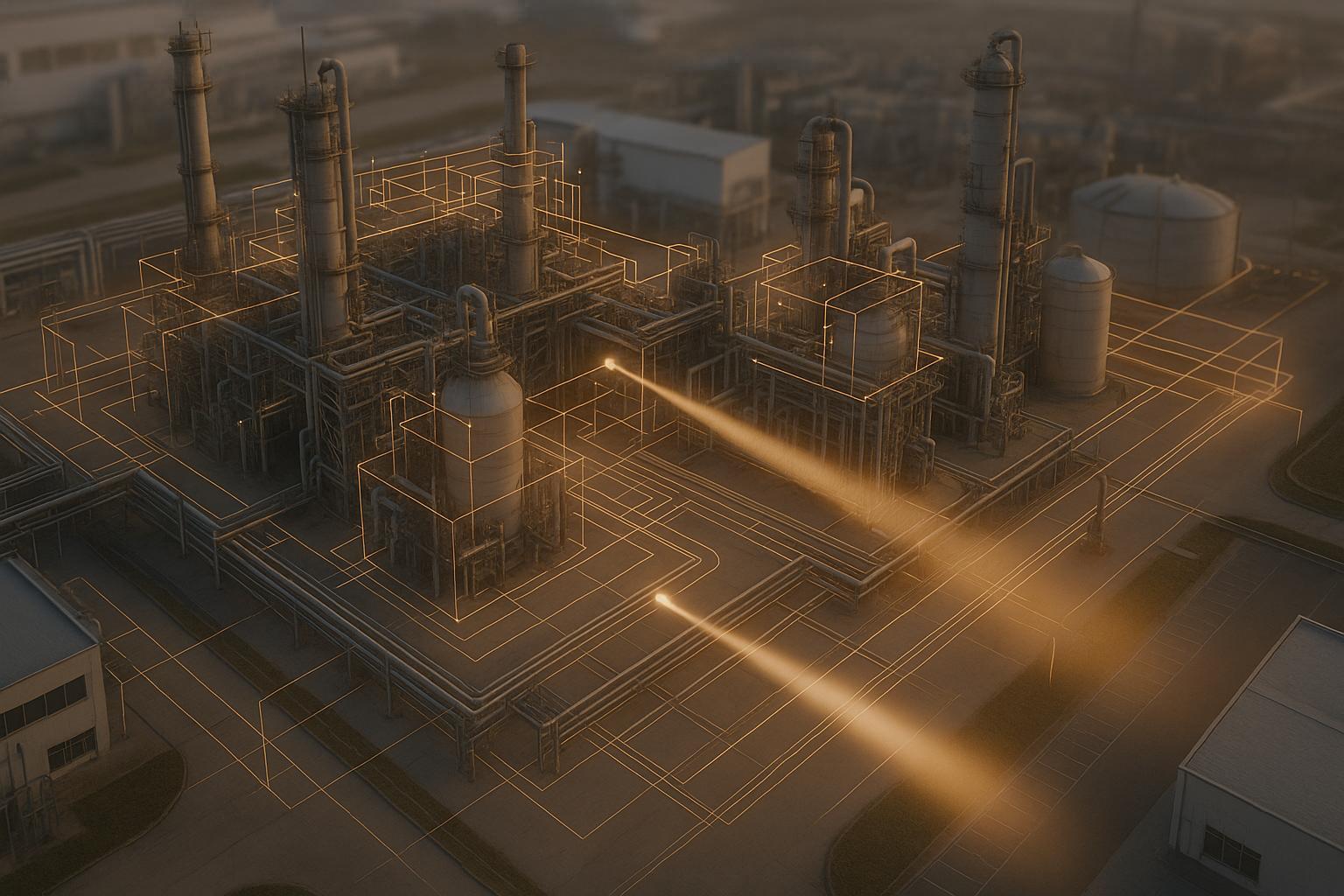
LiDAR and digital twins are transforming industries by creating precise 3D models of physical spaces, enabling smarter asset management and operational efficiency. LiDAR uses laser pulses to map environments with sub-inch accuracy, while digital twins simulate and monitor real-world systems in real time. Together, they improve inspections, reduce risks, and streamline collaboration across sectors like construction, manufacturing, and infrastructure.
Key Takeaways:
- LiDAR Technology: Provides highly accurate 3D spatial data for mapping and inspections.
- Digital Twins: Virtual models for monitoring, simulating, and managing assets.
- Combined Benefits: Faster inspections, improved safety, and reduced costs.
- Applications: Predictive maintenance, virtual simulations, and remote monitoring.
By integrating LiDAR with digital twins, organizations gain actionable insights, cut down on-site visits, and improve decision-making. Platforms like Anvil Labs simplify this process with tools for data processing, visualization, and collaboration.
For more details on implementation steps, challenges, and industry examples, read on.
Demo #6: From LIDAR to Digital Twins
Key Benefits of Using LiDAR for Digital Twin Integration
The combination of LiDAR technology and digital twins offers a range of advantages that enhance performance in complex industrial environments. By integrating LiDAR into digital twin systems, organizations can achieve higher levels of precision, safety, and collaboration. These improvements lead to cost savings and operational efficiency across various industries.
Improved Accuracy for Complex Environments
LiDAR technology excels at capturing millions of data points in a matter of seconds, producing highly precise 3D point clouds with sub-inch accuracy. This precision is essential for modeling intricate industrial spaces where traditional methods often fall short, missing critical details.
One key advantage is LiDAR's ability to detect defects with unmatched accuracy. It captures detailed measurements of machinery, piping, structural components, and other features that might escape human inspectors or be measured incorrectly. This accuracy is crucial for creating reliable digital simulations and supporting predictive maintenance, ensuring that digital twins remain effective tools for real-time applications.
For example, manufacturing facilities can use LiDAR-generated digital twins to test new workflows or equipment layouts virtually. This approach eliminates the need for costly physical modifications, allowing manufacturers to simulate and optimize layouts before implementation. The high geometric precision ensures these simulations align closely with real-world conditions.
In 2023, Siemens showcased these benefits in their gas turbine manufacturing processes. By incorporating LiDAR-enhanced digital twins, they achieved greater precision, reduced costs, and improved quality in their power generation solutions. These digital twins enabled predictive maintenance and process optimization, leading to more efficient production and minimized downtime.
Enhanced Safety and Risk Management
LiDAR-powered digital twins play a crucial role in improving safety by enabling virtual inspections. Workers can assess potential risks - such as structural weaknesses, hazardous materials, or equipment malfunctions - without needing to enter dangerous areas.
This capability is particularly valuable in high-risk industrial environments. By using LiDAR scans to build digital twins, teams can conduct virtual inspections to identify hazards like compromised structures or failing equipment, reducing the need for on-site presence.
Additionally, digital twins support continuous asset monitoring, allowing teams to track the health of equipment and predict failures before they occur. Maintenance records and inspection notes can be integrated directly into the 3D model, enabling proactive interventions that minimize unplanned downtime.
| Method | Accuracy | Safety | Efficiency | Worker Exposure |
|---|---|---|---|---|
| LiDAR-Powered Digital Twin | High | High | High | Minimal |
| Manual Inspection | Low-Medium | Low | Low | High |
Streamlined Collaboration and Accessibility
Modern platforms have transformed how teams collaborate using LiDAR-powered digital twins. Companies like Anvil Labs provide secure, cross-device access, enabling stakeholders to view, annotate, and measure 3D models from anywhere. This accessibility eliminates geographical barriers and fosters real-time collaboration among distributed teams.
These platforms support a variety of data types, including LiDAR scans, 360° photos, and orthomosaics, and integrate with tools like Matterport and AI analysis systems. Teams can annotate models, track changes, and share insights directly within the digital twin environment, simplifying project coordination and decision-making.
"My overall experience with the software has been satisfying because of the efficient workflow. I would highly recommend other organizations to use your software simply because of how much value you get for what you pay for..."
- Angel Rojas, Red Angel Drones
"This is a differentiator. Those that aren't able to provide visualization but are just doing raw footage - this gives you, in my opinion, that competitive edge."
- Adrian, Drone Service Provider
The ability to access and collaborate on digital twins from any device ensures that all team members can contribute to discussions and decisions, no matter where they are. This seamless collaboration accelerates decision-making and keeps projects on track.
Steps for Integrating LiDAR Data into Digital Twin Systems
Integrating LiDAR data into digital twin systems involves a structured process to ensure the data is accurate, well-processed, and seamlessly integrated with other information sources. This process unfolds in three key stages, transforming raw drone-collected data into functional digital twin models.
Collecting LiDAR Data Using Drones
The journey begins with gathering high-quality LiDAR data, which forms the backbone of any reliable digital twin. For industrial applications, precision is non-negotiable.
To start, carefully plan drone flight paths to cover the target area with the required level of detail. Pre-flight preparations are equally important - choose sensors that meet accuracy standards, and ensure all equipment is properly calibrated. Factors like weather conditions, flight altitude, and speed need to be optimized to balance coverage and resolution.
Ground control points are indispensable for achieving centimeter-level accuracy. These reference points enable precise georeferencing, which is critical for applications like asset management or safety assessments in industries such as construction and manufacturing.
Using overlapping flight paths minimizes data gaps, while immediate validation of collected data helps catch any anomalies early. Regular maintenance and recalibration of drones and sensors ensure consistent performance. Once accurate data is captured, the next step is to process and host it effectively.
Processing and Hosting LiDAR Data
After capturing the data, it’s time to process and host it to convert raw LiDAR scans into actionable models. Cloud-based platforms have significantly simplified this step by offering integrated tools for processing, hosting, and visualization.
For example, Anvil Labs provides a comprehensive platform that processes LiDAR point clouds alongside other data types. Their system leverages AI and 3D scanning to transform raw data into precise industrial models.
The typical workflow involves uploading raw LiDAR data to a cloud platform, where automated systems generate 3D models, perform quality checks, and prepare the data for integration into digital twin systems. Secure hosting ensures long-term accessibility, while cross-device compatibility allows teams to interact with the data from virtually anywhere.
Anvil Labs also offers a per-project pricing model, which helps organizations manage costs more predictably compared to traditional cloud storage fees.
"My overall experience with the software has been satisfying because of the efficient workflow. I would highly recommend other organizations to use your software simply because of how much value you get for what you pay for... The ROI is clearly marked within the first few uses."
- Angel Rojas, Red Angel Drones
Security features protect sensitive industrial data while still enabling authorized stakeholders to collaborate effectively. Once processed and hosted, this data becomes a solid base for integrating additional data sources.
Combining LiDAR with Other Data Sources
Processed LiDAR data becomes even more powerful when combined with other data sources. A complete digital twin requires integrating LiDAR data with additional information to capture both the physical structure and dynamic operations of industrial facilities.
Photogrammetry can be incorporated for visual context, while IoT sensor data adds real-time insights. Together, these elements enhance both the geometric accuracy and operational understanding of the digital twin. While LiDAR excels at capturing precise shapes, photogrammetry provides a visual layer, making the models more intuitive to navigate.
Integrating IoT sensors transforms static 3D models into dynamic tools. For example, overlaying real-time data - like temperature, humidity, or vibration - onto LiDAR-based models allows facility managers to monitor conditions spatially. In warehouse operations, this approach can optimize equipment placement and analyze traffic patterns, boosting both safety and efficiency.
In manufacturing, LiDAR scans combined with production data can reveal bottlenecks, test new layouts virtually, and enable preventative maintenance. This reduces downtime and avoids costly physical adjustments.
Platforms supporting multiple data formats - such as 3D models, 360° photos, thermal images, LiDAR point clouds, and orthomosaics - simplify this integration. These tools align various data sources and offer features like annotations and measurements, enabling teams to attach maintenance records or inspection notes directly to specific locations in the model.
"This is a differentiator. Those that aren't able to provide visualization but are just doing raw footage - this gives you, in my opinion, that competitive edge."
- Adrian, Drone Service Provider
The result is a digital twin that combines precise geometry with dynamic operational insights, allowing organizations to maximize the value of their LiDAR data for a variety of applications.
sbb-itb-ac6e058
Overcoming Challenges in LiDAR-Powered Digital Twin Integration
LiDAR technology brings incredible potential to digital twin systems, but integrating it effectively comes with its own set of challenges. Tackling these issues head-on with thoughtful strategies can pave the way for a smoother implementation and better results. Let’s explore some of the key hurdles and how organizations can address them.
Managing Large Data Volumes
LiDAR scans generate massive amounts of data. For instance, a single scan of an industrial facility can produce a mountain of point cloud data. Multiply that by multiple scans over time or across large sites, and the storage and processing demands can quickly spiral out of control.
Traditional cloud solutions often add to the headache with unpredictable costs tied to usage-based pricing models. However, platforms designed specifically for spatial data management are stepping in to solve these problems. These tools can compress data automatically, organize files efficiently, and provide scalable storage options that grow with your project. Fixed per-project pricing models are also gaining traction, making costs more predictable and easier to manage.
"The per project pricing makes it easy for me to bill customers. It's too arbitrary to predict the cost to customer with Agisoft or Pix4D's cloud costs."
- Connor Barnes, Leading Edge Environmental and Emergency Services
Another smart approach is leveraging edge computing to process data locally, combined with selective retention. By storing high-resolution scans only for critical areas, you can cut down on storage and transfer costs while keeping the data you truly need.
Maintaining Real-Time Accuracy and Security
Keeping digital twins accurate and secure is a constant balancing act. Real-time updates require continuous data feeds from sensors and frequent LiDAR scans, but this flow of information can open up security vulnerabilities if not managed carefully.
Modern platforms address these concerns with a suite of security features like role-based access, encryption, and audit trails. These measures protect sensitive industrial data while ensuring that updates remain accurate and timely.
Anvil Labs, for example, offers secure data-sharing capabilities that allow teams to collaborate without compromising sensitive information. Their system supports multi-user access while maintaining tight security controls, making it easier to keep digital twins both accurate and protected.
Automated compliance checks and spatial analysis tools further simplify the process by continuously monitoring and validating asset conditions. These automated systems reduce the manual workload, ensuring that updates are consistent and less prone to errors. Organizations using such integrated approaches report impressive efficiency gains, including inspections that are 75% faster while detecting 30% more defects. Many see a return on investment in just two months.
LiDAR vs. Manual Inspection Methods
Once scalability and security are addressed, it becomes clear how LiDAR outshines traditional manual inspections in terms of precision and efficiency. Comparing the two approaches helps decision-makers weigh their options and choose the best path for their digital twin projects.
| Feature | LiDAR Integration | Manual Inspection Methods |
|---|---|---|
| Accuracy | Centimeter-level precision with consistent results | Variable accuracy, subject to human error |
| Speed | Minutes to hours for large industrial sites | Days to weeks for comprehensive coverage |
| Safety | Remote data collection reduces on-site risk exposure | Requires physical presence in potentially hazardous areas |
| Cost Structure | Higher initial investment, lower ongoing operational costs | Lower upfront costs, higher long-term labor expenses |
| Data Richness | Comprehensive 3D geometry with real-time update capability | Limited detail, less frequent updates |
| Coverage | Complete spatial documentation of large areas | Labor-intensive and often incomplete coverage |
| Collaboration | Easy sharing, annotation, and cross-device accessibility | Manual data sharing with limited interactivity |
While LiDAR offers unmatched precision and efficiency, combining it with photogrammetry can add valuable visual context. This hybrid approach brings together detailed spatial data and intuitive visuals, making it easier for stakeholders to understand and act on the information.
Switching from manual methods to LiDAR-powered systems can save organizations significant money - not just in direct labor costs, but also by reducing the need for repeated site visits and minimizing human errors that could lead to costly mistakes. The key is to tailor the technology mix to fit the specific needs of your project, balancing accuracy, budget, and timelines effectively.
Integrating Digital Twins with Existing Industrial Systems
Getting LiDAR-powered digital twins to work seamlessly with existing industrial systems requires a well-thought-out integration process. Many industrial facilities rely on a mix of older and newer technologies, which presents unique challenges. Successfully bridging this gap can unlock smoother operations and better use of modern digital tools.
Connecting Digital Twins to Legacy Systems
LiDAR’s precision and the dynamic capabilities of digital twins can significantly improve operational insights when integrated with legacy systems. However, older industrial setups were not designed with digital twins in mind. This makes it essential to focus on compatibility and build effective connections between outdated and modern technologies.
To ensure compatibility, support standard LiDAR data formats like LAS, LAZ, and E57. Your digital twin platform should also integrate with existing software such as SCADA or ERP systems. Additionally, mapping legacy asset identifiers to the digital twin models is vital for creating a "translation layer" between the old and the new.
A great example of this approach is Siemens, which employs phased integration strategies. They start with non-critical systems and gradually expand to core operations, minimizing risks and disruptions. Middleware plays a key role here, acting as a bridge between modern platforms and older systems. For instance, it enables older PLCs to communicate with new digital twin platforms. APIs and data normalization tools further help align legacy asset records with digital models.
Using Platforms for Cross-Device Collaboration
Modern platforms are breaking down barriers between devices and teams, enabling industrial teams to collaborate across desktops, tablets, and smartphones. Cross-device accessibility ensures that teams can work flexibly, regardless of their location or device.
Anvil Labs showcases this approach by offering seamless access to 3D models on various devices. Users can annotate, measure, and share models in real time, making collaboration effortless. Security is a key priority, with features like role-based access controls and encrypted data transfer ensuring sensitive site information stays protected.
Brian Wellington from Litewing shared how presenting LiDAR data to a fire department using such tools earned strong positive feedback for its clarity and visual impact.
Platforms like Matterport and AI analysis tools enhance this collaboration further. They allow real-time updates and task management across distributed teams, ensuring that insights generated in one part of the workflow are easily shared with others. Standardizing data formats and ensuring smooth compatibility across platforms are critical to making this collaboration effective.
Practical Tips for Data Compatibility
Achieving smooth data compatibility requires a mix of technical precision and practical workflow planning. Start by standardizing LiDAR data formats, such as LAS or E57, to ensure a shared foundation that most industrial software can process. Coordinate systems and measurement units should align with U.S. standards for consistency.
Addressing these details early in the integration process can prevent costly errors. Data conversion tools are particularly useful for bridging gaps between CAD, BIM, and GIS platforms. Regular data quality checks and proper metadata documentation also help maintain consistency as your digital twin evolves. Combining LiDAR data with photogrammetry can further enhance accuracy and realism, making integration with BIM and asset management systems more effective.
Starting with a pilot project is a smart way to validate your integration strategy. This allows you to identify and resolve potential issues before scaling up. Documenting the data mapping process during this phase also creates a valuable reference for future integrations.
Collaboration between IT and operations teams is another critical factor. Each team brings unique insights, and clear communication helps ensure that all requirements are met.
Modern platforms with built-in compatibility features can simplify much of this work. Many solutions now handle tasks like format conversions, coordinate transformations, and data validation automatically, reducing the need for manual intervention. Regular software updates and periodic data quality reviews further ensure that your digital twin system remains reliable and effective for industrial operations.
Conclusion
How LiDAR Enhances Digital Twin Technology
LiDAR is reshaping how digital twins are integrated into industrial operations. With its centimeter-level precision and ability to capture detailed 3D spatial data, LiDAR helps create digital twins that accurately reflect real-world environments. This precision allows businesses to make decisions based on reliable data instead of rough estimates.
By enabling remote data collection, LiDAR eliminates the need for on-site visits to hazardous locations. It also offers rapid, high-accuracy inspections, which not only reduce costs but also deliver a fast return on investment - some companies have reported seeing results in as little as two months. Its ability to scan large, complex areas quickly and with high accuracy makes it particularly valuable for industrial applications.
Collaboration has also evolved significantly with platforms that support real-time data sharing and access across multiple devices. Teams of engineers, facility managers, and contractors can now collaborate effortlessly, no matter where they are. This streamlined communication minimizes project delays, improves coordination, and ensures that vital information is shared with the right people at the right time.
These advancements make it clear: LiDAR is a game-changer for digital twin technology.
Next Steps for Implementation
The first step is to evaluate your current asset management processes. Identify where greater accuracy, improved safety, or enhanced collaboration could make the biggest impact. These areas are often the best starting points for integrating LiDAR technology.
Choose a platform that seamlessly combines LiDAR data with your existing systems. For instance, Anvil Labs offers solutions designed to process, store, and share LiDAR data across various devices and teams, ensuring smooth integration.
From the outset, focus on compatibility and integration. Your platform should not only align with your current workflows but also allow for future growth. Investing time in proper planning and integration will pay off as your digital twin technology evolves.
Begin with a pilot project to test the system and validate its benefits. Train key team members to become advocates for the technology, helping to ensure successful adoption throughout your organization. Combining advanced tools with skilled users sets the stage for long-term success.
The future of industrial asset management lies in connecting LiDAR technology with digital twins. Companies that adopt this approach today will be better equipped to optimize operations, cut costs, and maintain a competitive edge in an increasingly complex industrial world.
FAQs
How does LiDAR improve the accuracy and functionality of digital twins in industrial settings?
LiDAR technology brings a new level of precision to digital twins by delivering exceptionally accurate spatial data. This data captures the exact dimensions and intricate details of industrial settings, enabling the creation of comprehensive 3D models. These models play a critical role in tasks like monitoring operations, planning workflows, and improving overall efficiency.
With the help of LiDAR-equipped drones, industrial sites can be scanned swiftly and effectively, even in areas that are tough to access. The detailed data collected enhances the accuracy of simulations and analyses, empowering teams to make well-informed decisions. Moreover, LiDAR integrates seamlessly with platforms such as Anvil Labs, making it easier to process, visualize, and securely share spatial data across various devices. This streamlined integration boosts collaboration and helps teams work more productively.
How can LiDAR data be integrated into digital twin systems, and what challenges should organizations prepare for?
Integrating LiDAR data into digital twin systems involves a series of essential steps. It starts with collecting raw LiDAR data, often using drones or specialized scanning devices. This raw data is then processed into formats like 3D point clouds or meshes, making it easier to work with. Once processed, the data is aligned with existing digital twin models to ensure precision and consistency. The final step is testing the integrated system to confirm it performs well and meets usability standards for practical applications.
However, this process isn’t without its challenges. Organizations often grapple with managing massive data sets, ensuring that LiDAR outputs are compatible with digital twin platforms, and resolving inaccuracies that can arise during data processing. Addressing these hurdles requires careful planning, advanced tools, and a team of skilled professionals. With the right approach, businesses can maximize the benefits of LiDAR-enhanced digital twins.
How can organizations securely manage large amounts of LiDAR data when integrating digital twins?
To handle large volumes of LiDAR data in digital twin applications securely, it's essential to focus on data encryption and access control measures. These steps are critical for safeguarding sensitive information. Using secure cloud storage with end-to-end encryption can help maintain data integrity and block unauthorized access.
When dealing with high-resolution datasets, automated data processing tools and scalable storage solutions are invaluable. They allow for efficient handling of large files while ensuring smooth performance. Platforms that enable cross-device access and integrate easily with analytical tools can further streamline workflows and improve team collaboration.
By combining advanced security measures with flexible infrastructure, organizations can manage their LiDAR data effectively without compromising the precision or reliability of their digital twin models.

.svg)


