

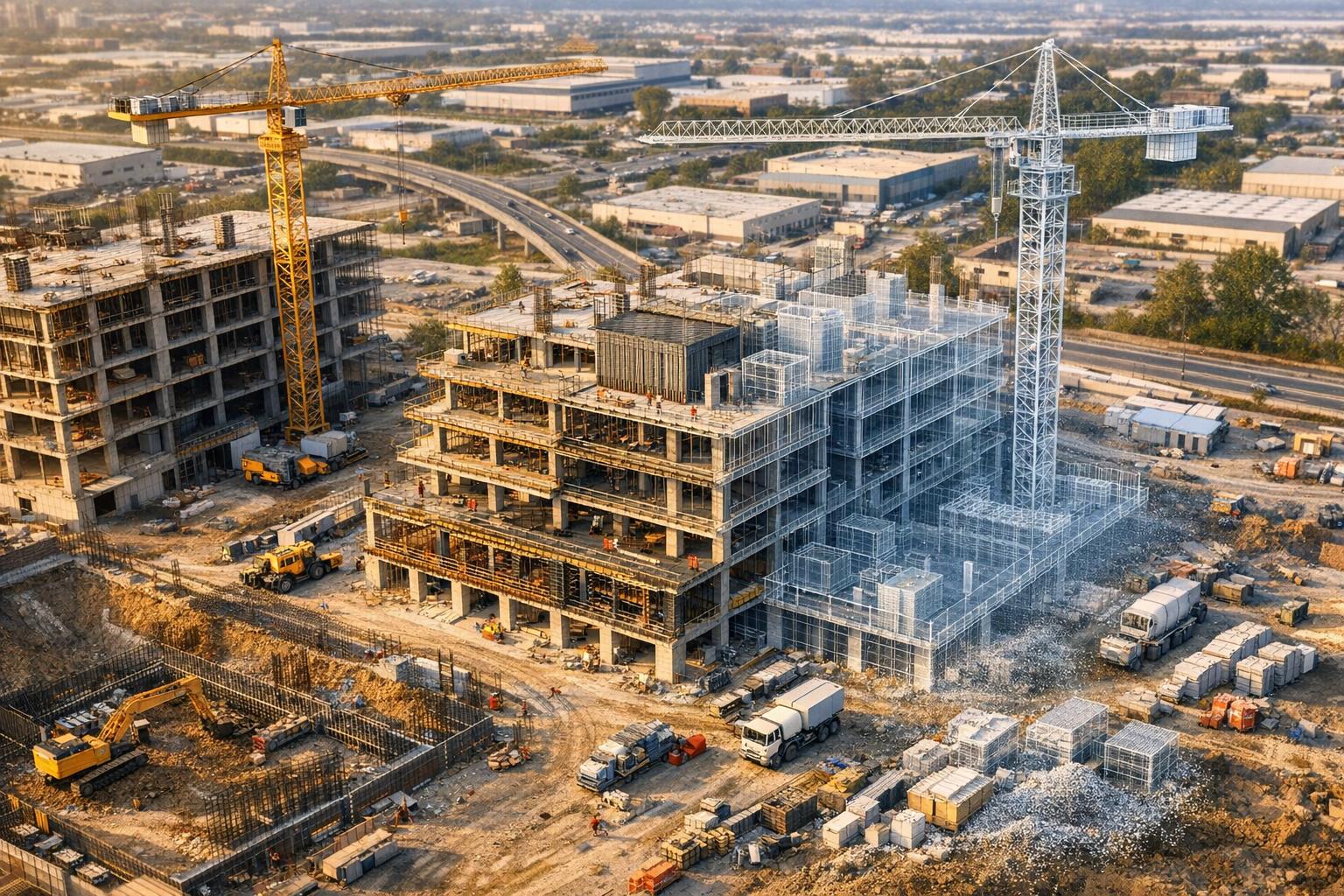
Hybrid 3D models are transforming construction by combining tools like drones, LiDAR, and 360° imagery to create detailed, interactive site models. These models save time, reduce costs, and improve accuracy across various stages of construction and facility management. Key benefits include:
- Faster Progress Tracking: Automated updates identify delays or discrepancies instantly, cutting manual survey times by up to 80%.
- Clash Detection: Spot design conflicts early, saving millions on large projects and preventing costly rework.
- Improved Asset Management: Unified models replace outdated blueprints, simplifying maintenance and updates.
- Enhanced Safety: Real-time monitoring and automated hazard detection reduce workplace risks.
- Precision in Quality Control: Overlay as-built conditions with plans to catch errors early.
- Material Efficiency: Accurate volume measurements minimize waste and over-ordering.
- Digital Twin Integration: Real-time data links physical sites with digital models, enabling smarter decisions.
Platforms like Anvil Labs simplify managing hybrid 3D data, offering affordable tools for measurement, collaboration, and updates. This shift from static plans to dynamic, data-rich models is reshaping how construction projects are planned, executed, and maintained.
1. Progress Tracking
Hybrid 3D models have redefined how construction progress is monitored, turning it into a highly accurate, data-driven process. By combining drone-based mapping, LiDAR scans, and on-site measurements, these models create a detailed digital record of your site. Instead of juggling scattered records, project managers now have access to a centralized, high-resolution 3D model that reflects the project's current state.
With automated comparison tools, these models overlay current scans onto original plans, instantly identifying any discrepancies or delays. For instance, if a concrete pour is behind schedule or a wall shifts even slightly from its intended position, the system flags the issue right away. Engineers can then annotate and measure directly within the 3D model, turning raw spatial data into actionable insights. This streamlined approach also supports smooth remote collaboration.
Remote visualization tools take this a step further by improving communication among stakeholders. Project managers can conduct virtual site walkthroughs from anywhere, exploring the 3D model as if they were physically there. This feature has been shown to cut architect travel by 50%, allowing remote teams to stay fully informed about multiple project areas without frequent on-site visits.
In the past, traditional workflows relied on lengthy manual surveys that could take an entire day and often resulted in fragmented data scattered across blueprints and spreadsheets. Hybrid 3D models change the game by enabling comprehensive scans at critical project milestones, creating a seamless, time-stamped record that documents the entire construction process.
2. Clash Detection
After tracking progress, hybrid 3D models play a key role in spotting design conflicts early. By combining BIM designs with laser scans and point clouds, these models can identify three main types of clashes: hard clashes (like a water pipe cutting through a steel beam), soft clashes (such as an HVAC unit obstructing maintenance access), and workflow clashes (for example, equipment arriving before excavation is finished).
Here’s a striking example: On a $230 million project, a $200,000 investment in BIM coordination delivered a 10x return on investment, saving over $2.5 million and trimming up to 20% off the contract value for large-scale projects.
"Faults that conventionally were detected on the site and involved high cost and schedule implications... can now be seen by BIM service providers in the office even before visiting the site." - Bharath Kumar, BIM Coordinator
The hybrid approach also minimizes false positives, a common issue with traditional BIM workflows. Take the restoration of Italy's Remondini Palace as an example: E-Making, a digital engineering firm, used Matterport point clouds within Autodesk Revit, cutting survey time by 70% and reducing costs by 20% while ensuring MEP feasibility.
To make the most of clash detection, it’s crucial to run it at every major design milestone rather than waiting for the final model. Setting project-specific tolerance rules can help filter out minor overlaps, reducing reported issues from over 500 to around 150 critical ones that require immediate action. Assigning each clash to the relevant discipline with clear deadlines through cloud-based issue tracking systems ensures smoother project management and fewer delays.
3. Asset Management
Once the early-stage efficiencies are in place, asset management takes things further by using hybrid models throughout a facility's lifecycle. After construction is complete, hybrid 3D models become the go-to system for tracking every asset. These models replace the chaos of scattered spreadsheets, paper blueprints, and outdated CAD files, offering facility managers a single, unified source of truth. This system combines the original design data with reality capture scans, which reflect the actual "as-built" conditions of the facility.
Maintenance planning becomes much more efficient with virtual site assessments. Engineers can inspect facades, roofs, or even entire building complexes without needing to step foot on-site. By integrating orthomosaic maps with LiDAR technology, teams can obtain precise measurements for distances, volumes, and clearances - critical for tasks like replacing equipment or routing new utility lines.
Keeping these hybrid models up to date is a process known as "evergreening." As renovations happen or equipment gets replaced, the digital model is continuously updated to reflect the real-world conditions. This ensures the model remains accurate even long after construction ends. Interestingly, while 78% of facility managers have adopted smart building technologies, only 36% report seeing measurable improvements. This is where digital twins can make a real difference.
"Digital twins can close the divide [between smart building adoption and measurable improvements] by offering a space to test actions and estimate outcomes based on this data, even when organizations lack data science talent."
– Emily Newton, Editor-in-Chief, Revolutionized
Another key feature is the ability to turn scan data into actionable insights using annotation tools. These tools allow teams to mark equipment locations, attach maintenance schedules, flag areas needing repairs, and document corrections - all within the 3D model. As a result, technicians can rely on accurate, up-to-date spatial data instead of outdated drawings, ensuring smoother operations and better decision-making.
4. Safety Monitoring
The construction industry ranks as one of the most hazardous in the U.S., accounting for 36% of all workplace fatalities. Hybrid 3D models are changing the game by combining design data, real-world conditions, and live monitoring systems to identify and address potential dangers. Let’s break down how automated rule-checking, real-time tracking, and environmental assessments are making construction sites safer.
Automated rule-checking algorithms scan 3D models to pinpoint risks like fall hazards - such as leading edges or floor openings - that might slip through the cracks in traditional planning. When these 3D models are paired with construction schedules, forming what’s known as 4D BIM, the system can also detect hazards specific to particular phases of the project. For instance, temporary openings created during floor installations can be flagged before they become a threat.
By integrating Ultra-Wideband (UWB) tags with 3D models, geofences can be established around high-risk areas like elevator shafts or exposed edges. If a worker crosses into a restricted zone, the system triggers instant alerts. This approach shifts safety practices from periodic inspections to continuous, real-time hazard monitoring.
"The existing periodical risk assessment approaches can be replaced by continuous monitoring of hazards in the working environment in real time" – Researchers at the Polish Academy of Sciences
Hybrid models also factor in environmental risks by combining Building Information Modeling (BIM) data with live weather updates. For example, they can calculate UV exposure risks by analyzing the amount of shade on-site. Mixed Reality devices, such as the HoloLens 2, take this a step further by overlaying safety information - like evacuation routes and danger zones - directly onto the physical workspace during inspections. This gives safety managers a more intuitive understanding of hazards in their actual spatial context.
These tools also streamline safety equipment planning by automatically generating materials lists and placement guides for items like safety railings, all based on the site’s 3D geometry. Additionally, high-resolution virtual inspections allow safety officers to assess dangerous areas remotely, minimizing personal risk while maintaining thorough oversight.
5. Quality Control and Inspections
Advancements in progress tracking and clash detection have reshaped quality control, making inspections more precise and efficient. Hybrid 3D models now play a pivotal role, overlaying as-built conditions onto design specifications. This allows inspectors to spot deviations instantly. Instead of relying on traditional manual measurements, they can explore digital twins, manipulate 3D models from any perspective, and compare actual construction with CAD designs with pinpoint accuracy. This proactive approach helps catch errors early, preventing costly rework down the line. Adding to this, drones are revolutionizing inspections by capturing data quickly and safely.
Take Los Angeles International Airport as an example. Architecture firm Corgan utilized Matterport Pro2 cameras to scan an 18,000-square-foot utility tunnel in just one hour, cutting scan time in half. The resulting 3D models enabled teams to create virtual punch lists, where discrepancies were marked directly on the digital twin. Similarly, during the 2020 COVID-19 lockdown, Swinerton scanned a 20,000-square-foot space in a matter of hours. These models allowed for real-time quality feedback, eliminating the need for client travel entirely, reducing architect and MEP travel by 50%, and avoiding four weeks of potential delays.
Thermal imagery is another game-changer in quality control. By layering thermal data onto 3D models, inspectors can detect issues like insulation gaps, moisture intrusion, or thermal inconsistencies - all without resorting to destructive testing. Combining tools such as 3D models, 360-degree photos, thermal imagery, LiDAR, and orthomosaics creates comprehensive digital quality records that go far beyond standard visual checks.
The financial benefits are equally impressive. For instance, Takenaka Corporation began using Matterport digital twins in 2017, reducing photo production time by 90% and saving thousands of dollars per scan. Automated photogrammetry software further ensures these models meet formal inspection standards.
These technologies integrate seamlessly with task management systems and AI analysis tools, creating streamlined workflows. Inspections, findings, and corrective actions are all documented within the 3D model itself, improving traceability from construction to post-completion maintenance. This centralized system ensures quality standards are upheld throughout the entire project lifecycle.
6. Geometric Optimization
Geometric optimization refines construction design by combining point clouds and CAD designs into a unified, actionable model. Using hybrid 3D models, raw scan data is segmented through curvature analysis to distinguish planar surfaces, developable structures, and complex geometries. Standard elements like walls, columns, and pipes are replaced with parametric 3D primitives - planes, cylinders, spheres, cones, and tori - while intricate details retain their mesh representation. This approach filters out noise from laser scanning or photogrammetry, converting imperfect data into precise shapes with an accuracy of 10 mm. The result? Better design precision and more cost-efficient project planning.
In December 2025, researchers at Izmir Demokrasi University showcased the financial advantages of this approach by completing a scan-to-BIM workflow for an oil production facility in Izmir, Turkey. The project involved a 240 m² industrial hall packed with dense mechanical equipment. Using 36 scan locations and processing a 4.82 GB LiDAR dataset, the team created an LOD-300 digital twin in Autodesk Revit. They converted machinery - such as tanks, platforms, and piping - into parametric families, maintaining geometric accuracy within a 10 mm tolerance. This digital twin enabled planners to test new machinery layouts and verify safety clearances before renovations began.
Hybrid models also offer impressive compression rates, ranging from 3.60 to 5.93 times smaller, with one church model achieving a 4.59 compression factor. This makes models quicker to load and easier to share. Additionally, these compressed models can include semantic metadata - like material properties and maintenance schedules - turning static geometry into actionable, data-rich assets.
Beyond improving design, geometric optimization helps identify soft clashes, such as equipment being installed too close to service walkways or violating safety clearances. When paired with BIM clash detection, accurate geometric modeling can cut costs by up to 20% of the contract value in major infrastructure projects. By overlaying high-density point clouds onto CAD designs, teams can compare "as-built" conditions with "as-designed" plans, catching discrepancies early and avoiding expensive fixes later.
sbb-itb-ac6e058
7. Material Optimization
Excess material waste not only drives up costs but also negatively impacts the environment. By utilizing precise geometric data, material optimization focuses on minimizing waste through accurate volume measurements. Hybrid 3D models address this challenge by analyzing material usage patterns and identifying areas of overconsumption. Combining drone scans and LiDAR for precise volume measurements with computational design for strategic material placement, this method ensures that every cubic foot of material - like concrete - is used efficiently.
One innovative solution is the use of permanent formwork. Unlike traditional timber or metal molds that are discarded after the concrete cures, hybrid 3D printing creates formwork shells that remain part of the final structure. These shells employ a high-performance mortar for the thin outer layer - just a few inches thick - while the interior is filled with low-cost, recycled-aggregate concrete. As Kees Leemeijer puts it:
"We can use the most sophisticated materials exactly where they are needed, and the most sustainable, cost-effective materials everywhere else. It is the end of monolithic thinking and the beginning of strategic, multi-material design".
This multi-material technique has the potential to reduce material usage by 30%–60%. Additionally, hybrid models define cut-and-fill volumes with precision, preventing over-ordering. Drone-based volume tracking of stockpiles further helps teams manage inventory efficiently, reducing both excess orders and the need to haul unused materials off-site. Zhu Jianchao, Vice President and Chief Engineer at China State Construction Engineering Corporation, highlights its versatility:
"3D printing can replace or integrate with modular construction where it can add value, such as with repetitive production tasks where some diversity is required... [it] could be executed quickly, with minimal materials waste".
Beyond cutting material waste directly, hybrid models also minimize waste caused by errors and rework. By merging architectural and MEP models from different software platforms into one coordinated model, teams can detect potential clashes before construction begins. This proactive approach eliminates the need for on-site fixes, saving both materials and time.
8. Digital Twin Integration
Digital twin integration is taking construction management to the next level by merging real-time data with digital replicas of physical sites. At the heart of this technology are hybrid 3D models, which create a seamless link between the physical world and its virtual counterpart. As Lukumon Oyedele describes:
"The DT is an information construct... that consists of a physical asset, a digital asset and a connection between the two assets".
The process starts with precise LiDAR scanning, which captures millimeter-accurate data through high-density point clouds. Add to this the power of IoT sensors and live data feeds, and you get a system capable of tracking everything from temperature and moisture levels to RFID-monitored foot traffic and equipment geolocation. Helly Kamdar from TYLin highlights how this synchronization enables continuous feedback loops, making adaptive control and proactive decision-making possible.
The impact is hard to ignore. Digital twin integration has been shown to cut project timelines by 22% and reduce cost overruns by 53%. Safety gets a boost too, with predictive sensing lowering incidents by 67%. During the COVID-19 pandemic, Swinerton leveraged this technology for the Fairmont Hotel project, using weekly site scans to eliminate client travel and cut architect travel by 50%. Similarly, Gilbane reported savings of 25% to 30% on design–build costs.
But the benefits don’t stop when construction wraps up. Digital twins remain valuable tools for facilities management, serving as navigable records complete with embedded maintenance manuals and spec sheets. By updating the twin at critical milestones - such as pre-design, post-demolition, pre-MEP installation, and pre-handover - it evolves from a Digital Twin Prototype (DTP) used during design to a fully functional Digital Twin Instance (DTI).
Despite its potential, digital twin adoption is uneven. While 72% of firms use this technology during design management, fewer than 40% apply it during operations. This gap represents a missed chance to improve energy efficiency by as much as 28%. Moving from static models to dynamic digital twins opens up new possibilities for resource optimization and smarter decision-making.
9. Anvil Labs Platform for Hybrid 3D Model Management
The Anvil Labs platform takes hybrid 3D model management to a whole new level, leveraging advanced digital twin integration to simplify complex workflows. Used by more than 350 companies, this web-based solution consolidates a wide range of hybrid 3D data - including 3D meshes, point clouds, LiDAR data, and orthomosaics - into one centralized hub, eliminating the hassle of juggling multiple software tools.
With the ability to transform hundreds of drone images into detailed 3D models and orthomosaics, Anvil Labs automates the process at an affordable rate of $3 per gigapixel. Its support for standard 3D and LiDAR formats ensures compatibility with existing workflows, making it an adaptable solution for diverse industry needs.
The platform’s in-browser measurement tools make virtual site surveys and precise measurements easy - no need for specialized desktop software. Features like interactive annotations and before-and-after comparisons provide clear visual updates on construction progress, enabling seamless collaboration between on-site teams and office stakeholders. These tools bridge the gap between field data and digital records, enhancing communication and efficiency.
Anvil Labs also integrates smoothly with Matterport, AI tools, and additional imagery, bringing all site data under one roof. It even supports thermal imagery and 360° panoramas, creating a complete digital snapshot of site conditions.
For secure sharing and professional presentations, the platform offers customizable access controls and project galleries. Pricing is straightforward: $99 per month for the Asset Viewer subscription, which includes hosting and collaboration tools, or $49 per project for individual file management. These features build on earlier digital twin capabilities, providing a comprehensive solution for managing hybrid 3D models from start to finish. By combining data processing, visualization, and secure collaboration in one platform, Anvil Labs simplifies every aspect of construction site management.
Comparison: Hybrid vs. Traditional 3D Modeling
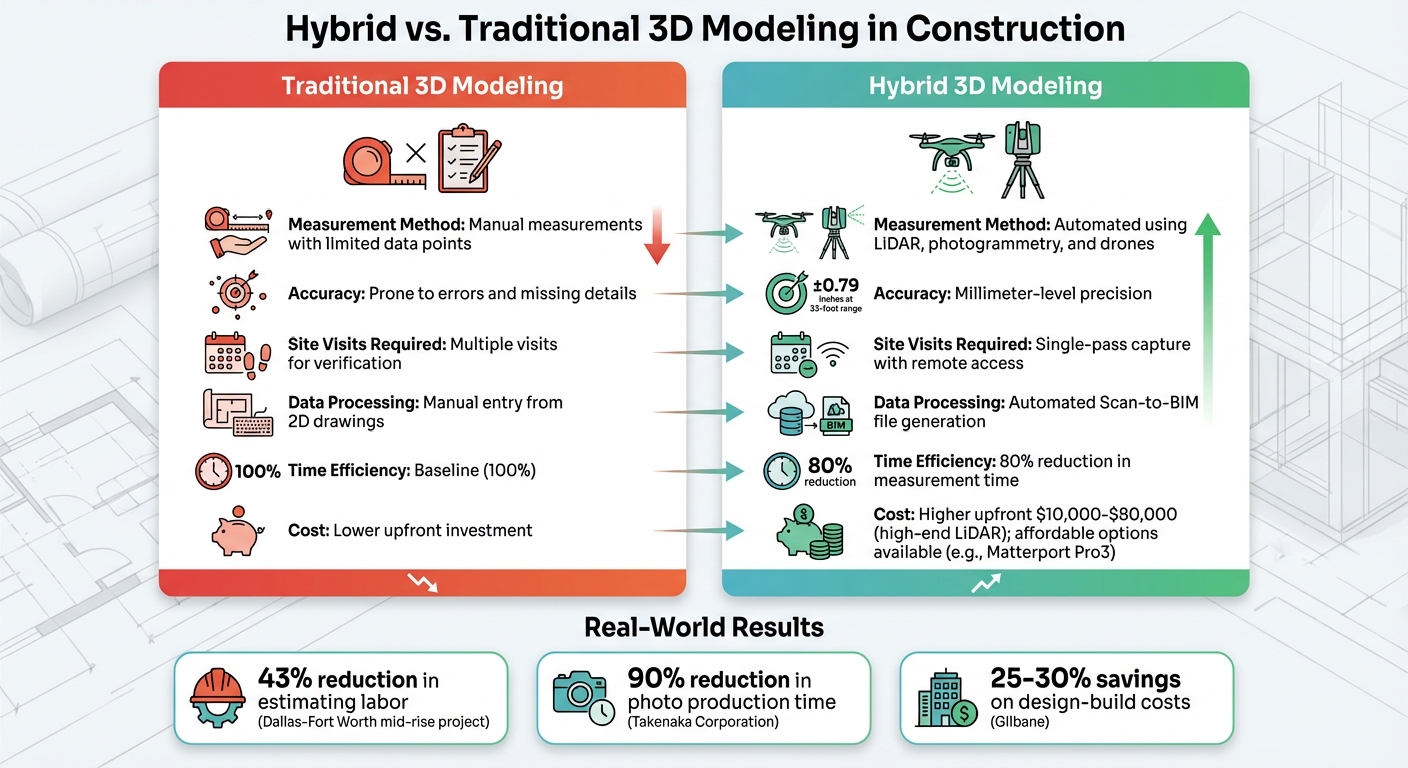
Hybrid vs Traditional 3D Modeling in Construction: Key Differences
When comparing hybrid modeling to traditional methods, the differences in efficiency and accuracy become clear. Traditional 3D modeling often relies on manual measurements using tools like tape measures and limited data points. This process is not only time-consuming but also prone to human error. In contrast, hybrid modeling integrates advanced technologies - such as LiDAR, photogrammetry, and drone imagery - to capture millions of data points in a single pass.
Traditional methods struggle to capture the intricate details of complex structures. Hybrid systems, however, deliver exceptional precision, achieving millimeter-level accuracy (within ±0.79 inches at a 33-foot range). For instance, a mid-rise project in Dallas–Fort Worth implemented a 4D/5D digital-twin framework in November 2025. This approach led to a 43% reduction in estimating labor, a 6% drop in overtime, and 30% project-buffer utilization, allowing the project to finish on time in just 128 days.
"With 3D scanning, you're not just scanning the subject; you're scanning everything within a 30-meter radius of the scanner... You're collecting context."
– Will Rourk, Architectural Historian
Another critical advantage lies in workflow integration. Traditional models often exist as static 2D drawings, requiring manual interpretation and data entry. Hybrid systems, on the other hand, generate BIM-ready files (such as .RVT or .E57) that integrate seamlessly with tools like Autodesk Revit, Procore, and AutoCAD. Construction firm Gilbane, for example, uses digital twins to share updated site scans with stakeholders, cutting design and build costs by 25% to 30% while reducing misunderstandings and speeding up approvals.
Key Differences Between Traditional and Hybrid 3D Modeling
| Feature | Traditional 3D Modeling | Hybrid 3D Modeling |
|---|---|---|
| Measurement Method | Manual measurements with limited data points | Automated using LiDAR, photogrammetry, and drones |
| Accuracy | Prone to errors and missing details | Millimeter-level precision (±0.79 inches) |
| Site Visits Required | Multiple visits for verification | Single-pass capture with remote access |
| Data Processing | Manual entry from 2D drawings | Automated Scan-to-BIM file generation |
| Time Efficiency | Baseline | 80% reduction in measurement time |
These differences highlight why hybrid modeling is becoming a game-changer for modern construction projects.
Cost is another factor to consider. While high-end LiDAR scanners can range from $10,000 to over $80,000 and require specialized training, hybrid solutions like the Matterport Pro3 offer a more affordable option. These devices strike a balance between speed and accuracy, meeting 95% of standard construction documentation needs at a fraction of the cost.
Conclusion
Hybrid 3D models are reshaping the construction industry by integrating LiDAR, photogrammetry, and drone imagery to deliver detailed, high-resolution data. This combination allows for precise measurements and shorter project timelines. For example, Swinerton avoided four weeks of potential delays and saved thousands in rework costs during a 2020 project, while Takenaka Corporation cut the time required to produce 360-degree photos by an impressive 90%.
These models provide centralized, interactive tools that make remote inspections and real-time collaboration between on-site teams and stakeholders seamless. Gone are the days of relying on scattered blueprints and spreadsheets that bog down decision-making. A prime example is the I-80/I-380 Systems Interchange Project in Iowa, which began in August 2018. Hybrid BIM was instrumental in refining models and incorporating contractor feedback across 4,200 feet of bridge structures.
The impact of these streamlined workflows is clear - significant savings in both time and costs. ICON’s 3D-printed homes in Texas highlight this, achieving a 30% reduction in material costs and completing homes in just one week. Integrated digital workflows help reduce on-site labor, minimize material waste, and identify potential conflicts before they escalate into costly issues.
Anvil Labs simplifies the management of hybrid 3D models by consolidating LiDAR data, thermal imagery, orthomosaics, and 3D models into a single platform. With cross-device accessibility, integrations for tools like Matterport, AI analysis, and task management systems, teams can annotate, measure, and securely share data without juggling multiple software platforms. Hosting plans start at $49 per project, with optional data processing available at $3 per gigapixel.
The transition from traditional methods to hybrid 3D modeling represents a major leap forward for construction. This approach enhances project planning, execution, and delivery, enabling teams to work faster, safer, and with greater precision than ever before.
FAQs
How do hybrid 3D models enhance safety in construction projects?
Hybrid 3D models improve construction safety by offering precise and detailed visualizations that make it easier to spot potential risks early in the process. These models are particularly useful for clash detection, helping teams identify design conflicts before construction even starts, which can significantly lower the chances of on-site accidents.
They also play a key role in tracking progress and pinpointing hazards, allowing safety measures to be planned and adjusted as needed in real-time. By providing a comprehensive view of the construction environment, these tools contribute to safer and more efficient workflows for everyone on the project.
How are digital twins used in facility management?
Digital twins are reshaping how facility management works by offering a real-time, interactive model of physical spaces. These digital replicas allow teams to oversee building performance, keep tabs on assets, and simplify maintenance tasks. By combining data from sensors, 3D models, and other inputs, digital twins empower teams to make smarter decisions and anticipate maintenance needs before problems arise.
Some standout uses include improving energy efficiency, maximizing space utilization, and streamlining renovations or repairs. This approach not only helps facilities run more smoothly but also cuts down on costs and minimizes disruptions.
How does clash detection with hybrid 3D models help reduce costs in construction?
Clash detection using hybrid 3D models pinpoints design conflicts early in the planning phase, allowing teams to address problems before construction starts. This helps sidestep costly rework, unexpected change orders, and unnecessary material waste.
By tackling these issues upfront, projects are more likely to stay on schedule and within budget. This early problem-solving approach not only reduces delays and labor costs but can also save millions on larger construction projects. It fosters better collaboration among teams, paving the way for smoother execution and improved project results.

.svg)


