

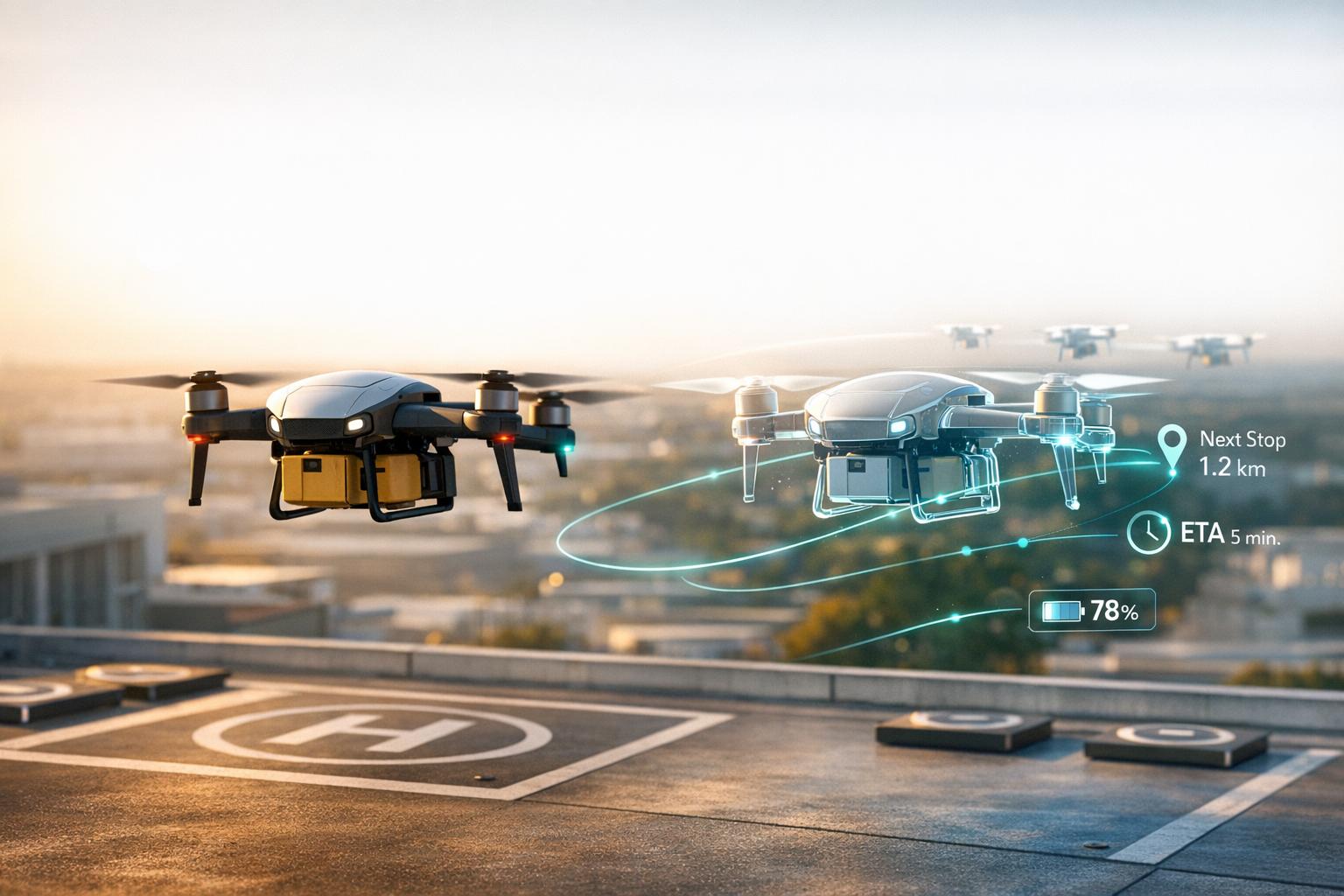
Managing drone operations is tough. Predefined routes and offline simulations often fail when drones face unexpected obstacles, weather changes, or hardware issues. Enter digital twins: virtual replicas of drones that sync with real-time data to monitor, adjust, and optimize drone performance mid-flight. This tech bridges the gap between static planning and dynamic, data-driven decision-making.
Key Takeaways:
- Real-time monitoring: Digital twins detect deviations and adjust routes dynamically.
- Predictive analytics: Anticipate risks, optimize schedules, and prevent failures.
- Better resource use: Handle multiple drones efficiently by tracking battery life, payload, and maintenance needs.
For complex drone operations, digital twins offer unmatched efficiency and reliability, reducing downtime and improving outcomes.
1. Traditional Drone Scheduling
Real-Time Data Integration
Traditional drone scheduling often relies on pre-determined routes, which don't account for real-world changes. This rigidity creates a disconnect between the planned mission and what actually happens during execution. For instance, if a drone encounters unexpected obstacles, sudden weather changes, or equipment malfunctions, the system won’t recognize these issues until failure has already occurred. As highlighted in IEEE:
The inherent safety and privacy risks associated with drone-based applications call for appropriate testing and monitoring tools.
This inability to adapt in real time makes traditional scheduling less effective, leaving room for newer approaches like predictive analytics to expose its limitations.
Predictive Analytics
Traditional scheduling depends on static simulations performed offline, which are unable to adjust to real-time scenarios. This means project managers can’t anticipate risks before they arise, making it harder to take preventive actions. MDPI Applied Sciences emphasizes this challenge, stating, "Traditional techniques... often remain unable to adapt to the instant changes required at the last moment". The result? Operational inefficiencies and delays.
On top of that, software bugs that aren't caught during initial testing may go unnoticed until the drones are already in operation, further complicating matters.
Resource Allocation Optimization
Efficient use of resources is another area where traditional scheduling falls short. Coordinating multiple drones is particularly tricky because these systems lack the tools to monitor and ensure safe, efficient operations across different applications. Hardware limitations add another layer of complexity, making real-time coordination even harder.
Additionally, traditional methods often fail to account for the specific characteristics and parameters of each drone. This lack of precision leads to poor collaboration, scheduling conflicts, and wasted resources. These inefficiencies highlight the need for more dynamic, data-driven solutions, such as digital twin technologies, which can address these gaps and improve overall performance.
2. Digital Twin-Enabled Drone Scheduling
Real-Time Data Integration
Digital twins are revolutionizing drone scheduling by creating synchronized digital replicas of physical drones. Instead of relying on static maps, these systems use real-time LiDAR data to adjust flight paths dynamically. Through a 4D discretization method called Skyroutes, digital twins account for ever-changing factors like construction cranes, utility poles, and growing vegetation. This adaptability addresses the rigid limitations of traditional scheduling methods.
A study published in Scientific Reports highlights the impact of digital-twin-based Advanced Aerial Mobility (AAM) systems. These systems can boost urban airspace capacity by up to 10% and generate UAV trajectories that are 50% more energy-efficient. Additionally, digital twin models with spatial tolerances under 3.3 feet provide a critical safety layer by identifying performance deviations in real time, preventing potential issues before they escalate. This real-time data integration sets the stage for advanced predictive capabilities.
Predictive Analytics
Digital twins also harness machine learning to tackle complex challenges like drone swarm coordination. By offloading resource-intensive computations to digital twins, drones can overcome the limitations of their onboard systems and adapt to changes in real time. This allows for proactive schedule adjustments and predictive maintenance, ensuring tasks are prioritized optimally. According to Matterport, digital twin platforms can create dimensionally accurate virtual models within 48 hours of data capture, keeping predictive analytics precise and actionable throughout every mission phase.
This continuous synchronization between physical drones and their digital counterparts ensures that the insights generated remain relevant and effective, enabling operators to anticipate and address potential disruptions before they occur.
Resource Allocation Optimization
The predictive insights from digital twins also enhance resource allocation, particularly for shared drone infrastructure. By coordinating routes and managing charging stations, these systems streamline the distribution of tasks, taking into account factors like battery life, payload capacity, and flight range. This approach resolves the coordination challenges that traditional scheduling methods often face.
As noted by Lei Lei, Gaoqing Shen, Lijuan Zhang, and Zhilin Li:
The decision model that integrates a machine learning algorithm is built to explore the global optimal solution and controls the behaviors of UAV swarm.
How Drones & Digital Twins Are Transforming Infrastructure Inspections [Free Training]
sbb-itb-ac6e058
Pros and Cons
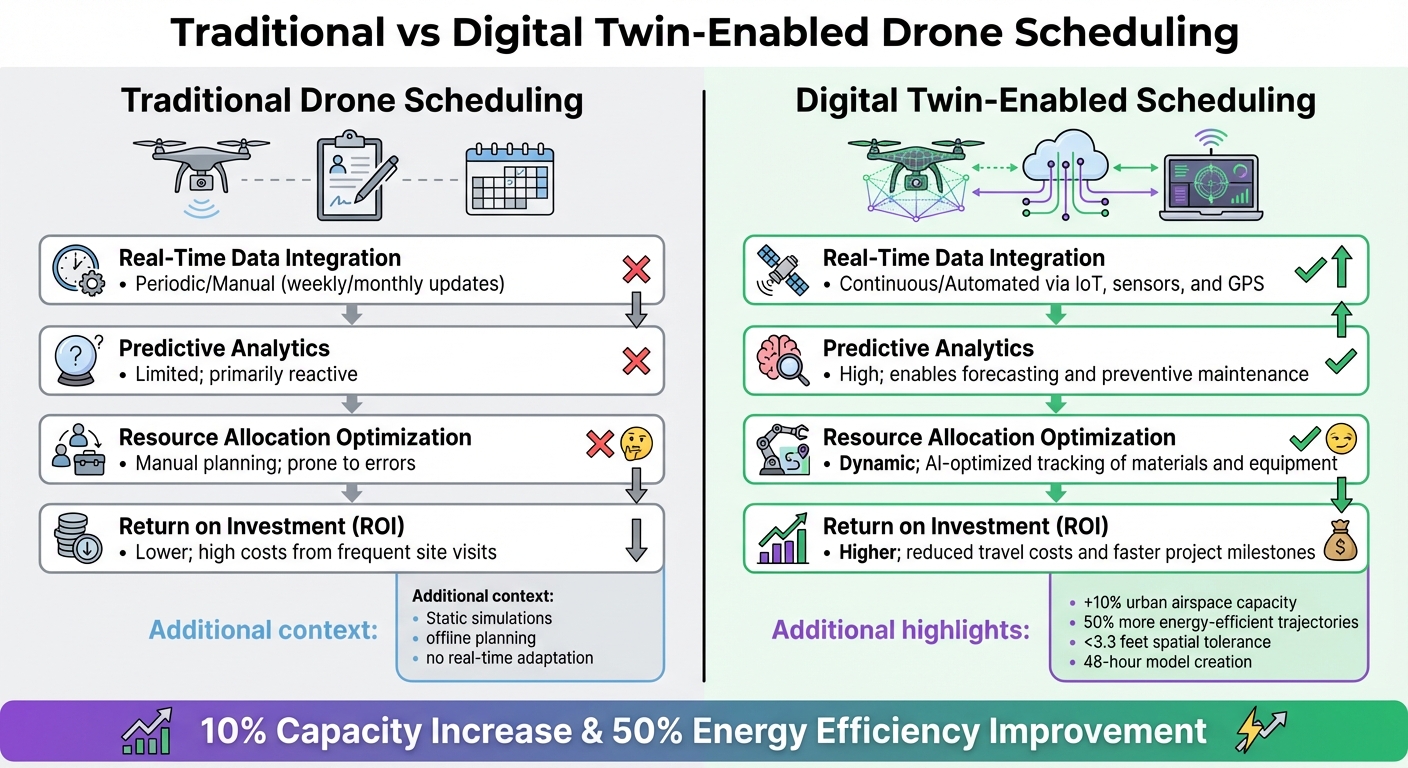
Traditional vs Digital Twin-Enabled Drone Scheduling Comparison
Traditional scheduling relies on periodic site visits and manual planning to keep upfront costs low. However, over time, this approach often leads to higher expenses due to increased travel and the need for manual surveying. Without access to real-time updates, decisions tend to be reactive, which can cause inefficiencies when unexpected changes occur on-site. This highlights the challenges of balancing computational efficiency with effective resource allocation.
On the other hand, digital twin scheduling requires a larger initial investment in drones, sensors, and specialized software. But this upfront cost is offset by long-term savings through reduced site visits and faster project completion. As previously mentioned, digital twin technology provides:
accurate real-time information that reflects construction progress
This capability allows teams to identify and address issues early, preventing them from escalating into larger problems.
Traditional scheduling also faces limitations due to the onboard processing capabilities of drones. As Lei Lei, Gaoqing Shen, Lijuan Zhang, and Zhilin Li point out:
The limited computation and storage capabilities of small-sized UAVs cannot meet the requirement of the resource-intensive artificial intelligent algorithms. It becomes a bottleneck restricting the improvement of UAV swarm intelligence
Digital twins overcome this by shifting heavy computational tasks to external systems, enabling more advanced global optimization.
Here’s a side-by-side comparison of the two approaches:
| Feature | Traditional Drone Scheduling | Digital Twin-Enabled Scheduling |
|---|---|---|
| Real-Time Data Integration | Periodic/Manual (weekly/monthly updates) | Continuous/Automated via IoT, sensors, and GPS |
| Predictive Analytics | Limited; primarily reactive | High; enables forecasting and preventive maintenance |
| Resource Allocation Optimization | Manual planning; prone to errors | Dynamic; AI-optimized tracking of materials and equipment |
| Return on Investment (ROI) | Lower; high costs from frequent site visits | Higher; reduced travel costs and faster project milestones |
The choice between these methods ultimately depends on the scale and complexity of the project. For smaller operations with occasional scheduling needs, traditional methods may be sufficient. However, for larger industrial sites requiring constant monitoring and intricate coordination, digital twins provide measurable gains in accuracy, efficiency, and cost savings.
Conclusion
Digital twins transform drone scheduling from a reactive process into a proactive one. By synchronizing real-world drones with their virtual counterparts in real time, they offer a level of compliance, conflict resolution, and predictive maintenance that traditional methods simply can’t match, as highlighted in earlier research.
Start by using offline simulation testing to identify potential scheduling errors before deployment. This two-phase strategy minimizes costly operational failures. Once in action, ensure continuous data synchronization between drones and their digital twins to immediately detect deviations and flag anomalies. This approach bridges the gap between simulation precision and real-world operational demands.
Digital twins thrive in complex environments, especially those involving multiple drones or shared infrastructure. Their ability to streamline decision-making and coordination makes them indispensable for managing autonomous fleets in logistics networks and smart city applications. By fostering collaboration and ensuring adherence to safety protocols, they build confidence in autonomous operations.
When designing a digital twin system, prioritize interoperability. For example, Anvil Labs’ platform integrates 3D models, thermal imaging, LiDAR, and real-time sensor data, showcasing how interoperability enhances real-time, data-driven scheduling. Features like cross-device accessibility and secure data sharing further bolster monitoring and analysis capabilities.
While the initial investment in digital twins may be higher, the long-term benefits are undeniable. They reduce site visits, accelerate project timelines, and enable faster issue resolution. By consolidating vast amounts of data and enabling predictive maintenance, digital twins not only improve task management but also maximize ROI for even the most complex drone operations.
FAQs
How does digital twin technology improve drone scheduling?
Digital twin technology is reshaping how drone scheduling works by providing real-time data insights, predictive analytics, and dynamic virtual models. These features empower operators to make quicker, smarter decisions, ensuring drones are used effectively and safely.
By using digital twins, operators can simulate different scenarios, fine-tune resource allocation, and tackle potential problems before they occur. The result? Better task planning, less downtime, and stronger performance compared to older scheduling methods.
How does predictive analytics in digital twins enhance drone operations?
Predictive analytics plays a key role in digital twin technology, especially when it comes to improving drone operations. By analyzing real-time data from sensors, it helps forecast potential issues and fine-tune maintenance schedules. This forward-thinking method minimizes downtime, ensures smarter use of resources, and boosts overall operational efficiency.
With these predictive insights, drone operators can stay ahead of maintenance needs, tackle problems before they grow into larger concerns, and organize tasks more effectively for consistent and dependable performance.
What are the long-term advantages of using digital twin technology for drone scheduling?
Digital twin technology brings a host of benefits to drone scheduling by offering real-time insights, supporting predictive maintenance, and improving resource management. These features help detect problems early, enhance decision-making, and increase operational efficiency.
By mimicking real-world conditions, digital twins enable more precise planning and smarter task prioritization. This reduces downtime and helps keep costs under control. Beyond improving daily operations, this technology also lays the groundwork for scaling drone workflows as demands grow.

.svg)


