

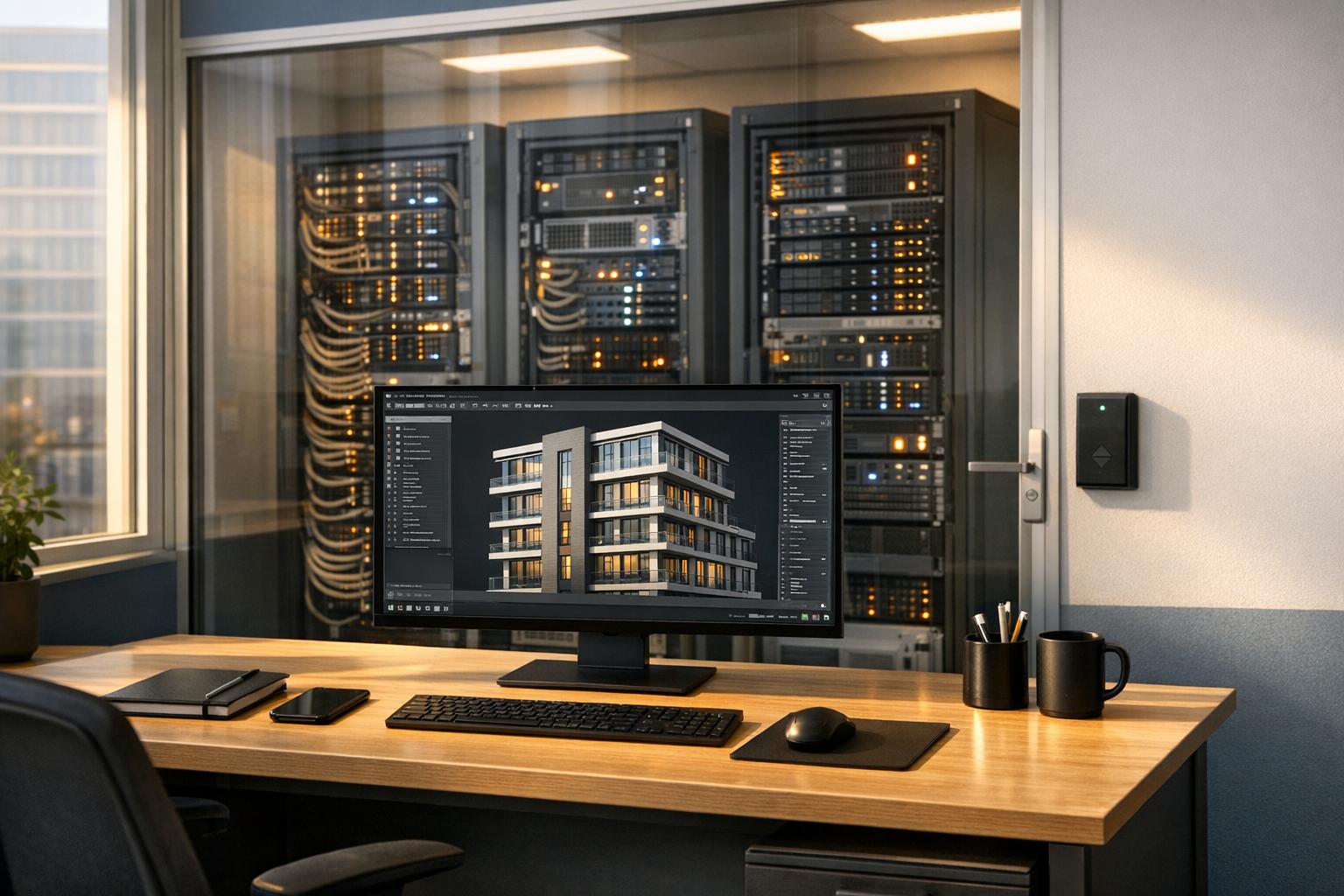
Managing 3D models on on-premise networks enables industries to securely store, access, and collaborate on large, data-heavy files without relying on external cloud services. Here's why this matters:
- Industries like energy, construction, and manufacturing use 3D models as digital twins to monitor assets, plan maintenance, and improve decision-making.
- On-premise networks keep data local, ensuring security and compliance, especially for sensitive sectors like defense and pharmaceuticals.
- Benefits include fast access to large files, real-time team collaboration, and reduced latency compared to cloud-based systems.
- Challenges like large file sizes, network speed, and system integration can be addressed with solutions like spatial streaming, optimized bandwidth, and master data management.
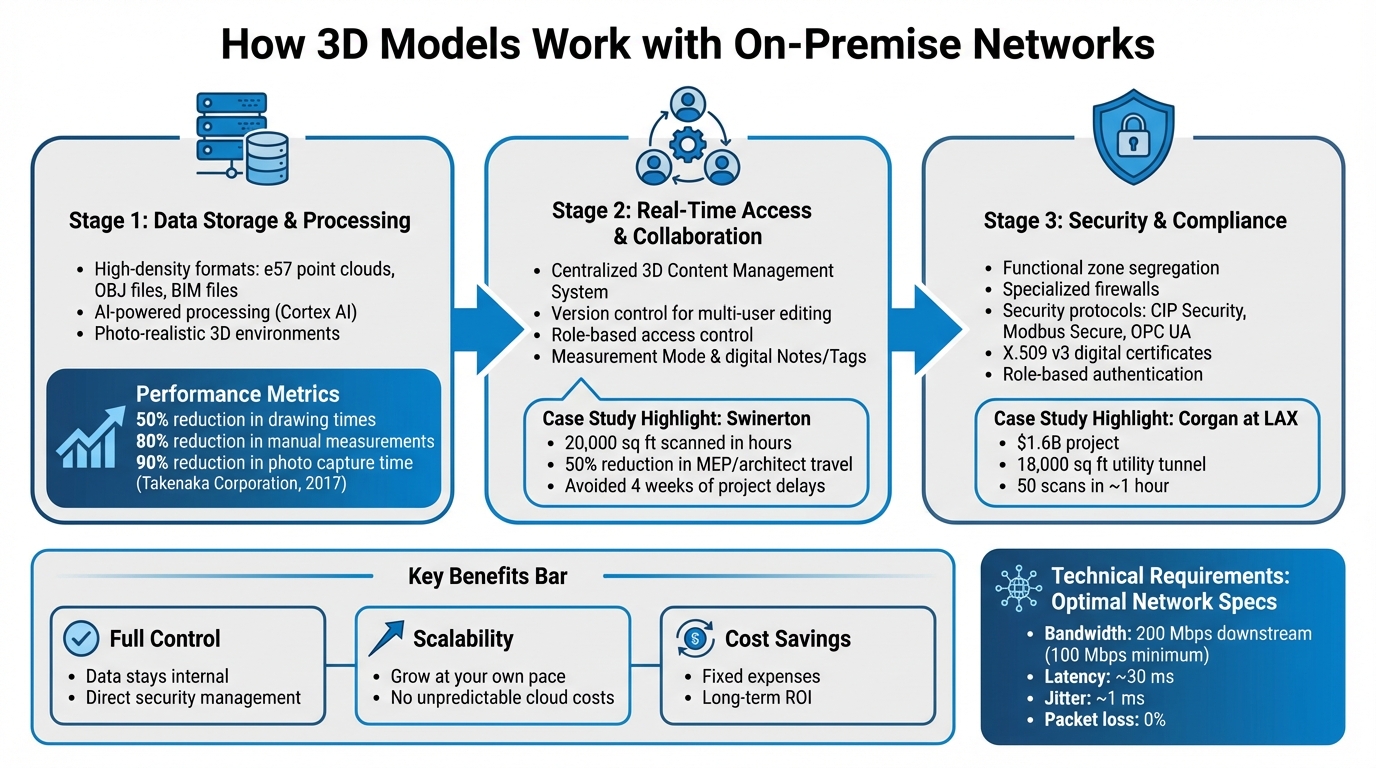
How 3D Models Work on On-Premise Networks: Storage, Collaboration, and Security
How 3D Models Work in On-Premise Environments
Data Storage and Processing Requirements
Once 3D models are connected to on-premise networks, reliable data storage and processing become essential. These systems handle massive datasets, converting spatial data into high-density formats like e57 point clouds, OBJ files, and BIM files. These colorized point clouds act as the definitive reference for project stakeholders, which means local servers need to accommodate significant storage demands.
Advanced tools like computer vision and AI (e.g., Cortex AI) transform these scans into immersive, photo-realistic 3D environments. Since these AI-powered visualizations run on local hardware, high-performance servers are a must to manage the heavy computational workload. The benefits? Digital 3D modeling slashes drawing times by 50% and cuts manual measurement efforts by 80%.
In 2017, Takenaka Corporation leveraged 3D digital twin technology to reduce 360-degree photo capture time by 90%, significantly lowering scanning costs.
Real-Time Access and Team Collaboration
Efficient access and seamless collaboration are just as crucial as storage. By keeping 3D models on local servers, teams gain high-speed access to essential tools like Measurement Mode and embedded digital Notes or Tags within the 3D models. These features provide immediate context, especially for MEP (mechanical, electrical, and plumbing) systems.
A centralized 3D Content Management System ensures smooth teamwork by enforcing version control, which prevents conflicts when multiple users work on the same model. Role-based access control adds another layer of organization, restricting viewing and editing rights to authorized personnel only.
During the COVID-19 lockdowns, Swinerton, a construction firm based in San Francisco, scanned a 20,000-square-foot space in just a few hours. By sharing these models with architects and engineers, they eliminated client travel entirely and reduced MEP/architect travel by 50%, avoiding four weeks of potential project delays.
Data Security and Regulatory Compliance
High performance and collaboration are only part of the equation - security is equally critical to protect sensitive 3D data. On-premise networks use functional segregation, dividing facilities into specific zones. This setup limits insecure communications, with specialized firewalls inspecting all traffic entering or leaving each zone.
To further secure data, protocols like CIP Security, Modbus Secure, and OPC UA provide authentication, message integrity checks, and encryption for data in transit. These systems rely on X.509 v3 digital certificates and role-based access control to authenticate users and devices. Additionally, sensitive areas within 3D models can be manually edited to safeguard information before sharing with broader teams.
Architecture firm Corgan employed 3D digital twins for a $1.6 billion project at Los Angeles International Airport (LAX). They captured an 18,000-square-foot utility tunnel with 50 scans in about an hour, streamlining site condition assessments while adhering to strict security protocols during the design phase.
Benefits of Using 3D Models with On-Premise Systems
Leveraging the strengths of on-premise systems - like strong performance and enhanced security - brings additional advantages to managing industrial assets effectively.
Full Control Over Data and Assets
Using local 3D models ensures your organization has complete control over sensitive data by keeping it within your internal infrastructure. This setup strengthens your protection against cyber threats while helping you meet strict data protection standards. Plus, it allows you to manage critical elements like role-based access, encryption protocols, and audit trails directly. This way, only the right people have access to sensitive information, and you maintain a tight grip on your data security.
Scalability for Growing Industrial Needs
On-premise systems are built to grow with your operations. As your 3D library expands and more team members need access, you can increase computing power and storage at your own pace. This means you avoid unpredictable expenses tied to cloud subscriptions. Instead, you can add capacity strategically, ensuring your systems handle high demand smoothly while aligning infrastructure upgrades with your actual needs.
Cost Savings and Long-Term Returns
By sidestepping ongoing cloud fees, on-premise systems offer a more predictable cost structure. While the initial investment in hardware, maintenance, and IT support can be substantial, these fixed expenses often lead to lower total costs over time for organizations with heavy 3D processing demands. High-performance servers and reliable network infrastructure may require upfront spending, but the long-term savings can be significant, making this approach a smart financial choice for many businesses.
sbb-itb-ac6e058
Common Challenges and How to Solve Them
While on-premise systems offer clear benefits, integrating 3D models can come with its own set of hurdles. These challenges require thoughtful solutions to ensure smooth implementation.
Managing Large Data Files
High-quality 3D models are resource-intensive and can strain network performance. To handle this, spatial streaming technologies allow you to stream 3D content directly from a local server, avoiding repeated large file transfers. For optimal results, aim for a downstream bandwidth of 200 Mbps (100 Mbps is the minimum) and use high-speed 5 GHz channels for devices that need more bandwidth. For others, stick to Ethernet connections. Assign specific channels to prevent frequency hopping, which can disrupt performance.
To further streamline operations, integrating BIM models with digital twins can centralize data, reducing redundant information and enabling real-time access to essential details. Also, placing your router in the same room as client devices and ensuring a clear line of sight can significantly improve signal strength for large data streams.
Balancing Speed and Security
Once the data volume is under control, the next hurdle is maintaining streaming speed while keeping security intact. Security protocols often block the ports needed for 3D streaming. To address this, manually open specific ports (like TCP 48010 and relevant UDP ports) without disabling firewalls. Keep latency at around 30 ms, jitter close to 1 ms, and aim for zero packet loss to ensure smooth performance.
In corporate settings with strict router configurations, a workaround is to use a Windows Mobile Hotspot set to 5 GHz from a secured workstation. This can bypass complex port restrictions while maintaining robust security measures.
System Compatibility and Integration
Organizations often face compatibility issues when different systems - like ERP, maintenance, and engineering - use inconsistent asset IDs for the same equipment. Master Data Management (MDM) can help by creating "golden records" to resolve these ID conflicts. Following industry standards, such as ASCE 38-22, can further improve data consistency and facilitate integration across asset management systems.
For network stability, assign unique SSIDs to each WiFi band and remove unused ones to avoid device switching and interruptions. Real-time monitoring tools can also help quickly identify and address any issues that arise.
Conclusion
Bringing 3D models into on-premise networks offers a centralized way to manage asset data while ensuring high levels of security and regulatory compliance. This setup is particularly effective for industries dealing with sensitive infrastructure, as it can handle large data sets and support scalable workflows. It also lays a strong groundwork for adopting emerging technologies that continue to transform asset management.
What's Next for 3D Models in Industry
The future of industrial asset management is leaning heavily toward AI-driven processing and edge computing. Real-world examples are already demonstrating the potential of these advancements. Take DJI FlightHub 2, for instance - it can create a 3D model in just five minutes using 500 drone-captured images. This kind of fast, on-premise processing is a game-changer for situations where delays or the risk of exposing sensitive data are simply not an option.
Another major development is the use of GPU-accelerated local modeling and hybrid cloud integrations. These technologies allow organizations to process data on-site while still connecting to enterprise-level tools via RESTful APIs. For industries like energy and manufacturing, running AI models on-premise for tasks like object classification and defect detection ensures that operational data stays secure and private.
How Anvil Labs Supports 3D Model Integration
Anvil Labs provides a platform specifically designed for managing 3D models on-premise. It accommodates a wide range of data types, including 3D models, LiDAR point clouds, 360° photos, thermal imagery, and orthomosaics, all hosted securely.
The platform also enables advanced features like cross-device annotations, precise measurements, and spatial analysis. By integrating task management and AI tools, Anvil Labs ensures that organizations maintain full control over their data while enhancing operational efficiency.
FAQs
How does using an on-premise network improve the security of 3D models?
Using an on-premise network offers a higher level of security for 3D models by giving you full control over your data's storage, access, and transmission. This setup enables the use of strong security measures, including encryption, secure protocols, and role-based access controls, to protect sensitive information effectively.
By managing data within your own infrastructure, you minimize the risk of external cyber threats and unauthorized access. This is particularly advantageous for industries dealing with confidential or proprietary data, helping to meet stringent security requirements and maintain compliance with industry standards.
What are the benefits of using 3D models with on-premise systems instead of cloud-based solutions?
Using 3D models with on-premise systems brings some clear benefits, especially for industries like utilities or industrial operations that deal with sensitive or proprietary data. One of the biggest advantages is the tight control over data security and privacy, which helps meet strict regulatory requirements and protects critical information from potential breaches.
Another perk is the ability to tailor these systems to fit an organization’s unique needs. This customization allows for smoother integration with existing infrastructure, better data accuracy, improved model precision, and reduced latency - all crucial for managing essential assets and keeping operations running smoothly.
While cloud solutions offer flexibility and accessibility, on-premise systems shine when it comes to ensuring data sovereignty and giving businesses complete control over their hardware and software environments.
What are the best practices for integrating large 3D model files into on-premise networks?
Integrating large 3D model files into on-premise networks can feel like a daunting task, but there are effective ways to tackle these challenges. One of the first steps is to use tools that support a variety of data formats, such as LiDAR, thermal imagery, and orthomosaics. This approach minimizes the need for time-consuming data conversions and ensures smoother compatibility across workflows. Establishing clear data standards and efficient processes further helps keep operations running smoothly.
Managing the large file sizes and computational demands of 3D models requires scalable storage solutions. While on-premise networks provide the advantage of local access, combining them with cloud-based storage can ease infrastructure strain. Cloud options can handle processing and backups while maintaining secure and efficient data management. To enhance model accuracy, using high-resolution equipment and incorporating Ground Control Points (GCPs) is key - accuracy is non-negotiable when it comes to reliable integration.
Equally important is building skilled teams and adopting standardized procedures for data collection and processing. Platforms like Anvil Labs make this easier by offering centralized tools for asset management, secure data sharing, and collaboration. These tools streamline the integration of 3D models into your existing network, making the entire process more manageable and efficient.

.svg)


