

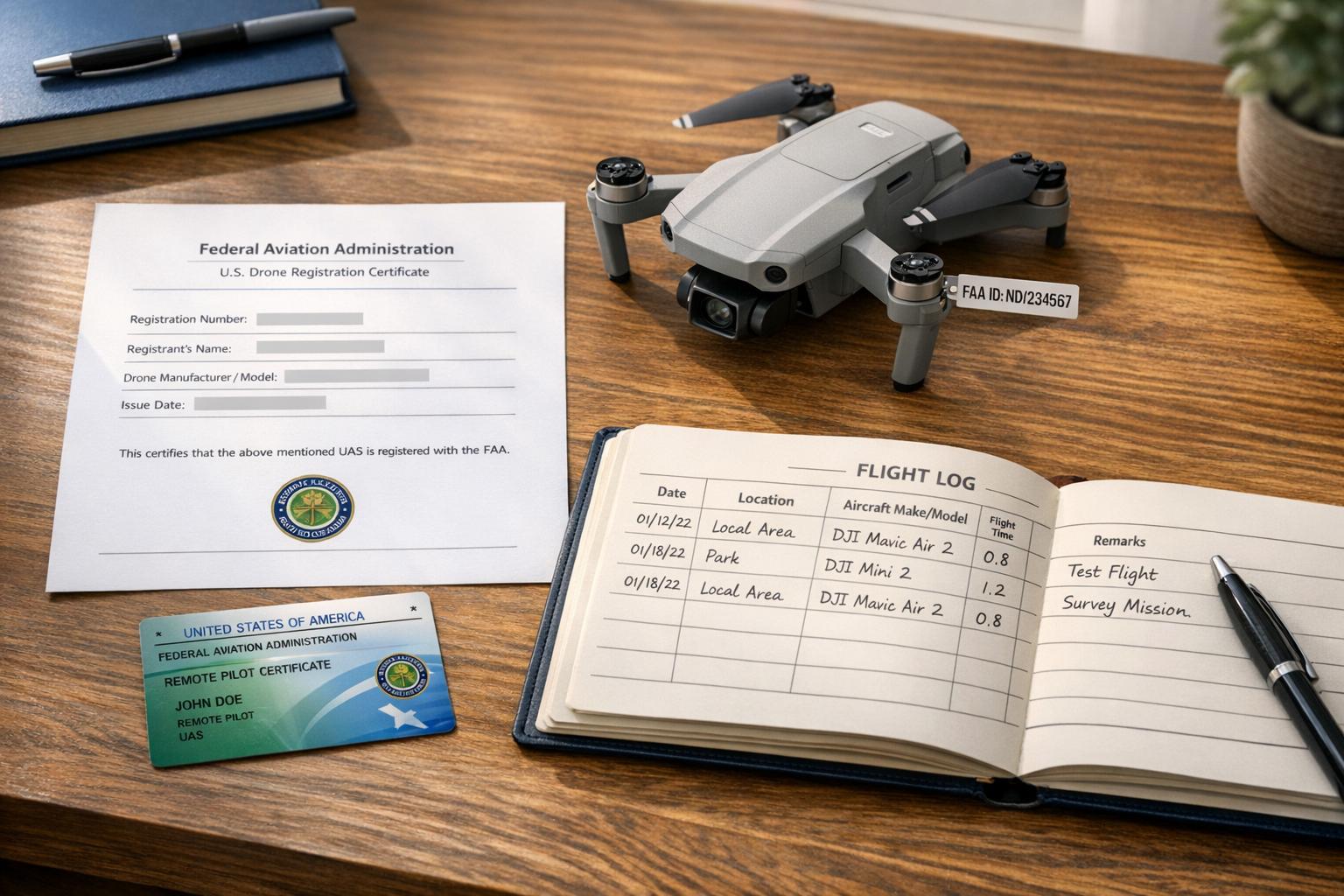
Flying drones legally in the U.S. requires more than just passing a test or registering online. You need proper documentation to comply with FAA regulations. Missing records like your registration, pilot certificate, or flight logs can result in fines or penalties. Here's what you need:
- Drone Registration Certificate: Register each drone via the FAA DroneZone portal. Recreational users pay $5 for three years, while Part 107 operators register each drone individually. Keep this certificate accessible during flights.
- Visible Registration Number: Display the registration number on the drone's exterior using stickers, engraving, or markers.
- Remote Pilot Certificate: Required for non-recreational flying. Pass the FAA Part 107 test and carry both the certificate and a government ID.
- Flight Logs: Track flight dates, times, drone details, locations, and airspace classifications. Maintain these logs for 12–24 months.
- Maintenance Records: Document repairs, inspections, and preflight checks to ensure safe operation.
- Waivers and Authorizations: Special operations (e.g., flying at night or in restricted airspace) may need FAA-approved waivers or real-time airspace authorizations via LAANC.
- Accident Reports: Report incidents involving injuries or $500+ property damage within 10 days via FAADroneZone.
Digital tools simplify compliance. Use centralized storage, automated deadline reminders, and platforms like Anvil Labs to keep records organized and accessible. Staying prepared helps avoid penalties and ensures safe operations.

Essential FAA Drone Documentation Checklist
FAA Drone Document Rules - What do You Need ?
sbb-itb-ac6e058
Required FAA Documents for Drone Operations
Flying a drone in the U.S., whether for recreation or under Part 107 commercial rules, comes with specific paperwork requirements. These documents prove your compliance with FAA regulations and must be available for inspection by officials or law enforcement. Without them, you could face fines or other penalties.
Drone Registration Certificate
To get your Drone Registration Certificate, use the FAA DroneZone portal. You'll need to provide details like your address, email, phone number, drone make/model, and the manufacturer's Remote ID serial number. Registration is open to U.S. citizens or legal permanent residents who are at least 13 years old.
The process differs slightly depending on your purpose for flying. Recreational users pay a one-time $5 fee that covers all drones over 0.55 lbs (250 grams) for three years. Meanwhile, Part 107 operators must register each drone individually, also at $5 per drone. Always have your registration certificate - either digital or printed - on hand during flights, as federal law mandates you present it upon request.
Registration Number Display Requirements
The FAA requires your drone's registration number to be visible on its exterior. Numbers hidden inside battery compartments are no longer acceptable. You can use permanent markers, stickers, or engraving to ensure the number is clearly displayed. This visibility helps officials or law enforcement identify the drone's owner, especially in cases of unsafe operation or restricted airspace violations.
Recreational flyers typically use one registration number for all their drones, while Part 107 operators must assign a unique number to each drone.
Remote Pilot Certificate and ID
If you're flying a drone for business, government work, or any other non-recreational purpose, you’ll need a Remote Pilot Certificate with a small UAS rating. To qualify, you must:
- Be at least 16 years old.
- Create a profile in the FAA's IACRA system to get an FAA Tracking Number.
- Pass the Unmanned Aircraft General – Small (UAG) Knowledge Test at an approved testing center.
After passing the test, complete FAA Form 8710-13 through IACRA to receive your certificate.
When operating your drone, carry the Remote Pilot Certificate along with a government-issued ID in physical form. Officials from the FAA, NTSB, TSA, or law enforcement can request these documents at any time. To keep your certificate valid, you must meet the aeronautical knowledge recency requirements outlined in § 107.65.
Next up, explore the additional documentation needed for specific scenarios, such as waivers or maintenance records.
Situation-Specific Documentation
Once you've nailed down the basics, it's time to dive into documentation that caters to specific operational needs. Beyond simple registration and pilot certification, certain drone operations demand extra paperwork to comply with FAA regulations.
Waivers and Special Authorizations
Operational waivers allow you to bypass certain Part 107 rules, provided you can prove your operation remains safe through alternative measures. Typical waiver scenarios include flying beyond visual line of sight, managing multiple drones at once, or operating from a moving vehicle. Most waiver requests are handled through the FAA's Aviation Safety Hub, while airspace authorizations for controlled airspace are processed via FAADroneZone or LAANC.
When applying for a waiver, you’ll need to outline your planned operation, identify potential risks, and explain how you’ll mitigate them. The FAA generally reviews waiver applications within 90 days of submission. If they need more details, you’ll have 30 days to respond - otherwise, your application will be canceled. Before applying for waivers to fly at night or over people, check if your drone meets the "Operations Over People" rule requirements (Categories 1-4). If it does, you might not need a waiver at all.
For airspace authorizations, LAANC offers near real-time approvals at over 726 airports and 530 FAA ATC facilities. Start with LAANC-enabled apps for quicker approval before resorting to manual requests through FAADroneZone. Once you secure these special permits, keep detailed records of your drone's maintenance and performance.
Maintenance and Inspection Records
Preflight inspections and maintenance logs are essential for safe drone operations. The Remote Pilot in Command must ensure the drone is in good working condition before every flight.
"No person may operate a civil small unmanned aircraft system unless it is in a condition for safe operation. Prior to each flight, the remote pilot in command must check the small unmanned aircraft system to determine whether it is in a condition for safe operation." - 14 CFR § 107.15
Maintain a maintenance log to document repairs, replacements, and updates. Record preflight checks, including control links, battery levels, and external load security. Monitor the usage time of critical components like propellers and batteries, replacing them as recommended by the manufacturer. These logs should cover the entire system - aircraft, communication links, and control components. You can store these records either digitally or on paper.
Flight Logs and Accident Reports
While the FAA doesn’t require a specific logbook format, you must keep records that demonstrate compliance. Your flight logs should include:
- Date, time, and duration of the flight
- Pilot in Command
- Drone make/model and registration number
- Location and airspace classification
- Mission purpose
Retain these logs for 12–24 months. Additionally, document weather conditions (like METARs or TAFs) to support incident reports. Keep maintenance records throughout the drone's service life. Many electronic or app-based flight logs can automatically track telemetry data - such as altitude, speed, and battery status - that would be tedious to log manually.
Accident reporting is required for incidents involving serious injury, loss of consciousness, or property damage (excluding the drone itself) exceeding $500. Reports must be submitted via FAADroneZone or your local Flight Standards District Office within 10 calendar days of the incident. Include key details such as the date, time, location, aircraft involved, nature of the event (e.g., flyaway or loss of control), and corrective actions taken.
Digital Documentation Management Tools
Keeping track of FAA paperwork doesn’t have to mean drowning in physical files. Digital tools make it easier to organize everything - registration certificates, flight logs, maintenance records, and waivers - while keeping you ready for inspections.
Centralized Storage Systems
Having all your FAA documents stored securely in one digital location turns compliance into a manageable task. A centralized system ensures your records are easy to access and meet FAA standards for legibility and on-demand retrieval. This means you can pull up your registration certificate, pilot credentials, or flight authorizations directly from your phone or tablet - no need for complicated software.
"If records cannot be accessed or understood on demand, the FAA may treat them as unavailable." - Paul Aitken, Co-Founder and CEO, Drone U
Digital storage also eliminates the risk of misplaced paperwork. Automated backups safeguard your records from device failures. For organizations managing multiple drones and pilots, centralized platforms allow you to assign roles like “Part 107 Administrators” or “Inventory Managers” to oversee your UAS inventory, waivers, and accident reports - all from one dashboard. These systems integrate easily with your overall compliance workflow, making them a practical choice.
Compliance Deadline Tracking
Missing a renewal or deadline can ground your operations quickly. Automated tracking systems monitor key dates for renewals and training, sending you reminders and ensuring compliance with FAA retention schedules. For instance, drone registration renewals cost $5 per aircraft and are required every three years.
Different types of records have varying retention requirements: flight logs need to be kept for 12–24 months, while maintenance records must be retained for the entire service life of your aircraft. Digital platforms take the guesswork out of this process by archiving records according to FAA timelines and notifying you when it’s safe to delete outdated files. For incident reports, which must be filed within 10 calendar days of a qualifying accident, automated alerts help you meet deadlines without the last-minute rush.
Anvil Labs for Documentation Management

Anvil Labs takes things a step further by combining spatial data with compliance records. If you’re already using the platform for hosting 3D models, orthomosaics, or thermal imagery from drone surveys, you can seamlessly integrate your compliance documentation alongside this data. The platform’s secure sharing features let you provide FAA inspectors or clients with view-only access to specific documents, keeping the rest of your project library private.
The platform’s cross-device accessibility ensures you can access your records whether you’re in the office or out in the field. Need to prove you had authorization for a controlled airspace flight? Just pull up the linked record. Want to attach maintenance notes to a specific asset inspection? Anvil Labs’ annotation tools let you connect documentation directly to the 3D models or site data you’ve captured. This integration simplifies compliance workflows, keeping everything organized in one place.
Conclusion
Staying on top of FAA compliance means keeping your drone documentation in order. Key items like your registration certificate, Remote Pilot Certificate, and flight logs are essential for demonstrating that your operations are both legal and responsible. Having well-organized records not only helps during inspections but also proves your aircraft was in good condition before any incident.
Compliance isn’t just a formality - it’s a safeguard. Federal law requires you to provide documentation to law enforcement upon request, and failing to do so can lead to serious consequences. Beyond avoiding fines, maintaining detailed records - such as maintenance logs and incident reports - shows your dedication to operating safely.
Digital tools can make this process easier by providing legible, timestamped records that are accessible from any device. Features like automated deadline reminders help ensure you never miss important dates, such as renewing your $5 three-year registration or reporting an accident within the required 10-day window. For those managing multiple drones or pilots, centralized platforms simplify compliance by keeping everything organized in one place. These tools not only make staying compliant easier but also enhance overall safety.
While the FAA doesn’t demand perfection, it does require you to demonstrate compliance when necessary. Keeping clear, accessible, and audit-ready records - whether through basic digital storage or platforms like Anvil Labs - can prevent small issues from turning into bigger problems.
FAQs
What happens if I don’t have the proper FAA drone documentation?
Failing to keep up with the necessary FAA drone documentation can lead to serious repercussions. Civil fines can climb as high as $27,500, while criminal penalties might include fines up to $250,000 and/or up to three years in prison.
To steer clear of these hefty penalties, make sure your documentation is in order. This includes things like drone registration, any required waivers, and operational records. Staying compliant with FAA regulations not only helps you avoid trouble but also ensures your drone operations are both safe and legal.
How do digital tools simplify FAA compliance for drone operations?
Digital tools simplify staying compliant with FAA rules by automating and streamlining critical processes. They handle tasks like drone registration, airspace authorizations, and operational waivers, ensuring forms are submitted on time and documents are stored securely. Using a centralized platform, operators can manage key paperwork, including registration certificates, Part 107 waivers, and remote ID declarations, while also receiving timely reminders for renewals or updates.
Beyond document management, specialized software can monitor flight logs, maintenance records, and crew qualifications, automatically aligning them with FAA regulations. These tools can even flag potential compliance issues, such as unauthorized airspace usage, and assist in addressing them quickly. By consolidating all compliance-related information into one system, digital tools cut down on paperwork, enhance audit preparation, and allow operators to focus on safe and legal drone operations.
When do I need additional FAA waivers or authorizations for drone operations?
If you're planning specialized drone operations, you might need extra FAA waivers or authorizations. These are necessary for activities like flying beyond visual line of sight, over people, or at night, especially when the Operations Over People rule doesn't apply. You'll also need waivers for flights in controlled airspace, above 400 feet in Class G airspace, or when operating foreign-registered drones.
Certain advanced missions also call for waivers. These include tasks like emergency response, chemical or agricultural spraying, package delivery, or working with unmanned traffic management (UTM) systems. Always review FAA regulations carefully to make sure you're meeting the requirements for your specific operation.

.svg)


