


Digital twins are transforming how we predict and manage wind loads on structures like turbines, bridges, and buildings. These virtual models replicate physical assets in real time, using data from sensors to simulate performance and forecast stress or fatigue. Here’s why they matter:
- Cost Savings: Offshore wind turbine inspections can cost over $20,000 per turbine. Digital twins reduce this by offering virtual monitoring.
- Improved Accuracy: Studies show digital twins can estimate fatigue loads with 10%–15% accuracy compared to physical sensors.
- Faster Analysis: Reduced-order models (ROMs) process complex simulations up to 300 times faster than traditional methods.
- Predictive Maintenance: They enable condition-based maintenance, cutting downtime and lowering energy costs by 5%–10%.
Recent applications include monitoring offshore platforms, using AI to predict wind speeds, and integrating real-time data for structural health tracking. Challenges like computational demands and data integration remain, but advancements in AI and sensor technology are addressing these issues. Digital twins are a practical tool for safer, more efficient wind energy operations.
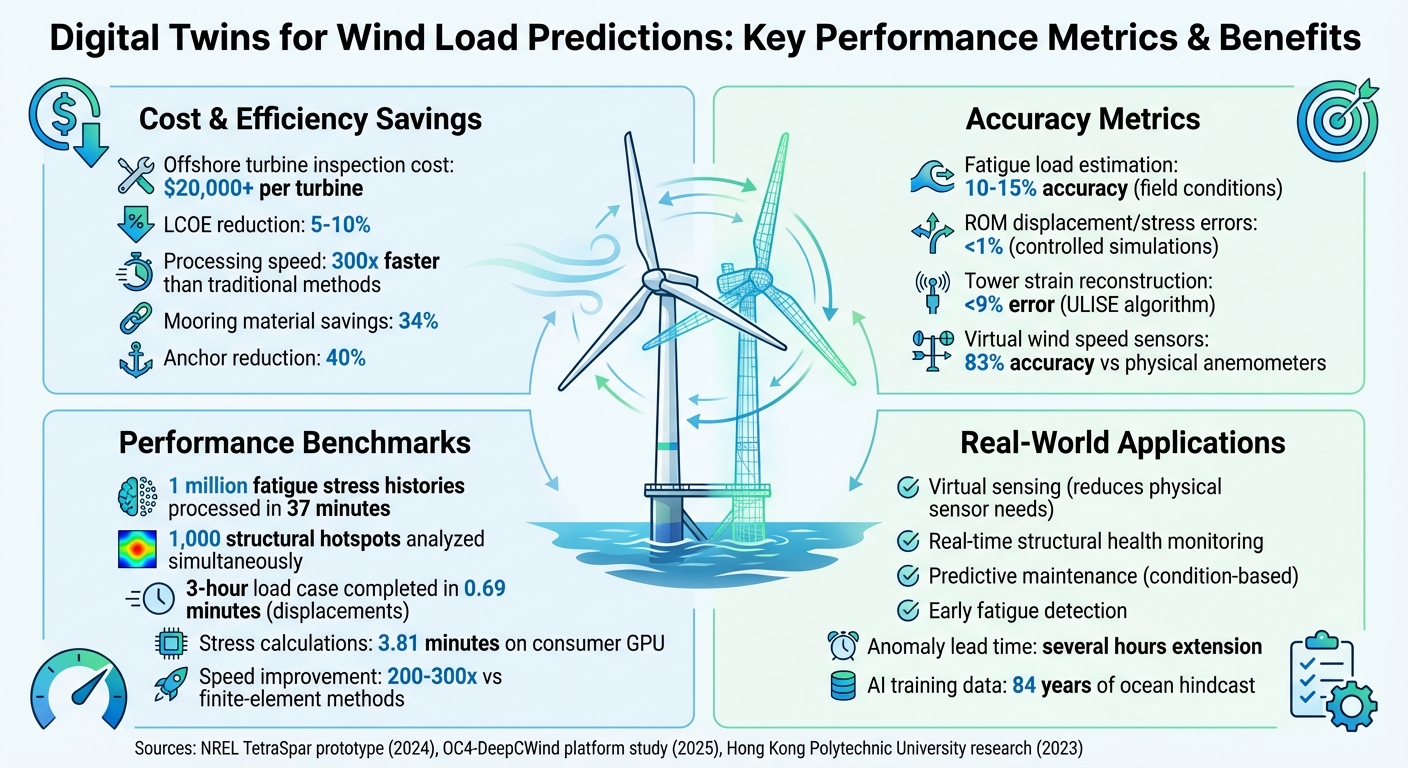
Digital Twin Performance Metrics and Benefits for Wind Energy Structures
Recent Research on Digital Twins for Wind-Resistant Structures
AI-Powered Digital Twins for Wind Turbines
In January 2024, Emmanuel Branlard and his team at the National Renewable Energy Laboratory (NREL) introduced a digital twin for the TetraSpar floating prototype located off the coast of Norway. This system utilized a Kalman filter in combination with OpenFAST linearization, enabling it to predict tower loads without relying on extensive sensor networks. When tested against the actual prototype, the digital twin demonstrated an accuracy range of 10% to 15% in estimating damage equivalent loads.
"The accuracy of the results appears promising and demonstrates the possibility to use digital twin solutions to estimate fatigue loads on floating offshore wind turbines." – Emmanuel Branlard, National Renewable Energy Laboratory
Another noteworthy development came in 2023, when researchers from Hong Kong Polytechnic University and Southeast University applied the Unified Linear Input and State Estimator (ULISE) algorithm to a 1:50 scaled wind turbine model. This algorithm effectively estimated unknown excitations, such as blade rotation bending moments, and reconstructed unmonitored dynamic responses using limited sensor data. The results showed impressive performance, with tower strain and acceleration responses reconstructed with a normalized root mean square error of less than 9%.
Wind Load Reconstruction for Floating Offshore Platforms
Research on digital twins has also made strides in addressing wind loads on floating offshore platforms.
In October 2025, Andres Pastor-Sanchez and Julio Garcia-Espinosa from Universidad Politécnica de Madrid tested a real-time digital twin framework on the 5 MW OC4-DeepCWind semi-submersible platform. Their approach used a hydro-elastic reduced-order model (ROM) to process an immense dataset - one million fatigue stress histories across 1,000 hotspots and scenarios - in just 37 minutes on an NVIDIA RTX 4070 Ti GPU. The ROM delivered outstanding results, achieving relative errors below 1% when compared to full finite-element models, while operating over 200 times faster.
sbb-itb-ac6e058
AI Techniques and Methods for Wind Load Prediction
Multi-Physics Simulations with Data Integration
Digital twins shine when they combine multi-physics simulations with real-time sensor data from SCADA systems and structural health monitoring networks. By using Kalman filters, these systems can integrate live measurements - like power output, pitch angle, rotor speed, and tower acceleration - to estimate loads in areas without physical sensors.
Reduced-order models (ROMs) play a key role in this process by simplifying complex finite-element models, which often involve millions of degrees of freedom, into just a few structural modes. This compression allows for real-time calculations without compromising accuracy. For example, a hydro-elastic ROM applied to the 5 MW OC4-DeepCWind platform completed a three-hour load case for displacements in 0.69 minutes and stresses in 3.81 minutes using a consumer-grade GPU. This seamless integration sets the stage for further data simplification techniques.
Dimensionality Reduction in Deep Learning
Dimensionality reduction techniques streamline massive wind and structural datasets into forms that can be processed in real time. Filter methods focus on identifying and retaining the most critical features from high-dimensional sensor data streams, reducing computational overhead. Meanwhile, projection-based ROMs use modal response amplitude operators (MRAOs) to transform complex hydrodynamic and aerodynamic loads into generalized modal coordinates. This enables quick reconstruction of full-field displacements and stresses across entire structures.
The efficiency gains are impressive. For instance, analyzing one million fatigue stress histories across 1,000 structural hotspots and operating scenarios took a ROM just 37 minutes - a speed-up of nearly 300 times compared to traditional methods. This capability makes continuous structural health monitoring and rapid "what-if" assessments feasible for offshore wind farms. These reductions pave the way for hybrid physics-AI models that further enhance predictive accuracy.
Hybrid Physics-AI Models
Hybrid models merge the strengths of physics-based simulations with AI's pattern-recognition capabilities, offering a powerful tool for wind load prediction. In December 2025, a team led by Mahtab Shahin from Tallinn University of Technology showcased this approach on a 10-turbine floating wind farm in the Azores. By integrating OpenFAST physics simulations with Long Short-Term Memory (LSTM) neural networks trained on 84 years of ocean hindcast data, they achieved remarkable results: a 40% reduction in required anchors, 34% savings in mooring materials, and extended anomaly detection lead times by several hours.
"The AI component provides actionable early warnings for preventive interventions under extreme sea states, extending anomaly lead times by several hours." – Mahtab Shahin, Estonian Maritime Academy
Benefits, Challenges, and Performance Comparisons
Comparing Benefits and Challenges
Virtual sensing offers a way to cut back on the need for large-scale physical instrumentation. Digital twins bring a cost-efficient solution for virtual sensing and real-time monitoring, but they come with their own set of hurdles, such as computational demands and data integration difficulties. Real-time structural health monitoring provides continuous updates on fatigue states, allowing for early detection of damage before it escalates into catastrophic failures. This shift from routine inspections to condition-based maintenance has the potential to lower the levelized cost of energy (LCOE) by 5% to 10%.
That said, implementation is far from straightforward. Computational overhead remains a challenge - high-fidelity physics models often lack the speed needed for real-time applications unless significant reduction techniques are applied. Data integration is another sticking point, as synchronizing high-frequency sensor data with complex simulation engines can be incredibly tricky, especially in the harsh conditions typical of offshore environments. Additionally, data-driven models might miss critical physics, leading to unsafe predictions under extreme scenarios.
| Benefit | Impact | Challenge | Impact |
|---|---|---|---|
| Virtual sensing | Cuts down on the need for physical sensor arrays | Computational demands | High-fidelity models require reductions for real-time use |
| Real-time monitoring | Detects fatigue early | Data integration complexity | Synchronizing sensor data with simulations is difficult |
| Predictive maintenance | Extends turbine lifespan, reduces downtime | Physical fidelity risks | Data models may miss critical physics in extreme conditions |
| 5–10% LCOE reduction | Improves operational efficiency | Material complexity | Composite fatigue requires extensive testing |
These benefits and challenges highlight the trade-offs involved and set the stage for a closer look at how digital twins perform in real-world applications.
Performance Metrics from Research Studies
Recent studies have showcased the potential of digital twins, delivering notable performance improvements while acknowledging some accuracy limitations. For instance, in October 2025, researchers tested a digital twin framework on the 5 MW OC4-DeepCWind semi-submersible platform using an NVIDIA RTX 4070 Ti GPU. The reduced-order model processed one million fatigue stress histories across 1,000 structural hotspots in just 37 minutes - a speed improvement of roughly 300 times compared to traditional finite-element methods. The system achieved relative errors below 1% for displacements and stresses in controlled simulations. These results demonstrate that digital twins are well-suited for making real-time operational decisions.
However, field data paints a slightly different picture. In January 2024, NREL and Stiesdal Offshore tested a physics-based digital twin on the full-scale TetraSpar prototype off the coast of Norway. Numerical experiments showed 5% to 10% error rates, while actual field measurements revealed 10% to 15% variance for tower fore-aft bending moments. Virtual wind speed sensors performed with about 83% accuracy compared to physical anemometers, with mean absolute error values ranging from 0.26 to 0.57 in controlled tests. These findings suggest that while digital twins provide real-time capabilities with acceptable accuracy for operational decisions, they still fall short of the precision offered by offline high-fidelity simulations.
Practical Applications and Future Developments
Real-Time Structural Monitoring
Digital twins are reshaping how we monitor structures, shifting from periodic inspections to continuous tracking. By blending sparse sensor data with physics-based models, these systems act like virtual sensors, offering insights into areas where physical monitoring isn’t feasible or cost-effective. For example, in offshore wind turbines, this technology helps track tower fatigue, mooring-line tensions, and platform displacements as environmental conditions shift throughout the day.
This is made possible by reduced-order models (ROMs), which simplify complex finite-element simulations into faster, more responsive tools. A 2025 study on the 5 MW OC4-DeepCWind platform showed how ROMs make real-time monitoring not just possible but efficient. Data streams from accelerometers, GPS units, and SCADA systems are fed into Kalman filters, which continuously update the digital twin. This allows operators to spot vibration anomalies or structural issues early, preventing potential failures.
Predictive Maintenance and Cost Reduction
Digital twins are also revolutionizing predictive maintenance, a game-changer for cutting operation and maintenance (O&M) costs, which make up 30% to 34% of wind power’s levelized cost of electricity. By forecasting wear and estimating remaining useful life, operators can plan repairs during low-wind periods, reducing downtime and avoiding costly emergency fixes.
"Predictive maintenance goes a long way in eliminating unexpected downtime and preventing catastrophic failures by taking action before small faults can get out of hand." - IEEE Access
The TetraSpar prototype, deployed off Norway’s coast in November 2021, showcased this in action. Researchers from NREL and Stiesdal used a physics-based digital twin to estimate tower fatigue loads with an accuracy of 10% to 15% compared to real-world measurements. Using tools like Kalman filters and OpenFAST linearization, the system tracked aerodynamic loads and structural health, providing valuable insights for maintenance planning. This approach not only helps reduce energy costs by 5% to 10% but also boosts global wind energy production. Even a 1% increase in output could generate over 30 terawatt hours of additional electricity annually.
Future Developments in AI and Sensor Integration
Looking ahead, hybrid physics-AI modeling is set to take digital twins to the next level. This approach combines the physical accuracy of reduced-order models with the pattern recognition and speed of machine learning. Tools like physics-informed neural networks (PINNs) are leading the charge, allowing AI models to adhere to physical laws while improving their ability to generalize beyond training data. The goal? Level 5 autonomous digital twins that can optimize performance and even schedule repairs without human intervention.
Sensor technology is also advancing rapidly. Low-cost MEMS sensors are making high-precision monitoring more accessible, while computer vision systems like Digital Image Correlation (DIC) can measure tower dynamics without direct contact. A great example is the Aerosense project, which in November 2024 demonstrated a "Digital Shadow" twin for aerodynamic monitoring on a 6 kW Aventa AV-7 wind turbine in Switzerland. Using MEMS sensors, the system monitored real-time wind speeds and angles of attack.
"The main transformative aspect of a digital twin is to improve the predictive capability of a system by augmenting computational models with data to create a virtual prediction tool that can evolve over time." - Yuriy Marykovskiy, Researcher, ETH Zürich
Cloud-based IoT platforms are making it easier to integrate high-frequency sensor data with visualization tools and automated analytics. This allows for fleet-wide monitoring and "what-if" scenario testing. As these technologies develop, digital twins will transition from diagnostic tools to prescriptive systems, offering actionable recommendations based on probabilistic risk assessments.
R&D Test Systems: Digital Twins for Wind Turbine Testing
Conclusion
Digital twins are reshaping how wind load prediction and management are handled. By blending physics-based models with real-time sensor data, they enable continuous structural health monitoring - something that would have been unthinkable just a few years ago. Studies highlight their accuracy, achieving finite-element precision (error <1%) while being over 200 times faster.
These systems also drive down the levelized cost of energy by 5%–10% through smarter maintenance strategies and reduced downtime. Considering that routine offshore turbine inspections can cost upwards of $20,000 each, the ability to remotely monitor structural health is a game-changer for project economics.
The financial and operational benefits are clear. For instance, the OC4-DeepCWind project processed one million fatigue stress histories in just 37 minutes using consumer-grade hardware. This isn't just theoretical - it’s been validated in full-scale, real-world deployments.
For engineers and project managers, the next steps are straightforward: embrace reduced-order modeling, utilize virtual sensing, and transition to condition-based maintenance. These advancements have moved beyond research and now offer practical, measurable improvements in safety, efficiency, and cost management. They also lay the foundation for future autonomous performance systems.
As hybrid physics-AI models and advanced sensors continue to evolve, digital twins will shift from being diagnostic tools to systems capable of optimizing performance autonomously. The real question is no longer if this technology should be adopted, but how soon you can integrate it into your operations. In an industry where margins are tight and structural failures can be catastrophic, staying ahead with this technology is critical.
FAQs
What data do I need to build a wind-load digital twin?
To build a wind-load digital twin, you’ll need two main components: measurement data and model-based inputs. The measurement data typically includes turbine-specific metrics like power output, pitch, rotor speed, and tower acceleration. For offshore platforms, motion sensors such as inclinometers and GPS devices provide crucial readings.
On the model side, physics-based tools - such as aerodynamic and structural models - combine with this data to simulate wind loads and how the structure responds. Advanced techniques, like Kalman filters, play a role in estimating the structural states, enabling accurate real-time predictions.
How accurate are digital twins in real offshore conditions?
Digital twins used in offshore environments show a high level of reliability, with predicted damage loads varying only about 5% to 15% from actual measurements. This accuracy underscores their effectiveness in predicting wind loads under practical conditions.
What’s the fastest way to get real-time wind load predictions?
The quickest method involves using a physics-based digital twin. These models integrate turbine data - such as wind speed, power output, and structural sensor readings - with advanced tools like Kalman filters and virtual sensing. To ensure precision and dependability, the results are cross-checked using full-scale prototypes.

.svg)


