

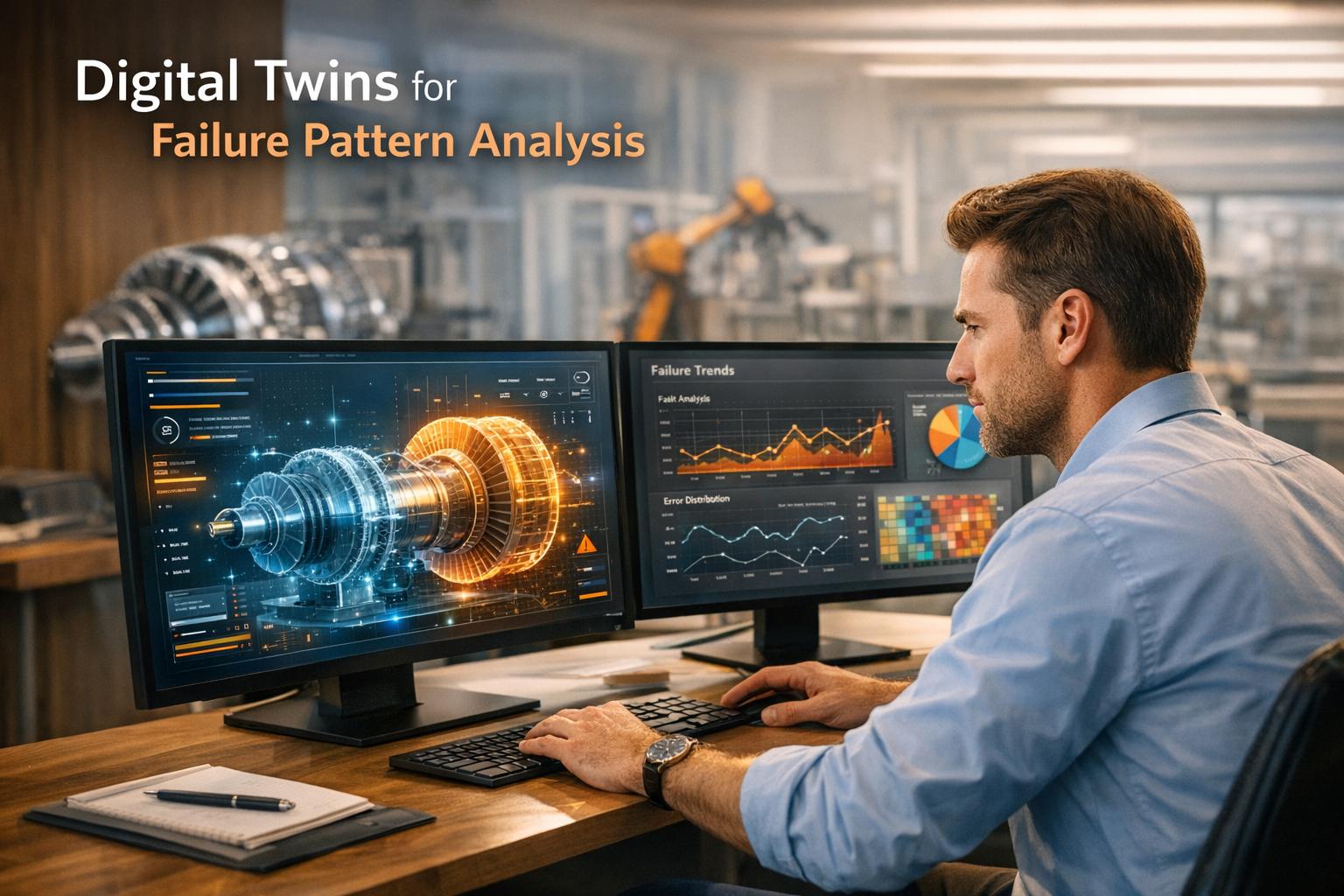
Digital twins are transforming how industries manage equipment failures. These virtual replicas of physical assets use real-time data to predict issues, simulate fault scenarios, and optimize maintenance strategies. By identifying failure patterns early, they help prevent costly downtime and improve operational reliability.
Key Insights:
- What They Do: Digital twins mimic physical systems, enabling real-time monitoring and failure prediction.
- How They Help: They shift maintenance from reactive to predictive by simulating failures and generating synthetic data.
- Methods Used: Two main approaches - physics-based models (rely on physical laws) and data-driven models (use AI and historical data).
- Real-World Examples: Sheremetyevo Airport saved $120M using digital twins; Argonne Lab distinguished sensor errors from actual failures in real time.
- Future Potential: Advances like system-wide integration and bi-directional data flow will further enhance their impact.
Digital twins combine sensor data, simulations, and predictive algorithms to revolutionize maintenance workflows. Whether it's estimating an asset's remaining useful life or providing real-time repair guidance, this technology is a game-changer for industrial operations.
Predictive Maintenance: Getting the most out of your Digital Twin
Methods for Recognizing Failure Patterns

Physics-Based vs Data-Driven Digital Twin Failure Analysis Methods Comparison
Physics-Based Model Analysis
Physics-based models rely on mathematical equations grounded in physical laws to simulate how industrial systems behave under various conditions. These models predict how assets should ideally function, offering a framework for identifying deviations.
Take the example from March 2025: researchers at Shenyang Aerospace University developed a digital twin for rolling bearings using a five-degree-of-freedom (5-DoF) dynamic model. This system simulated both healthy and defective states by calculating contact forces when components entered a "spalling zone." This approach generated synthetic data to address the lack of real-world failure samples. Why focus on bearings? Because they account for 45–55% of all industrial equipment failures.
"The model-based method... relies on mathematical models of a physical system that simulate its behavior that can be derived from first principles or can be developed using data-driven techniques." - MDPI Sensors
One major advantage of these models is their ability to create synthetic failure data, which eliminates the need for costly and risky physical tests. For instance, in September 2023, Argonne National Laboratory used an engineering digital twin for their liquid sodium facility. This system successfully diagnosed component failures in real time and distinguished between sensor degradation and actual component issues.
While physics-based models excel at simulating failures, data-driven approaches take a different route by analyzing historical and real-time sensor data for deeper insights.
Data-Driven Analysis Methods
Data-driven methods harness machine learning and AI to find hidden patterns in sensor data, without relying on physical equations. These techniques are particularly effective at uncovering correlations that traditional methods might miss.
In 2022, researchers working with Wärtsilä's 9L50DF marine engine combined data-driven models with thermodynamic analysis to detect sensor abnormalities. The system achieved an error margin of just 1.1% in identifying sensor irregularities. Similarly, MathWorks created a predictive maintenance workflow for a triplex pump by simulating 200 scenarios, including blocked inlets and seal leaks. Their machine learning model successfully identified seven distinct failure combinations using only outlet pressure data.
The distinction between physics-based and data-driven methods boils down to interpretability versus data requirements. Physics-based models explain why a failure happens, while data-driven models can detect patterns without understanding the underlying causes. However, data-driven methods demand large datasets to perform effectively. A hybrid approach, combining both methods, demonstrated 97.13% accuracy in diagnosing crack types in cylindrical rolling bearings at the Ulsan Industrial AI Lab in 2021.
| Feature | Physics-Based | Data-Driven |
|---|---|---|
| Primary Source | Mathematical equations from first principles | Historical and real-time sensor data |
| Data Dependency | Low (can simulate its own data) | High (requires extensive datasets) |
| Best Use Case | Rare failures, new designs | Routine monitoring, systems with abundant data |
| Interpretability | High (explains "why" failures occur) | Lower (often acts as a "black box") |
Both approaches have their strengths, but they share a common foundation: the integration of robust sensor data, which is critical for accurate failure analysis.
Integrating and Processing Sensor Data
Incorporating diverse sensor data significantly enhances a digital twin's ability to detect and analyze failure patterns. This includes vibration sensors for spotting mechanical wear, thermal cameras for identifying overheating components, and LiDAR scans for capturing precise structural changes. The real challenge lies in processing this varied data to uncover meaningful insights.
Modern systems address this by using combined noise models that simulate real-world measurement errors. When physical sensors are too expensive or inaccessible, digital twins can rely on "virtual sensors" to calculate system-level data. For instance, a robot's end-effector trajectory can be determined using motor position data.
"By the fusion analysis of multiple data sources, DT model can reveal hidden patterns and correlations behind the data. Accordingly, clearer insights of fault mechanisms and propagation paths can be derived." - Scientific Reports
One practical example comes from the Devonport Royal Dockyard in the UK. Here, a digital twin framework monitors five interconnected air compressors, providing operators with real-time guidance on fault repairs based on continuous performance feedback.
Building Digital Twins for Industrial Assets
Collecting Data and Creating Models
The first step in building digital twins is creating a detailed CAD model and collecting IoT sensor data. Tools like laser scanners, such as the CyberGage 360, can capture precise dimensions, while sensors track metrics like temperature, vibration, and other operational data.
To establish performance benchmarks, it's crucial to incorporate manufacturing guidelines, inspection records, and design specifications. Before analysis, sensor data must go through cleaning and feature engineering to ensure accuracy and usability.
A practical example comes from September 2023, when SEACOMP, an electronics manufacturer, used Matterport to create digital twins of their production lines and offices. These virtual walkthroughs helped the company cut $250,000 in annual travel costs by reducing the need for on-site visits. Similarly, Northumbrian Water in the UK integrated 3D Matterport scans into their Building Information Modeling (BIM) system. This allowed them to combine 3D assets with a 2D legacy platform, minimizing the need for physical site visits.
To dive deeper into sensor data, techniques like Fast Fourier Transform (FFT) are used to extract critical features for machine learning applications. For instance, a study on ACME bolt failures demonstrated how machine learning models integrated with digital twins achieved 100% accuracy in predicting failures using real-time data. This kind of precision sets the stage for dynamic, real-time synchronization of digital twins.
Syncing Digital Twins with Real-Time Data
Real-time data takes digital twins from static models to dynamic systems that can monitor and respond to changes as they happen. This two-way feedback loop is what sets digital twins apart from simple 3D models.
"Real-time data enables agile feedback and adjustment of the DT model, allowing immediate response to failures in practical engineering scenarios." - Scientific Reports
Live data not only updates asset conditions but also enhances failure detection by refining analysis mechanisms. This is especially valuable in distinguishing between sensor malfunctions and actual component issues, which can significantly reduce false alarms. For example, in September 2023, researchers at Argonne National Laboratory's Mechanisms Engineering Test Loop (METL) facility used an engineering digital twin to monitor a liquid sodium purification system. The system successfully identified real-time component failures while distinguishing them from sensor errors.
Real-time syncing also adjusts for environmental changes like temperature fluctuations or fluid viscosity, improving the reliability of fault detection algorithms under varying conditions. Despite these advantages, only about 30% of scientific papers on digital twin-driven prognostics currently incorporate real-time data approaches, highlighting a vast opportunity for broader adoption. Platforms like Anvil Labs offer solutions to keep models updated and ensure seamless integration for actionable insights.
Using the Anvil Labs Platform

Anvil Labs simplifies the management of complex data required for high-fidelity digital twins, including 3D models, LiDAR scans, thermal imagery, 360° panoramas, and orthomosaics.
The platform integrates data from multiple sources into a unified view, accessible across devices. Maintenance teams can review models on-site or remotely, annotate issues, and securely share information. It also supports integrations with Matterport, AI tools, and task management systems, streamlining workflows from issue detection to resolution.
For $99 per month, the Asset Viewer plan provides hosting, management, and collaboration tools. Teams handling large-scale industrial scans can opt for additional data processing at $3 per gigapixel. This level of integration speeds up failure detection and promotes proactive maintenance, ensuring smoother operations.
sbb-itb-ac6e058
Using Failure Pattern Analysis to Improve Maintenance
Identifying Patterns Through Historical Comparisons
Digital twins play a key role in maintenance by comparing real-time sensor data against an ideal baseline. This process helps identify deviations that signal potential issues before they escalate into costly failures.
By continuously monitoring metrics like vibration, temperature, and pressure, these systems detect unusual patterns and flag them for review. One of the standout features is their ability to differentiate between sensor degradation and actual component failure. This ensures that maintenance teams receive a prioritized list of potential problems, reducing false alarms and eliminating the trial-and-error approach that often wastes time and resources.
Another advantage of digital twins is their ability to simulate rare fault conditions without disrupting production. Using synthetic data, they train predictive algorithms to recognize potential issues. During an 18-month industrial evaluation, digital twin technology successfully identified maintenance needs in 33 out of 47 instances, proving its reliability in practical settings.
"The application of DT in PHM can enhance the comprehensiveness, depth, accuracy, and interpretability of fault analysis, providing optimized support for the operation and maintenance of industrial assets." - Nature Scientific Reports
This constant monitoring and analysis lay the groundwork for more precise and efficient maintenance scheduling.
Calculating Remaining Useful Life (RUL)
Digital twins go a step further by predicting how long an asset can continue to operate effectively. This Remaining Useful Life (RUL) estimation shifts maintenance from being reactive to proactive, allowing for strategic planning. By tracking an asset's operating conditions, digital twins can forecast when critical parameters are likely to reach their limits.
The process relies on continuous feedback synchronization, where the digital twin updates its parameters to mirror real-time changes in the physical equipment. As the asset ages and its performance shifts, the virtual model adapts, delivering more accurate predictions about when maintenance will be needed. This approach addresses a common hurdle in predictive maintenance: the lack of failure data for machines that typically operate in good condition.
"Predictive maintenance is a system's competency in distinguishing future scenarios where the machine is likely to fail, enabling timely repairs." - R. Raja Singh et al., Vellore Institute of Technology
To overcome the scarcity of failure data, digital twins generate synthetic fault scenarios through simulation. These virtual datasets allow for robust RUL calculations without waiting for actual breakdowns. The result? Maintenance is performed only when needed, avoiding both unexpected failures and unnecessary early servicing.
Sharing Data with Maintenance Teams
The insights generated by digital twins are most effective when shared seamlessly with maintenance teams. Integrated platforms, such as Mobile Enterprise Asset Management (EAM) solutions, provide technicians with real-time access to digital twin models and asset details. This eliminates delays caused by back-and-forth communication with central offices.
Platforms like Anvil Labs further enhance collaboration by enabling teams to annotate issues directly within 3D models. Technicians can add notes or tags to specific components in the virtual model, offering immediate context for others responding to alerts. This visual representation simplifies the interpretation of complex data, speeding up decision-making.
Secure data sharing also proves invaluable for organizations managing multiple facilities with similar equipment. By pooling fault data across locations, enterprises can address the challenge of limited historical records for complex assets. Additionally, these platforms often integrate with task management systems, ensuring that flagged issues automatically generate work orders. For large industrial operations, this level of coordination can mean the difference between smooth, planned maintenance and costly, unplanned downtime.
Conclusion: Digital Twins in Industrial Operations
Key Takeaways
Digital twins are reshaping industrial operations by shifting maintenance strategies from reactive to proactive. By creating real-time virtual replicas of physical assets, they address the traditional challenges of limited failure data. This approach can cut maintenance costs by as much as 50% compared to older methods. Beyond cost savings, digital twins help reduce downtime, extend the lifespan of assets, and improve overall efficiency. For instance, a UK-based project using a digital twin for voltage control reduced renewable energy curtailment by approximately 56%. Similarly, Sheremetyevo International Airport used digital twin-based forecasting to save over $120 million.
What sets digital twins apart is their ability to combine diverse data sources - geometric details, sensor data, and expert knowledge - into a single, cohesive system. This integration uncovers failure patterns that traditional methods might miss. By offering a more detailed and actionable view of asset performance, digital twins empower maintenance teams to make quicker, more informed decisions. And as the technology continues to evolve, its role in streamlining industrial operations will only expand.
What's Next for Digital Twin Technology
With demonstrated benefits like cost savings and improved maintenance efficiency, digital twins are on track to become even more integral to industrial operations. The next big step is System of Systems (SoS) applications, where entire production lines or interconnected facilities are managed through unified virtual models. This allows for global optimization across organizations. Another emerging trend is transfer learning, which enables digital twin models to adapt to different machines and environments with minimal retraining.
Between 2018 and late 2023, there were 24,724 scholarly publications on predictive maintenance using digital twins, highlighting the rapid growth of this field. The technology is also branching out beyond manufacturing, finding applications in sectors like healthcare, smart water management, and agriculture. Future advancements are expected to focus on bidirectional data flow, where virtual models not only monitor but also send control commands back to physical assets, enabling automated optimization. Platforms such as Anvil Labs are already making strides in improving collaboration through 3D visualization and secure data sharing. These developments are narrowing the gap between complex data insights and practical decision-making, making digital twin technology more accessible and actionable for industrial teams.
FAQs
How do digital twins enhance predictive maintenance in industrial operations?
Digital twins bring a new level of precision to predictive maintenance by creating virtual models of physical assets. These models use real-time data from sensors and simulations to monitor equipment performance closely. By analyzing this data, digital twins can detect patterns that signal potential failures, predict when issues might arise, and even suggest maintenance actions to address them before they become serious.
This forward-thinking approach reduces unexpected downtime, ensures maintenance is performed at the right time, and helps extend the life of industrial machinery. Armed with these detailed, data-driven insights, businesses can lower costs and streamline operations, making digital twins an essential tool in today's industrial landscape.
What’s the difference between physics-based and data-driven digital twin models?
Physics-based digital twin models are crafted using the principles of physics, engineering, and mathematics to mimic real-world systems. These models are designed to simulate how assets perform under specific conditions, providing precise insights for tasks such as failure analysis, testing new designs, and planning operations.
In contrast, data-driven digital twin models depend on real-time data collected from sensors and IoT devices. By leveraging machine learning and statistical techniques, these models identify patterns in historical and current data to predict failures, spot anomalies, and anticipate future performance. They are particularly effective for complex systems where creating a physical model isn’t practical.
The key difference lies in their approach: physics-based models prioritize simulations rooted in physical laws, while data-driven models excel at analyzing data trends for predictive insights. Together, these methods can work hand in hand to enhance failure analysis and refine predictive maintenance strategies.
How do digital twins assist in predicting an asset's Remaining Useful Life (RUL)?
Digital twins act as dynamic virtual models of physical assets, offering real-time insights through continuous monitoring and analysis. By combining sensor data with operational trends, they can pinpoint failure patterns and predict an asset's Remaining Useful Life (RUL) with impressive precision.
This predictive edge allows for smarter maintenance planning, minimizes downtime, and prolongs the life of assets - all contributing to smoother, more efficient operations.

.svg)


