

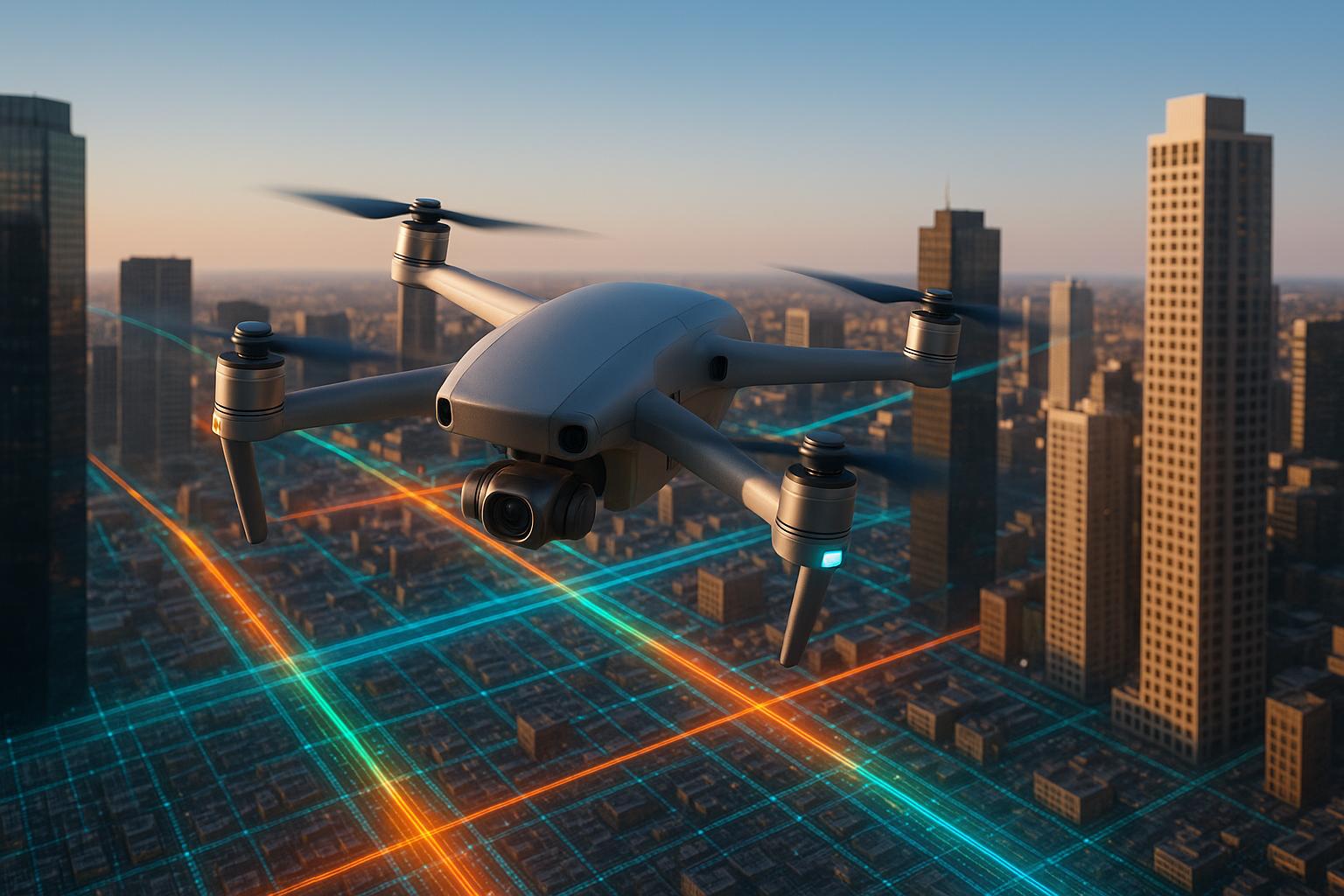
Digital twins are revolutionizing how drones navigate by creating virtual replicas of environments, enabling drones to plan and refine missions before takeoff. These systems combine AI and machine learning to simulate real-world conditions, improving accuracy and reducing risks. Key platforms like Anvil Labs, Skydio X2D, and HKUST’s SERENGETI project showcase different strengths:
- Anvil Labs specializes in processing drone-captured data into 3D models for infrastructure inspections, offering tools for analysis and collaboration.
- Skydio X2D focuses on autonomous navigation for tactical missions, using onboard AI to handle complex environments with minimal human input.
- HKUST’s SERENGETI integrates data and machine learning to refine flight simulations, aiming for certified systems in agriculture, logistics, and rescue operations.
Each platform addresses specific needs, from industrial asset management to defense applications and research-driven automation. Whether you're managing infrastructure, conducting tactical missions, or exploring certified autonomous systems, digital twins are transforming drone operations.
Mapping in digital twins for autonomous navigation in the real world - Yadunund Vijay
1. Anvil Labs

Anvil Labs offers a cloud-based platform that turns drone-captured data into actionable digital twins for industrial sites. It takes raw aerial imagery and converts it into usable 3D models, making photogrammetry more accessible through detailed spatial representations.
Data Integration
The platform supports a variety of data formats, including 3D models, 360° photos, thermal imagery, LiDAR, and orthomosaics. By leveraging AI and 3D scanning technologies, Anvil Labs creates highly accurate spatial models that can be stored and used for ongoing asset management. This compatibility with multiple formats ensures seamless integration with most drone systems.
Once data is uploaded, the platform processes it into precise spatial models, enabling teams to conduct spatial analyses and generate automated reports across industrial sites. New assets can be added continually, simplifying long-term asset management. This streamlined process ensures fast and accurate results, saving time and resources.
Anvil Labs also integrates with tools like Matterport, YouTube, AI-powered defect detection systems, and task management platforms. These integrations enhance workflows, making mission planning and analysis more efficient and effective, particularly for industrial inspections.
Application Domains
The platform shines in areas like infrastructure inspection and construction monitoring. It delivers tangible improvements, such as inspections being 75% faster than traditional methods and detecting 30% more defects using digital twin technology. Many organizations have saved hundreds of thousands of dollars by switching to this approach, with some reporting a return on investment within just two months.
"My overall experience with the software has been satisfying because of the efficient workflow. I would highly recommend other organizations to use your software simply because of how much value you get for what you pay for... The ROI is clearly marked within the first few uses." - Angel Rojas, Red Angel Drones
The platform is particularly effective for inspecting bridges, highways, building facades, and roofs. In multi-building construction projects, teams can monitor progress across entire sites by processing drone data into unified digital twins. This allows stakeholders to view up-to-date site conditions from any device, eliminating the need for physical visits.
"This is a differentiator. Those that aren't able to provide visualization but are just doing raw footage - this gives you, in my opinion, that competitive edge." - Adrian, Drone Service Provider
Anvil Labs also includes tools for annotation and measurement, enabling teams to extract precise dimensions and mark areas of interest directly within the digital twin environment. The platform’s cross-device accessibility ensures seamless collaboration, whether team members are in the field, at the office, or working remotely. Secure sharing controls further protect sensitive information during these collaborations.
For pricing, Anvil Labs offers Asset Viewer at $99/month and Project Hosting at $49/project. Additionally, data processing is available at $3 per gigapixel, catering to organizations that handle their own data capture but want to utilize the platform’s advanced processing features. These flexible pricing options make it easier for businesses to integrate digital twin technology into their workflows, optimizing drone operations for maximum efficiency.
2. Skydio's AI-powered Drone Systems
Skydio's X2D stands out as an advanced drone system that uses onboard AI to create fully autonomous digital twins. Built and assembled in the United States, this NDAA-compliant drone is trusted by the Department of Defense for tactical missions where manual operation is either impractical or too dangerous to attempt.
Autonomous Navigation Capabilities
The X2D takes care of every aspect of its flight autonomously. From setting boundaries and preferences to analyzing the scene and determining the best flight path, this drone handles it all. It actively avoids obstacles and adjusts its route in real time, ensuring precise positioning for capturing high-quality digital twin data. This is especially critical in high-risk areas where human intervention could be hazardous.
The drone's integrated 3D Scan software simplifies operations with an easy-to-use interface. Operators can set parameters like overlap, offset distance, and Ground Sample Distance (GSD) to customize the data capture process. The software also estimates battery usage and flight time based on the capture area and resolution, streamlining mission planning.
During flight, the AI-driven obstacle avoidance system ensures safe navigation through complex environments. It collects multi-angle data, even around structures with challenging geometries, all without requiring constant pilot oversight. This combination of autonomy and precision ensures the system captures the data needed for accurate digital twin creation.
Data Integration
The X2D captures high-resolution imagery that integrates seamlessly with standard photogrammetry software, making it easier to generate detailed 3D models. By setting capture parameters ahead of time, operators often achieve usable data on the first try, reducing the need for additional flights to fill in gaps. The system consistently delivers data that closely mirrors ground conditions, a critical factor for constructing precise digital twin models.
This reliable and efficient data collection feeds directly into digital twin applications, providing refined and accurate representations for various uses.
Application Domains
While the X2D is primarily designed for defense and tactical operations, its capabilities extend far beyond the battlefield. For military units, it offers a safer way to gather detailed situational data, allowing personnel to document high-value targets, buildings, or entire sites without putting themselves at risk. Its portable design makes it easy to deploy at the unit level, enhancing intelligence, surveillance, and reconnaissance (ISR) missions with 3D data.
In addition to military use, the X2D proves invaluable in emergency response situations. First responders can quickly deploy the system in disaster zones, where it navigates hazardous environments to produce detailed 3D reconstructions of damaged infrastructure. This rapid deployment, paired with autonomous operation, enables teams to generate actionable insights swiftly, even in chaotic conditions. By simplifying complex flight planning and data collection, the X2D allows less experienced operators to carry out advanced missions with ease.
Whether in defense or emergency scenarios, the X2D highlights the importance of precise data in advanced AI-driven drone navigation, making it a powerful tool across a variety of fields.
sbb-itb-ac6e058
3. HKUST's Digital Twin Platform

HKUST is pushing the boundaries of drone technology by using digital twin research to refine AI-driven drone navigation. This approach combines advanced data integration techniques with machine learning to create highly accurate virtual models of real-world environments.
Academic Contributions and Data Integration
The heart of digital twin technology lies in its ability to merge diverse data sources into a cohesive virtual model. Previous projects have shown that blending simulated flight data with real-world measurements can produce precise digital replicas. HKUST builds on these successes by applying robust data integration methods to improve the accuracy of drone navigation simulations.
Machine learning plays a crucial role here. These algorithms spot inconsistencies between simulated and actual data - like deviations in flight paths or variations in environmental conditions - and use this feedback to continuously refine the digital twin. This iterative process ensures the virtual model becomes increasingly reliable over time.
Enhancing Autonomous Navigation
Digital twin platforms are transforming autonomous drone navigation by enabling precise risk assessment and efficient route planning. These virtual replicas allow systems to anticipate potential challenges and make smarter decisions. For example, they can help estimate battery usage or flight duration based on specific mission parameters. Rigorous validation of these models with real-world data ensures they meet safety standards and are ready for practical use. The result? Not only improved navigation but also a foundation for wider applications in various industries.
Application Domains and Future Prospects
The potential uses for digital twin technology stretch across numerous fields, from agriculture to disaster response, rescue missions, and logistics. For instance, the ability to quickly generate detailed 3D maps of environments can be invaluable in assessing infrastructure damage during emergencies. It also supports coordinated operations involving multiple drones or robotic systems. Platforms like Anvil Labs and systems such as Skydio's have already begun leveraging these insights, demonstrating how rigorous virtual modeling can enhance both industrial and tactical drone operations. HKUST's research underscores the growing importance of digital twins in advancing drone navigation and expanding their practical applications across various sectors.
Pros and Cons
Each platform has its own strengths and weaknesses, helping organizations decide which solution fits their needs best.
Anvil Labs stands out for its ability to manage a wide range of data formats and its cross-device accessibility, which is especially useful for post-flight analysis. It supports 3D models, 360° photos, thermal imagery, LiDAR, and orthomosaics, making it a go-to choice for industrial site management and infrastructure inspections. The platform integrates with AI tools to provide automated insights, while secure sharing controls ensure sensitive data remains protected during collaboration. However, its primary focus is on hosting and visualization, meaning it doesn’t handle real-time flight operations. To use Anvil Labs effectively, organizations need a separate drone navigation system to capture data, which can then be processed and managed through the platform.
Skydio's AI-powered systems excel in autonomous navigation. The X2D, paired with its 3D Scan software, simplifies operations by letting users set basic parameters like overlap, offset, and GSD before the system takes over. It even calculates battery requirements and flight time in advance, streamlining mission planning. Skydio’s advanced obstacle avoidance reduces operator workload and increases mission success, making it a strong choice for tactical environments. Built and assembled in the U.S., Skydio complies with NDAA standards, making it a trusted option for the Department of Defense. However, its focus on tactical and defense applications might make it unnecessarily complex and expensive for more basic commercial uses, such as agriculture or logistics.
HKUST's digital twin platform, known as SERENGETI, combines advanced data integration with machine learning. The system continuously refines itself by detecting gaps between simulations and real-world data. It’s also on track for European Aviation Safety Agency (EASA) certification, meeting rigorous safety standards. However, as a research project transitioning into the commercial sector, it might lack the immediate availability and support infrastructure of more established platforms.
| Platform | Key Strengths | Primary Limitations | Best Application Domains |
|---|---|---|---|
| Anvil Labs | Handles multiple data formats; cross-device access; AI integration; secure sharing | Lacks real-time flight capabilities; needs separate drone systems | Industrial site management, infrastructure inspection |
| Skydio X2D | Autonomous navigation; obstacle avoidance; NDAA compliance; mission planning automation | Geared toward tactical/defense; may be overkill for simpler needs | Defense operations, tactical reconnaissance |
| HKUST SERENGETI | Advanced data integration; machine learning refinement; EASA certification pathway | Limited commercial readiness; research-focused infrastructure | Agriculture, rescue services, logistics, certified systems |
The platforms differ significantly in how they integrate and use data. HKUST’s SERENGETI project stands out for merging elevation data, obstacle databases, connectivity predictions, and air traffic information into a single digital twin. Anvil Labs, on the other hand, focuses on post-capture data integration, bringing together various formats into one management system. Meanwhile, Skydio emphasizes real-time data capture during autonomous flights, feeding high-resolution imagery directly into digital twin creation.
Navigation capabilities also vary. Skydio’s fully autonomous systems can manage complex flight paths without constant human input, making them ideal for scenarios where operator safety is critical. HKUST’s software embeds pilot expertise and safety standards into its algorithms, allowing faster and safer flight planning while meeting EASA certification requirements. Anvil Labs, while not designed for navigation, excels in analyzing flight data after missions, enabling detailed measurements, annotations, and collaborative reviews.
The ideal platform depends heavily on an organization’s priorities. For defense and tactical operations, Skydio’s autonomous features and compliance certifications are invaluable. For example, an ERDC-funded project highlighted how AI-driven visual navigation supports autonomous disaster response by creating 3D reconstructions. Industrial facilities focused on long-term asset documentation benefit from Anvil Labs’ robust data hosting and sharing capabilities. Meanwhile, organizations looking for EASA-certified autonomous systems for agriculture, logistics, or rescue services should keep an eye on HKUST’s SERENGETI as it moves closer to commercial deployment.
Cost structures also differ. Anvil Labs offers flexible pricing tailored to various organizational needs. Skydio, with its advanced hardware, represents a significant investment - better suited for defense budgets. HKUST’s SERENGETI project, which builds on its earlier SIMBA project, has involved substantial research funding but aims to release a minimum viable product for early adopters.
Regulations play a crucial role in platform selection. HKUST’s pursuit of EASA certification involves extensive flight testing to meet high safety standards, aligning with the EU Drone Strategy 2.0's emphasis on automated systems. Skydio’s NDAA compliance and its trustworthiness with the Department of Defense make it a strong choice for U.S. defense needs. Organizations must weigh these regulatory factors against their operational and jurisdictional requirements.
Conclusion
Digital twin technology is reshaping AI-powered drone navigation, but its success hinges on tailoring the platform to specific operational goals.
Anvil Labs is ideal for organizations focused on industrial asset management and infrastructure inspection. Its strength lies in post-flight data analysis, seamlessly integrating 3D models, thermal imagery, LiDAR, and orthomosaics into a single, user-friendly system. This makes it a valuable tool for teams managing assets like bridges, highways, utilities, or mining operations. The platform also offers cross-device accessibility and secure sharing options, simplifying collaboration across departments or with external partners. With AI-driven insights, it reduces the need for manual data analysis. However, it’s important to note that Anvil Labs specializes in post-flight analysis and relies on external drone systems for data collection.
For high-risk environments, Skydio delivers enhanced safety through autonomous systems. The Skydio X2D system is particularly suited for defense and tactical applications, where autonomous navigation is critical. Its ability to analyze scenes, chart optimal flight paths, and avoid obstacles significantly reduces the operator's workload in demanding situations. Additional features like its 3D Scan software, which calculates battery and flight time requirements before missions, take the guesswork out of planning. Built in the USA and compliant with NDAA standards, it meets stringent Department of Defense requirements. However, its advanced capabilities come with higher costs and complexity, which may make it less practical for commercial users in agriculture or logistics.
Meanwhile, HKUST's SERENGETI platform addresses the need for EASA-certified autonomous systems. It combines elevation models, obstacle databases, connectivity predictions, and airspace data into detailed digital twins, enabling safer automation. The platform’s machine learning component refines its performance by comparing simulated flights with real-world outcomes. While it holds promise for European operators in agriculture, rescue services, and logistics, SERENGETI is still in the process of transitioning from research to commercial deployment. This could limit its immediate availability and established support infrastructure.
Each of these platforms highlights the importance of aligning digital twin solutions with mission-specific needs. For teams prioritizing detailed post-flight analysis and asset documentation, Anvil Labs offers robust capabilities. Defense contractors and tactical operators will benefit most from Skydio’s autonomous features and compliance with defense standards. Organizations in Europe or those requiring EASA-certified systems should keep an eye on SERENGETI as it moves toward commercial availability.
One noteworthy example of digital twin technology in action is the University of Missouri’s $3.3 million ERDC-funded project. This initiative demonstrates how digital twins can accelerate 3D reconstructions for disaster response by processing data in the cloud instead of on devices.
Pricing structures vary widely across these platforms. Anvil Labs offers flexible pricing to accommodate organizations of different sizes. Skydio’s investment level is more suited to defense budgets, while SERENGETI’s pricing remains uncertain as it nears commercial release, though significant research funding has supported its development.
The fusion of AI, reality capture, and digital twin technology is unlocking new possibilities for infrastructure management and operational efficiency. Whether the goal is industrial asset management, tactical defense, or certified automation, choosing the right digital twin platform is key to achieving maximum impact.
FAQs
How does digital twin technology improve drone navigation and safety in complex environments?
Digital twin technology takes drone navigation to the next level by crafting virtual replicas of real-world environments. These digital replicas empower AI-powered drones to simulate and evaluate flight paths in real-time, allowing them to dodge obstacles and fine-tune routes before taking off.
With access to detailed 3D models and spatial data, drones can navigate with greater precision, even in complex environments like industrial facilities or crowded urban areas. This approach minimizes risks, boosts efficiency, and promotes safer operations overall.
What advantages does Anvil Labs' platform offer for infrastructure inspections over traditional methods?
Anvil Labs' platform simplifies infrastructure inspections by cutting costs, accelerating workflows, and reducing the reliance on manual labor. Equipped with tools like AI-driven analysis, 3D scanning, and automated compliance checks, it delivers precise and dependable results.
Additionally, the platform minimizes the need for repeated site visits by offering comprehensive spatial data that can be accessed remotely. This approach not only saves time but also boosts safety and improves the overall efficiency of inspection processes.
What is the significance of digital twins in AI-powered drone navigation?
Digital twin technology is transforming how AI-powered drones navigate and plan their paths. By generating virtual replicas of real-world environments, digital twins enable drones to simulate and refine their routes in real-time. This not only boosts efficiency but also enhances safety by allowing drones to respond intelligently to shifting conditions during flight.
Platforms such as Anvil Labs take this a step further by providing tools to create and manage detailed 3D models. These models incorporate data from sources like LiDAR, thermal imagery, and orthomosaics, enabling drones to perform more accurate spatial analysis and achieve better navigation results. With these advancements, digital twins are quickly becoming a cornerstone of autonomous drone technology, setting the stage for smarter and more dependable operations.

.svg)


