

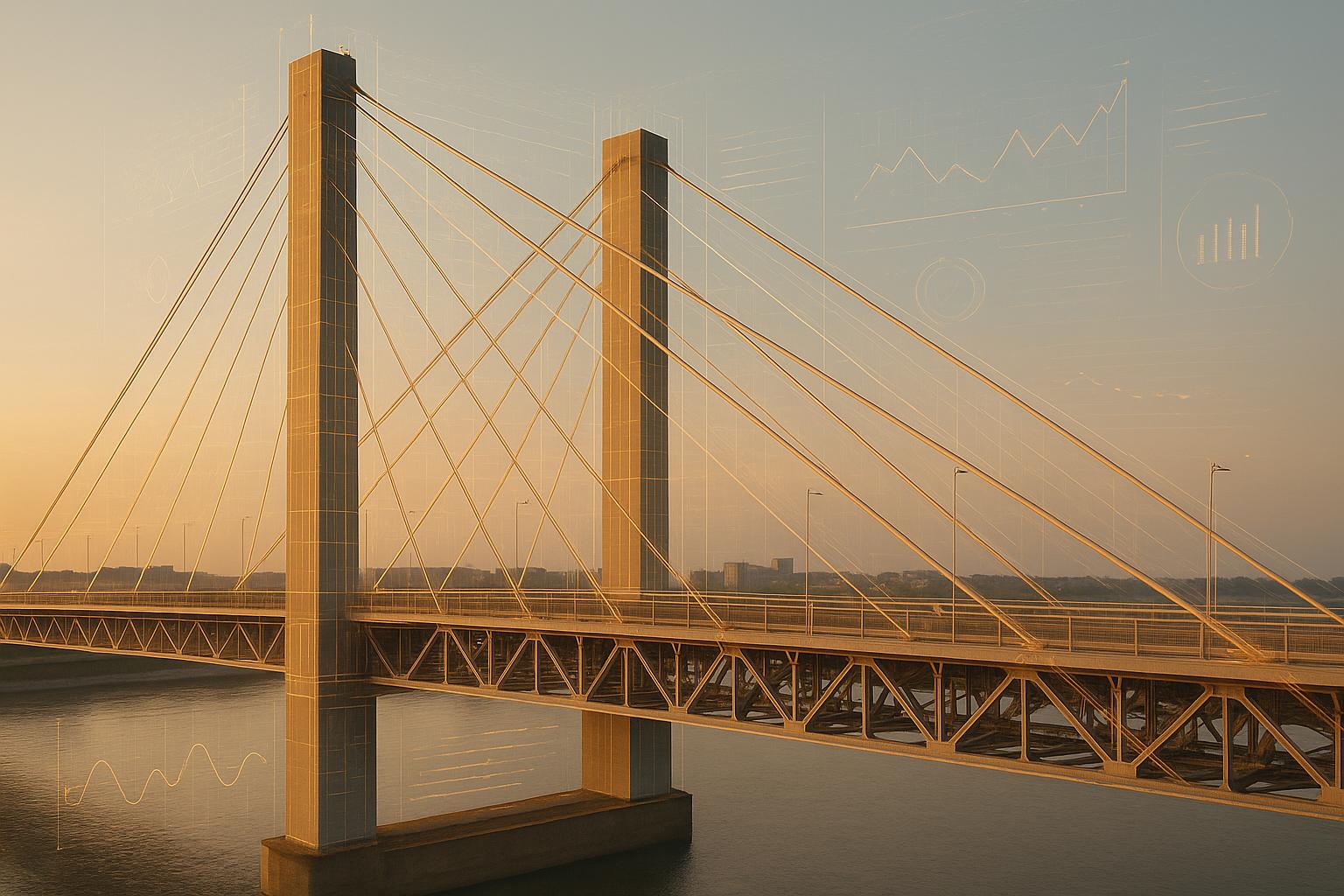
Digital twin models are transforming how bridges are monitored for seismic activity. These systems create a real-time, virtual replica of a physical bridge, using data from sensors like accelerometers, strain gauges, and displacement monitors. By analyzing this data with advanced simulations, engineers can predict structural issues, respond to earthquakes faster, and extend the lifespan of aging infrastructure.
Key points:
- Real-time monitoring: Sensors continuously track vibrations, stress, and movement.
- Predictive insights: Combines physics-based modeling and AI to forecast potential failures.
- Improved safety: Identifies weak points during seismic events and guides maintenance.
- Case studies: Projects like the I-90 Homer Hadley Bridge show reduced inspection costs and faster responses.
Despite challenges like high setup costs and data management, digital twins are reshaping seismic bridge monitoring by offering more precise, efficient, and responsive solutions.
Staffordshire Bridges Digital Twins System Demonstration
Core Components of a Seismic Digital Twin System
Creating a digital twin system for seismic bridge monitoring involves three key components. Together, these elements form a system capable of predicting, monitoring, and responding to seismic events as they happen.
Sensor Networks and Data Collection
At the heart of any seismic digital twin system is its sensor network, which collects vital structural and environmental data about the bridge.
Accelerometers play a key role in seismic monitoring. They measure ground motion and bridge vibrations during earthquakes, offering critical insights into the bridge's dynamic response and identifying potential resonance issues. These sensors capture how the bridge behaves during seismic activity, helping engineers assess its real-time performance.
Strain gauges are another crucial tool. They monitor material stress across the bridge, highlighting areas that may be at risk of cracking or failure. By tracking how different parts of the structure stretch or compress, strain gauges provide valuable data on stress and deformation patterns. Lab tests confirm their effectiveness in capturing real-time structural changes.
Tilt meters and displacement sensors focus on shifts in the bridge's geometry. These sensors can detect foundation movement or structural instability, making them essential for spotting early warning signs of potential problems before they escalate into critical failures.
These sensors are connected through IoT platforms, ensuring continuous data transmission to the digital twin. A notable example is the I-90 Homer Hadley floating bridge project, which used IoT sensors linked to Microsoft's Azure Digital Twins platform. Over a year, the system collected data on seasonal variations and operational anomalies.
The sensor network aggregates this data via cloud computing frameworks, enabling seamless communication between the physical bridge and its digital counterpart. This data then feeds into physics-based models to simulate how the bridge behaves under seismic loads.
Physics-Based Modeling and Simulation
Physics-based models take raw sensor data and turn it into actionable insights about how the bridge behaves structurally. Finite element analysis (FEA) is a cornerstone of this process, simulating internal stress, displacement patterns, and stability under seismic loads.
Unlike data-driven models that rely solely on historical data, physics-based models apply the laws of physics to predict how a bridge will react to various seismic scenarios, even those that haven't been experienced before. For instance, a study involving a scaled truss bridge used FEA combined with inverse load identification to visualize real-time structural behavior. The system accurately pinpointed load magnitude and location while analyzing stress and deformation.
Bayesian model updating further enhances the accuracy of digital twins. This approach has been validated on major structures like the Samoa Channel Bridge and the Golden Gate Bridge, where it improved seismic monitoring reliability. These models have proven effective in detecting critical failure modes and guiding proactive maintenance decisions.
By combining physics-based modeling with advanced simulation tools, engineers gain a deeper understanding of not just what is happening to a structure, but why it’s happening and what could happen under different conditions. These insights are then presented through advanced visualization tools.
Visualization and Analytics Tools
The final component translates complex data and simulation results into clear, actionable insights. Tools like 3D modeling, augmented reality (AR), virtual reality (VR), and AI analytics make it easier for engineers to monitor and maintain bridges.
3D modeling software allows engineers to virtually explore the bridge, inspecting its condition and pinpointing structural issues with precision. These models provide a complete view of the structure, simplifying maintenance planning.
AR overlays digital models onto the physical bridge, enabling real-time inspections, while VR creates immersive walkthroughs for detailed analysis without requiring physical access to dangerous areas. These technologies make anomaly detection more efficient and help maintenance teams locate problems quickly.
AI-driven analytics platforms process large datasets to identify stress concentrations, predict failure modes, and test different scenarios. These platforms can uncover patterns in structural responses that might go unnoticed, such as unexpected stress points or unusual deformation rates.
How to Implement a Digital Twin for Seismic Monitoring
Transforming a bridge into a smart structure for seismic monitoring involves three main phases: sensor instrumentation, creating a digital twin, and running simulations. Let's break down the steps for sensor installation, building the digital model, and analyzing seismic scenarios.
Bridge Instrumentation and Sensor Placement
Placing sensors strategically is crucial for accurate monitoring. Start by using finite element analysis to determine areas of high stress and critical load paths on the bridge structure.
- Strain gauges should be installed in high-stress zones like joints, supports, and mid-span sections. These sensors capture dynamic responses across the structure.
- Accelerometers need to be distributed along the bridge deck, towers, and support structures. This setup monitors vibrations and helps identify potential resonance issues during earthquakes.
- Displacement sensors and tilt meters are essential at foundation points and key connections. These detect movement or instability, serving as early warnings for structural shifts.
- Data loggers should be installed for real-time data transfer. Choose locations that account for environmental challenges like weather, electromagnetic interference, and power supply reliability. Ensure these devices connect via IoT platforms to enable continuous data flow to the digital twin system.
Building the Digital Twin Model
Once the sensors are in place, the next step is creating a digital twin. This involves integrating a detailed structural model with real-time sensor data. Begin by developing a 3D model of the bridge using CAD or BIM software. This model should include the bridge's geometry, material properties, and boundary conditions.
- Finite element analysis capabilities are essential for simulating structural behavior under seismic loads. For instance, studies at the University of Florida and UCLA on the Samoa Channel Bridge and Golden Gate Bridge showed how digital twins, combined with Bayesian model updating, enhance seismic monitoring accuracy.
- Real-time data integration is critical. Use telemetry systems to link sensor data to the digital twin via cloud computing. This setup ensures the model updates continuously, allowing engineers to detect seismic impacts in real-time and leverage predictive analytics.
Laboratory tests have shown that digital twins can accurately simulate structural behavior. In one study, a scaled truss bridge model successfully identified load magnitudes and locations while tracking strain and deflection in real-time.
- Incorporate inverse load identification to calculate applied forces from strain data. This feature provides immediate insights into how seismic forces affect the bridge.
- Ensure the digital twin supports continuous validation by comparing predicted behavior with actual sensor readings. Automated processes can refine the model's accuracy over time.
Running Seismic Scenarios and Analyzing Results
With the digital twin operational, you can simulate various seismic conditions to uncover vulnerabilities and improve the bridge's resilience. Use physics-based simulations to assess stress, displacement, and failure modes under different earthquake scenarios.
- Scenario planning should cover a range of seismic events, from probable to extreme, with varying magnitudes, frequencies, and directions. Simulating historical earthquakes can provide valuable insights into the bridge's response. This approach helps identify stress concentrations and potential failure points that might not be evident in historical data alone.
- The San Roque Canyon Bridge project highlighted the benefits of digital twins for post-earthquake assessments. Engineers used the digital twin to evaluate structural conditions quickly and guide operational decisions.
Leverage AI-driven analytics to process the extensive data generated by simulations. These tools can identify patterns, stress points, and anomalies that might be missed during manual analysis. For example, unusual deformation rates or unexpected stress concentrations can signal potential problems.
Focus your analysis on identifying critical failure modes, undesired stress patterns, and uneven load distributions. Use these findings to guide maintenance strategies and retrofitting efforts that enhance seismic resilience.
- Set up automated alert systems to notify maintenance teams when real-time sensor data or simulation results exceed predefined thresholds. For example, the I-90 Homer Hadley Bridge system sends alerts for anomalies like water level changes in pontoons or unusual cable stress.
Regularly testing seismic scenarios builds a comprehensive performance baseline and helps you understand how environmental factors impact the structure. Conduct a full year of monitoring to capture seasonal variations, creating a robust database for future comparisons and anomaly detection.
sbb-itb-ac6e058
Benefits and Challenges of Digital Twin Models
Digital twins bring a wealth of advantages to seismic bridge monitoring, but they also come with their fair share of challenges. By weighing both sides, engineers and infrastructure managers can make smarter decisions about adopting this technology.
Benefits of Digital Twin Models
Real-time structural health monitoring is one of the standout advantages of digital twins. Unlike traditional inspections, which depend on periodic manual assessments, digital twins use IoT sensors to continuously track bridge conditions. For instance, the I-90 project utilized this technology to provide near real-time data and send anomaly alerts to maintenance teams.
Predictive maintenance is another game-changer. By analyzing sensor data, digital twins can identify early signs of wear, stress, or deformation, helping to prevent costly emergency repairs. Studies show that using tech-driven inspection methods can save hundreds of thousands of dollars, with a return on investment often achieved in just two months.
Safety monitoring is enhanced through physics-based simulations, which allow engineers to test seismic scenarios without putting anyone at risk. Case studies like the San Roque Canyon Bridge and the Golden Gate Bridge demonstrate how digital twins can provide rapid assessments after earthquakes, guiding critical decisions during emergencies. Simulating past and extreme seismic events also helps pinpoint potential failure points.
Operational efficiency gets a significant boost, too. Digital twins enable inspections to be completed 75% faster while increasing defect detection rates by 30%. Remote monitoring and virtual inspections using VR and AR technologies reduce the need for multiple site visits, streamlining the entire process.
While these benefits are impressive, there are hurdles that need to be addressed for successful implementation.
Challenges and Limitations
Although digital twins offer transformative potential, they come with several challenges.
High initial costs remain one of the biggest obstacles. Setting up sensor networks, building detailed physics-based models, and establishing the necessary data infrastructure demands a substantial upfront investment.
Managing data is another hurdle. The constant flow of real-time data from sensors like strain gauges, accelerometers, and environmental monitors requires robust systems for storage, processing, and cybersecurity.
Specialized expertise is essential for operating these systems, which can create staffing issues. Engineers and maintenance crews often need additional training to handle the advanced analytics involved. For example, the I-90 project included workshops to prepare teams for this new technology.
Integration with existing systems can also be tricky. Many bridges still rely on older monitoring equipment, making it challenging to merge digital twins with legacy infrastructure. This often requires custom solutions and careful planning.
Lack of standardization poses another limitation. Without common frameworks, it becomes difficult to share data and collaborate effectively across projects, contractors, and regulatory bodies.
Pros and Cons Comparison Table
| Aspect | Benefits | Limitations |
|---|---|---|
| Monitoring Capability | Continuous, real-time data from multiple sensors | Requires extensive sensor installation and ongoing upkeep |
| Cost Impact | Faster inspections, ROI in as little as 2 months | High upfront costs for sensors and infrastructure |
| Maintenance Approach | Prevents expensive failures through predictive insights | Requires specialized expertise to interpret complex data |
| Safety Assessment | 30% increase in defect detection rates | Data management and cybersecurity challenges |
| Operational Efficiency | Remote monitoring reduces site visits | Integration issues with older systems |
| Data Analysis | AI-driven insights and physics-based simulations | Standardization gaps hinder collaboration |
| Long-term Value | Extends bridge lifespan with proactive maintenance | Ongoing staff training needs |
The American Society of Civil Engineers has recognized digital twins as a transformative tool for managing resilient infrastructure, especially when combined with AI and IoT technologies. Striking a balance between the benefits and challenges is crucial for advancing seismic bridge monitoring through this technology.
Using Anvil Labs for Digital Twin Workflows

Anvil Labs takes the concept of digital twin systems for seismic monitoring to the next level, offering a streamlined way to tackle common challenges. Designed specifically for seismic bridge monitoring, the platform simplifies the creation and management of digital twins by addressing critical issues like data organization, visualization, and teamwork. Below, we'll dive into the features and tools that set Anvil Labs apart.
Anvil Labs Features for Digital Twins
At its core, Anvil Labs brings together various data types - LiDAR scans, thermal imagery, 360° photos, and orthomosaics - into a single, cohesive platform. AI-powered processing and customizable views make it easier to create precise digital replicas of bridge structures, which is essential for effective monitoring.
The platform allows engineers to personalize their interface based on specific needs, whether they're focusing on stress distribution, thermal shifts, or structural changes. With in-model annotation and measurement tools, users can document structural issues in detail. These tools make it easy to highlight problem areas, add technical notes, and take accurate measurements directly on the 3D model. This level of detail is invaluable for tracking changes over time and ensuring compliance with safety standards.
Secure data sharing ensures sensitive information stays protected, granting access only to authorized individuals. Additionally, integration options allow seamless connection with external tools like Matterport, AI analysis software, and task management platforms, expanding the platform's utility.
Users have praised the platform for its efficiency and quick returns. Angel Rojas from Red Angel Drones shared:
"My overall experience with the software has been satisfying because of the efficient workflow. I would highly recommend other organizations to use your software simply because of how much value you get for what you pay for... The ROI is clearly marked within the first few uses."
Improving Collaboration and Data Analysis
Beyond its technical features, Anvil Labs excels in fostering collaboration and enhancing data analysis. Its cross-device accessibility ensures that engineers, inspectors, and project managers can access digital twin models and related data from desktops, tablets, or smartphones. This flexibility enables real-time monitoring and decision-making, no matter where team members are located.
The platform also supports real-time model updates, ensuring that everyone works with the most current data. This is especially critical during seismic events, where conditions can change rapidly, and outdated information could lead to costly mistakes.
Anvil Labs' spatial analysis tools allow teams to evaluate stress patterns, pinpoint potential failure zones, and simulate seismic scenarios directly within the system. Meanwhile, automated reporting features simplify the creation of detailed reports, whether for technical reviews or executive summaries.
Brian Wellington from Litewing noted:
"I showed this to the fire department and they all loved it!"
This feedback highlights how effective visualization and secure data sharing can improve communication among emergency responders and other key stakeholders. By simplifying workflows and shifting away from traditional monitoring methods, the platform makes it easier to manage multiple bridge assets. Its centralized approach supports consistent monitoring practices and encourages collaboration across projects.
The Future of Seismic Bridge Monitoring with Digital Twins
Seismic bridge monitoring is entering a new era as digital twin technology continues to evolve and become more accessible. These virtual replicas of physical structures are emerging as essential tools for real-time seismic monitoring, powered by advancements in sensor technology, artificial intelligence, and cloud computing platforms. This shift is transforming how we approach infrastructure protection, moving from reactive repairs to proactive risk management.
This transition from traditional inspection methods to technology-driven solutions is more than just a technical upgrade - it’s a complete rethinking of how we safeguard critical infrastructure. Early implementations of digital twins have already demonstrated improvements in efficiency and defect detection, leading to better safety outcomes.
Real-time monitoring is no longer limited to just collecting data. It now includes automated risk assessment and integration with smart city systems. These capabilities enhance simulation accuracy and enable immediate maintenance planning, reinforcing the focus on proactive safety measures for bridges. Research shows that digital twins can precisely simulate seismic responses. This accuracy allows engineers to model earthquake impacts in real time and fine-tune their response strategies.
Anvil Labs is taking these advancements further by addressing workflow bottlenecks that have historically slowed adoption. Their platform integrates diverse data types - such as LiDAR, thermal imagery, 360° photos, and orthomosaics - into a unified digital twin system, simplifying the monitoring process. With users reportedly seeing returns on investment within just two months, the economic benefits of adopting these technologies are becoming increasingly clear.
Standardizing data frameworks is another critical step forward, helping to resolve past challenges with integration. By adopting open data standards, smaller municipalities and engineering firms can more easily access and implement digital twin technology. Experts highlight that open standards are key to fostering collaboration among agencies and technology providers, paving the way for a more unified approach to infrastructure resilience.
In the future, digital twins will evolve beyond monitoring to become pivotal tools in emergency response. Their capabilities are expected to include real-time coordination with first responders, automated evacuation plans, and integration with regional disaster management systems. This progression represents a shift from reactive infrastructure management to predictive systems that adapt to changing conditions and emerging threats.
The future of seismic bridge monitoring is about building safer, more resilient transportation networks that not only withstand seismic challenges but also deliver tangible benefits to the communities they serve. By embracing these advancements, we’re moving closer to a world where infrastructure is smarter, stronger, and better prepared for the unexpected.
FAQs
How can digital twin models enhance bridge safety and maintenance during earthquakes?
Digital twin models are transforming how we approach bridge safety and maintenance, especially during earthquakes. These models act as virtual replicas of bridges, combining data from sensors, 3D models, and other sources to monitor structural health in real time and uncover potential weak spots.
By simulating earthquake scenarios, digital twins allow engineers to predict how a bridge might react under seismic stress. This insight helps them plan ahead with targeted maintenance and reinforcement strategies. The result? Reduced risks, less downtime, and safer bridges for the communities that rely on them.
What challenges can arise when using digital twin technology to monitor bridges for seismic risks?
Implementing digital twin technology for monitoring seismic activity in bridges isn't without its obstacles. One of the biggest challenges is data integration. Merging real-time sensor readings, historical data, and detailed 3D models demands precise synchronization and compatibility across multiple systems - a task that's far from straightforward.
Another key issue lies in maintaining the accuracy and reliability of these models. For digital twins to effectively identify seismic risks, they need to consistently reflect real-world conditions with minimal error.
Cost and scalability also come into play. Deploying and maintaining digital twin systems, particularly for extensive or intricate bridge networks, can be expensive and resource-intensive. On top of that, interpreting the data and making necessary updates often requires specialized technical expertise. For organizations with limited budgets or a lack of skilled personnel, this can be a significant barrier.
How do AI and physics-based models improve the accuracy of digital twins for monitoring bridge health and predicting seismic risks?
AI and physics-based models play a crucial role in improving digital twin systems, especially when it comes to creating more accurate simulations and predictions. AI excels at processing massive amounts of real-time data collected from sensors, spotting patterns, and flagging anomalies that could signal structural problems or weaknesses. Meanwhile, physics-based models rely on established engineering principles to simulate how a bridge would react to different forces, like those caused by an earthquake.
When these two technologies are combined, digital twins can deliver highly detailed insights into a bridge's current condition and forecast its performance during seismic events. This powerful integration enables engineers to make informed decisions, prioritize maintenance tasks effectively, and enhance overall safety and durability.

.svg)


