

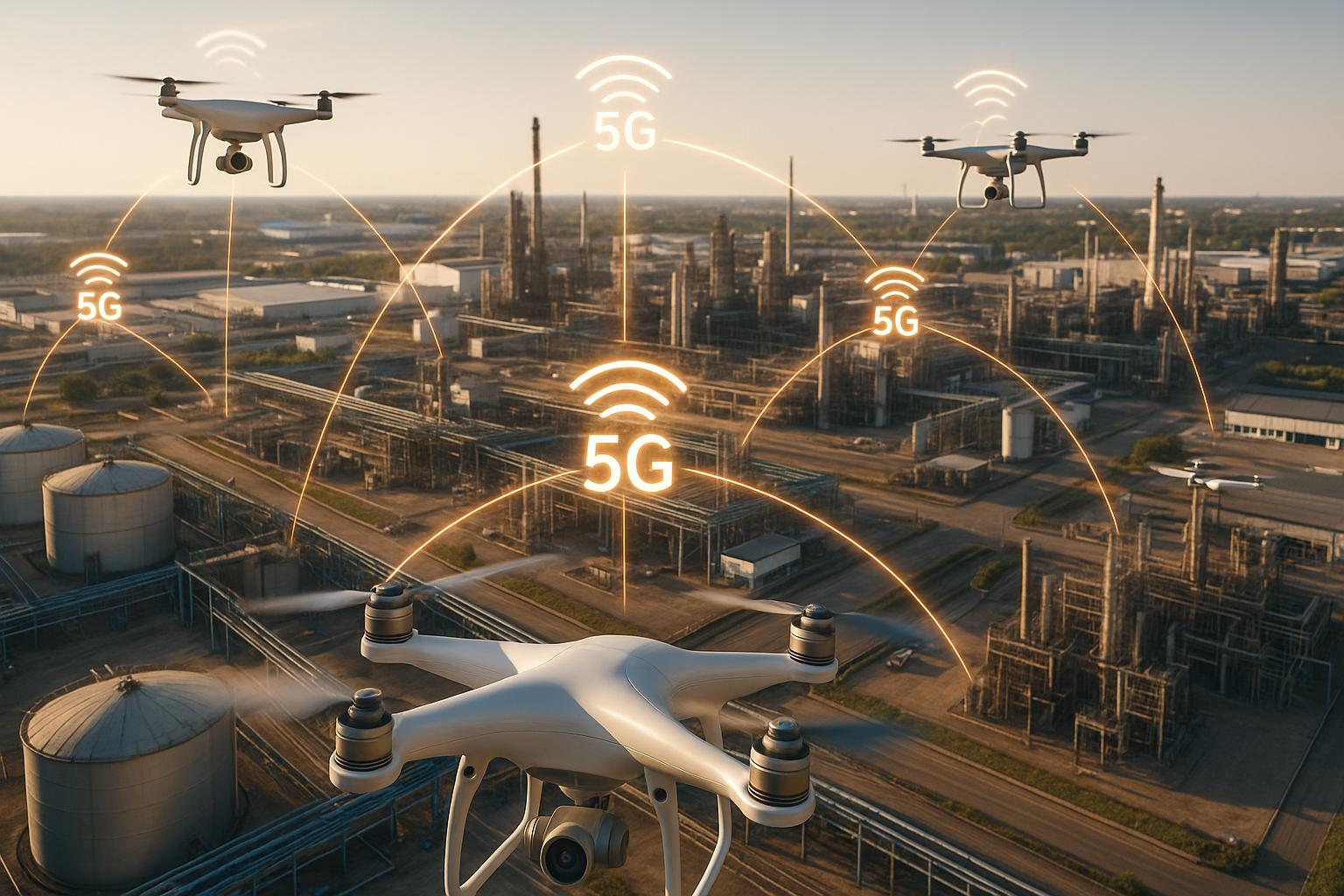
5G is transforming how industries use drones to create digital twins of physical sites. By enabling ultra-fast data transfer, real-time updates, and advanced drone capabilities, industries like construction, mining, and utilities are achieving faster inspections, improved maintenance, and better decision-making. Here’s how it works:
- Digital Twins: Virtual models of physical assets created using drone data like 3D scans, thermal imaging, and LiDAR.
- 5G Benefits: Ultra-low latency (as low as 1 ms), high bandwidth (up to 10 Gbps), and reliable connectivity enable real-time data streaming and edge processing.
- Key Use Cases: Faster inspections (75% time savings), predictive maintenance (reducing breakdowns by 70%), and real-time site monitoring.
- Private 5G Networks: Dedicated systems ensure secure, uninterrupted drone operations in remote or challenging environments.
- Advanced Sensors & AI: Drones now combine multiple sensors with AI to autonomously detect defects, track progress, and optimize operations.
Industries are already seeing results, such as a 30% increase in defect detection rates and reduced costs. With platforms like Anvil Labs managing drone data, businesses are simplifying workflows and improving efficiency. This technology is shaping the future of industrial operations.
5G Drone Integration and LiDAR Digital Twins from UAVs - Jon White and James Glue - COMIT 2 Digital
Ultra-Low Latency and High Bandwidth for Real-Time Modeling
5G technology is revolutionizing drone-based digital twins by delivering ultra-low latency and high bandwidth, allowing for precise, real-time updates. This breakthrough enables drones to capture and transmit data instantly, creating virtual models that closely mirror physical industrial sites. With continuous high-speed connectivity, drones are now equipped to integrate advanced sensors and perform edge processing, setting the stage for enhanced industrial operations.
Real-Time Data Streaming for High-Resolution Models
With speeds reaching up to 10 Gbps, 5G allows drones to transmit massive amounts of sensor data in real time. This capability opens the door for industrial drones to stream multiple data types simultaneously - like high-resolution video, LiDAR point clouds, thermal imagery, and orthomosaics. The result? Digital twins that update in real time with a level of detail that was previously unattainable.
5G-powered drones enable continuous streaming of high-resolution data, supporting applications that demand ultra-low latency. During a single flight, drones can collect orthomosaics for site mapping, perform thermal scans to check structural integrity, and gather LiDAR data for volumetric calculations. All of this information is fed directly into digital twin models without the delays associated with traditional batch processing.
The combination of 5G networks and real-time data streaming offers near-instant data transmission, eliminating the need to send large datasets to distant cloud servers. This advancement ensures that industrial facilities maintain up-to-date digital twins, which are essential for detecting anomalies and addressing issues as they arise.
"The ability to stream high-resolution data in real time is a game changer for industries relying on drone technology." – John Smith, CTO of Anvil Labs
Edge Computing and Reduced Transmission Delays
Edge computing brings data processing closer to the source - on the drone itself or nearby - rather than relying on distant cloud servers. This approach, combined with 5G’s ultra-low latency, significantly reduces delays and boosts efficiency. Instead of waiting for cloud-based analysis, data can be processed locally, enabling real-time insights and immediate actions.
The impact is substantial: tasks like anomaly detection, structural analysis, and 3D model creation can now happen on-site, in real time. For industries like construction and mining, this means drones can make split-second decisions, monitor safety conditions live, or detect equipment failures instantly.
Verizon is leading efforts in 5G-enabled drone traffic management systems, while private 5G networks are being deployed in industrial settings like mines to ensure uninterrupted connectivity. Edge computing paired with 5G reduces data transmission delays by 75%, enhancing responsiveness and enabling immediate corrective actions. This setup allows multiple drones to work together, each processing its own sensor data locally before contributing to a unified, real-time digital twin model. The result is a constantly updated view of large-scale infrastructure projects, giving teams the ability to act on current, rather than outdated, information.
The advantages of real-time processing are especially clear in thermal imaging applications, where drones can instantly identify issues such as moisture infiltration, electrical hotspots, or structural weaknesses. Instead of waiting for post-flight analysis, edge computing enables immediate alerts and corrective actions. This rapid processing capability is a game-changer for industrial sites, making digital twin applications more effective and responsive than ever before.
Better Network Reliability and Coverage for Industrial Sites
Industrial sites often deal with connectivity issues that traditional networks just can't handle. Remote locations, tough environments, and interference from machinery can disrupt drone operations and compromise the accuracy of digital twins. With 5G technology, these challenges are being addressed head-on. It provides reliable connectivity that keeps drone-based digital twins running smoothly, even in demanding conditions. This ensures continuous monitoring, real-time data analysis, and swift responses to critical situations - laying the groundwork for tailored 5G applications in tough industrial settings.
Private 5G Networks for Industrial Use Cases
Private 5G networks are changing the game for industrial connectivity by offering dedicated, on-site wireless systems designed specifically for operational needs. Unlike public networks that share bandwidth with countless users, private 5G networks provide latency as low as 1 millisecond and full control over network resources, ensuring consistent performance.
These networks bring several key benefits to drone-based digital twins. For starters, enhanced security safeguards sensitive industrial data by keeping operations isolated from public networks, reducing the risk of cyberattacks and ensuring data integrity during drone flights. Additionally, guaranteed bandwidth allows multiple drones to operate simultaneously without competing for resources, enabling full site coverage and smooth fleet coordination.
Industries like mining and construction are already leveraging these systems to support drones conducting real-time 3D mapping and equipment inspections in areas where public cellular coverage is unreliable or nonexistent.
"Private 5G networks provide the reliability and security that industrial operations demand, especially in remote environments where traditional connectivity options are limited." – John Smith, CTO of Anvil Labs
The smart construction drone market is expected to grow from $3.77 billion in 2025 to $6.33 billion by 2029, driven in large part by the adoption of private 5G networks that enable uninterrupted operations. According to Gartner, 75% of organizations are predicted to adopt private 5G networks by 2025, demonstrating the growing importance of these dedicated solutions in industrial sectors.
| Feature | Public 5G Network | Private 5G Network |
|---|---|---|
| Reliability | Variable, shared | High, dedicated |
| Security | Standard, public | Enhanced, site-specific |
| Customization | Limited | Tailored to site needs |
| Coverage (Remote) | May be limited | Can be extended as needed |
| Control | Carrier-managed | Enterprise-managed |
Maintaining Connectivity in Remote Environments
For remote industrial sites, staying connected requires solutions that go beyond standard network infrastructure. 5G offers innovative strategies to tackle these challenges, ensuring reliable connectivity even in the most isolated areas.
One approach involves portable 5G base stations, which can be deployed on-site to create localized coverage zones. These mobile units deliver the same high-performance capabilities as permanent installations but with the added flexibility to move as project needs evolve.
Additionally, mesh networking between drones ensures redundant communication pathways. If one drone loses connection to the base station, others can maintain the data flow, keeping digital twin models updated even during temporary disruptions.
Another critical component is edge computing with 5G, which processes data locally when backhaul connectivity is weak. Drones can handle tasks like anomaly detection and safety monitoring on-site until full connectivity is restored. This hybrid approach blends the high-speed capabilities of 5G with practical solutions for challenging environments.
Platforms like Anvil Labs thrive with these connectivity advancements. Their ability to handle diverse data types - such as LiDAR, thermal imagery, and orthomosaics - depends on high-bandwidth, reliable connections. By combining private 5G networks with edge computing, platforms like these can deliver secure, real-time digital twins, even in the harshest industrial environments.
The result? Uninterrupted operations that were previously unachievable with older wireless technologies. Digital twin solutions now maintain real-time accuracy and provide immediate insights, no matter the location, weather, or environmental conditions. For industries where safety, efficiency, and compliance rely on constant monitoring and rapid responses, this level of reliability is a game-changer.
sbb-itb-ac6e058
Advanced Sensor Fusion and Autonomous Capabilities
5G-enabled drones are revolutionizing industrial operations by combining multiple sensors and operating autonomously. This advanced integration elevates the creation and maintenance of digital twins from simple visuals to detailed, multi-dimensional models. Thanks to 5G's ultra-low latency and high bandwidth, drones can process and transmit vast amounts of sensor data in real time, delivering richer, more precise digital representations of industrial environments.
Modern drones now incorporate a range of sensors - like LiDAR, thermal imaging, multispectral sensors, and 360-degree cameras - into a single flight. With 5G managing the immense data streams these tools produce, industrial operators gain unparalleled insights into their assets, from structural conditions to thermal efficiency and surrounding environmental factors.
Integrating Multiple Sensor Types for Richer Data
The backbone of this seamless sensor integration is 5G technology, which offers blazing-fast data speeds of up to 10 Gbps and latency as low as 1 millisecond. This capability allows drones to simultaneously gather and transmit data from diverse sensor arrays without lag or loss of quality.
By combining data from multiple sensors, digital twins provide a complete, real-time view of industrial sites. For instance:
- LiDAR sensors deliver precise 3D spatial data.
- Thermal cameras detect heat anomalies, often signaling equipment issues or energy inefficiencies.
- Multispectral sensors analyze environmental conditions and material properties.
- 360-degree cameras offer full visual documentation of the site.
This multi-sensor fusion eliminates previous limitations tied to data volume and synchronization, enabling digital twins to remain not only comprehensive but also up-to-date as conditions evolve.
"The combination of 5G and advanced sensor fusion allows us to create digital twins that are not only accurate but also updated in real-time, which is essential for effective asset management." – John Doe, CTO of Anvil Labs
The applications of this technology are vast. For example, energy companies can combine LiDAR and thermal imaging to detect heat leaks in power infrastructure, while mining operations use multispectral data to monitor environmental conditions and vegetation health near extraction zones. This layered approach enhances situational awareness and leads to faster, better-informed decisions. It also lays the groundwork for autonomous drone operations powered by real-time analytics.
Autonomous Drones Powered by 5G Connectivity
Using the wealth of sensor data, autonomous drones are now capable of dynamic, real-time decision-making. Powered by artificial intelligence and 5G connectivity, these drones handle complex tasks like surveying, mapping, and infrastructure inspections with minimal human input. The combination of AI and 5G's real-time data processing enables drones to adjust operations on the fly, improving both efficiency and safety.
5G's low latency and reliability also enable real-time edge computing. This means drones can process sensor data locally - either onboard or at the network edge - reducing the need to send raw data to distant cloud servers. This local processing supports immediate analytics, such as defect detection or progress tracking, while allowing drones to autonomously modify flight paths or inspection routines based on live feedback.
"5G connectivity allows drones to operate autonomously in complex environments, executing tasks formerly dependent on human oversight." – Anvil Labs
Industries are already seeing measurable benefits. Autonomous drones are streamlining progress reporting and enabling real-time defect identification, which speeds up maintenance and minimizes downtime. By reducing human exposure to hazardous areas, they also enhance workplace safety.
Platforms like Anvil Labs are central to this workflow, offering tools to host, process, and visualize data from various drone sensors. These platforms support everything from 3D modeling and thermal imaging to LiDAR processing. Features like annotation, measurement tools, and AI-driven analysis make it easier to turn raw data into actionable insights. Additionally, their task management and secure data-sharing capabilities enable seamless collaboration across industrial teams, ensuring that every step from data capture to decision-making is efficient and effective.
Industrial Applications and Platform Integration
5G-enabled drone digital twins are transforming how industries handle asset management, site monitoring, and equipment maintenance. By combining ultra-fast connectivity with advanced drone technology, sectors like construction, mining, and utilities are seeing measurable improvements. Let’s dive into some key use cases and explore how Anvil Labs simplifies digital twin management.
Key Industrial Use Cases for 5G-Enabled Digital Twins
With 5G’s ability to transmit data faster than ever, many industries are achieving new levels of efficiency and accuracy.
Construction and Infrastructure Management: These industries are leveraging 5G-enabled drones for real-time aerial surveys, progress tracking, and safety inspections. Teams can monitor project progress daily or weekly, ensuring schedules and payment milestones stay on track. By integrating tools like LiDAR and photogrammetry, construction teams can create precise 3D models, providing a reliable single source of project data.
Mining Operations: Mining companies report up to 25% improvement in efficiency, thanks to real-time monitoring and predictive maintenance. Drones equipped with advanced sensors continuously track equipment performance, environmental conditions, and site operations, even in remote areas where connectivity is often limited.
Utilities and Energy Infrastructure: Utility companies use drones with thermal sensors to spot electrical hotspots or moisture issues before they lead to costly failures. With 5G, thermal data streams in real time, allowing operators to act quickly and prevent disruptions.
Predictive Maintenance: Across industries, predictive maintenance has become a game-changer. By combining thermal imaging, vibration sensors, and visual inspection data, digital twins create detailed equipment health profiles, helping teams identify and address potential failures before they happen.
Asset Inspections: For hard-to-reach structures like bridges, towers, or building facades, drones eliminate the need for scaffolding, cranes, or rope access. With 5G, inspectors can view high-resolution images and 3D models instantly, making informed decisions on-site without waiting for post-processing.
How Anvil Labs Facilitates Digital Twin Management

To make the most of these advancements, industries need platforms capable of managing the massive amounts of data generated by 5G-enabled drones. This is where Anvil Labs steps in, offering a cloud-based platform that simplifies every step of digital twin management - from data capture to reporting.
The platform supports a wide range of data types, including 3D models, 360-degree photos, thermal imagery, LiDAR point clouds, and orthomosaics. No matter the drone’s sensor setup, the data integrates seamlessly into a unified digital twin environment.
Data Processing and Hosting: Anvil Labs handles the enormous data streams produced by 5G-enabled drones. By processing gigapixels of imagery and large LiDAR datasets, the platform converts raw data into actionable 3D models and insights. Users often see a return on investment within just two months, thanks to faster workflows and reduced manual processing.
Integration Capabilities: The platform connects with third-party tools like Matterport for 3D visualization, AI-powered defect detection, and task management systems. These integrations eliminate data silos, enabling smooth operations from data collection to final deliverables.
"Streamline asset management with our cloud platform, processing products, and nationwide data capture network." - Anvil Labs
Annotation and Measurement Tools: Teams can mark defects, add context, and take precise measurements directly within the 3D model. This is especially useful for compliance documentation and maintenance planning, where accuracy is critical. These tools enhance the real-time inspection capabilities made possible by 5G.
Cross-Device Accessibility: Whether on a desktop, tablet, or mobile device, teams can access updated digital twin data from anywhere. Field teams, for instance, can compare real-world conditions to digital models on-site, identifying changes or issues quickly.
Secure Data Sharing: With granular access controls, project managers can share specific datasets or views with contractors, stakeholders, or regulators without compromising sensitive information. This ensures smooth collaboration while maintaining security.
Users have reported faster inspections and better defect detection compared to traditional methods. As Angel Rojas from Red Angel Drones shared:
"My overall experience with the software has been satisfying because of the efficient workflow."
The platform’s task management integration further enhances efficiency by linking digital twin insights directly to maintenance workflows. If AI analysis flags a potential issue or an inspector identifies a defect, the system automatically generates work orders and assigns tasks to the right team.
As the smart city solutions market is projected to reach $250 billion by 2025, platforms like Anvil Labs are becoming essential. By combining cutting-edge drone technology, 5G connectivity, and robust data management, they deliver the efficiency and insights modern industries need.
Conclusion and Future Outlook
The combination of 5G technology and drone-powered digital twins is changing the way industrial sites function, offering major improvements in efficiency, safety, and innovation. Throughout this discussion, we’ve highlighted key advancements like ultra-low latency data streaming, edge computing, advanced sensor fusion, and AI-driven autonomous flight systems - all of which are driving this shift. These developments are setting the stage for even greater advancements in the future.
Market trends show a growing demand for 5G-enabled drone solutions, underscoring the practical benefits these technologies bring, such as enhanced operational efficiency and better predictive maintenance tools.
Looking ahead, exciting innovations are on the horizon. Drone swarming technology will allow multiple autonomous drones to work together seamlessly on large-scale industrial tasks, such as inspections and monitoring. Quantum-enhanced navigation systems promise unparalleled precision, while blockchain-based data sharing will tackle concerns around cybersecurity and data integrity.
The next generation of digital twins will evolve from passive monitoring systems into proactive optimization tools. By integrating real-time AI-driven simulations with ultra-fast 5G connectivity, these systems will provide predictive insights, enabling operators to fine-tune processes before problems occur. This shift will transform digital twins into invaluable strategic assets for industrial operations.
To make the most of these advancements, industrial operators will need to map 5G network coverage, adopt platforms that support multi-sensor integration, and implement hybrid connectivity solutions. Industry leaders are already leveraging these technologies to save billions annually through automation and real-time updates to digital twins.
Platforms like Anvil Labs are helping drive this transformation. Their tools support diverse data types - ranging from LiDAR scans to thermal imaging - and combine them with AI-powered analysis and task management systems. This creates a solid foundation for the next wave of industrial operations.
Regulatory frameworks are also evolving to support these changes. As guidelines for commercial drone operations become more accommodating, adoption is expected to accelerate in the United States and beyond. Paired with the ongoing expansion of 5G networks, these regulatory updates will unlock new opportunities for automation and strategic management.
The future of industrial operations lies in the seamless integration of 5G connectivity, autonomous drones, and intelligent digital twins. Companies that embrace these technologies now will gain a competitive edge, paving the way for safer, more efficient, and forward-thinking industrial environments.
FAQs
How is 5G transforming drone technology for creating digital twins in industrial settings?
5G technology is transforming how drones contribute to digital twin solutions. By offering faster data transmission, lower latency, and stronger connectivity, 5G enables drones to capture and share high-resolution 3D models, thermal imagery, and LiDAR data almost instantly. This allows for the creation of precise, up-to-date digital twins of industrial sites.
The improved connectivity of 5G also means drones can navigate complex environments with greater efficiency. This is particularly useful for tasks like asset monitoring, predictive maintenance, and spatial analysis. Additionally, 5G makes it easier to integrate drone data with platforms like Anvil Labs, which provide tools to manage and analyze industrial data using 3D models and other visual formats.
What are the benefits of using private 5G networks for drone operations in remote or challenging industrial environments?
Private 5G networks bring several standout benefits to drone operations, especially in remote or challenging industrial environments. One of the most notable is their ability to provide ultra-reliable, low-latency communication, which ensures drones can perform precise maneuvers and respond instantly to commands. This is particularly important for tasks like real-time inspections, mapping, or monitoring where split-second accuracy matters.
Another advantage is their support for high-bandwidth data transfer, allowing drones to send large amounts of information - like 3D models, thermal images, or LiDAR scans - back to a central system without lag. This seamless data flow plays a key role in improving the efficiency and accuracy of creating digital twins for industrial sites.
Lastly, private 5G networks offer strong security and control. Being dedicated to specific operations, they provide a secure environment for sensitive data while ensuring steady connectivity, even in areas where traditional networks fall short. This tailored approach makes them ideal for mission-critical drone operations.
How do advanced sensors and AI-driven autonomy enhance drone-based digital twins for industrial sites?
Advanced sensor integration combined with AI-powered autonomy is transforming how drone-based digital twins function. By pulling in data from various sensors like LiDAR, thermal imaging cameras, and 360-degree cameras, drones can produce incredibly detailed and precise 3D models of industrial sites. These models offer a full, layered view of assets, helping teams make smarter decisions and plan more effectively.
AI-driven autonomy takes this a step further by allowing drones to handle tasks with minimal human input. They can optimize flight paths, spot anomalies, and gather essential data in real time. This not only cuts down on operational costs but also boosts safety by keeping personnel out of dangerous areas. Together, these advancements make drone-based digital twins an essential tool for navigating the challenges of complex industrial environments.

.svg)


