

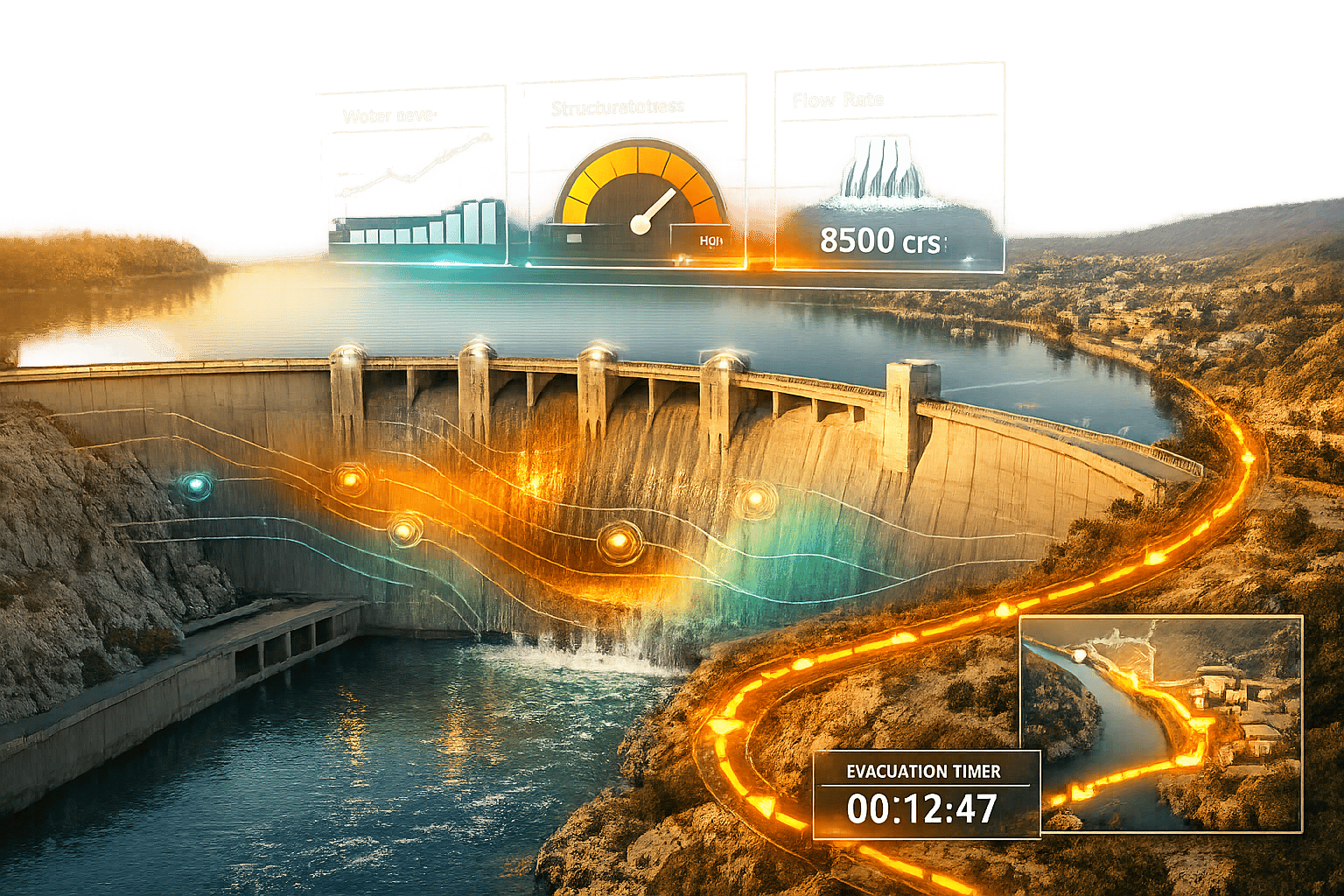
Digital twins are changing how dam operators prepare for and respond to emergencies. These systems create virtual models of physical dams, integrating real-time sensor data, numerical simulations, and machine learning. This allows operators to predict issues, monitor conditions instantly, and simulate disaster scenarios without risking equipment or safety.
Key highlights:
- Faster Monitoring: Manual inspections can take a week; digital twins provide updates twice daily or continuously.
- Improved Safety: Remote monitoring reduces risks for personnel.
- Predictive Insights: Simulations forecast failures under stress, like earthquakes or floods.
- Cost Efficiency: After setup, monitoring costs drop to nearly zero per event compared to $5,000 for manual checks.
These tools provide real-time overviews, automate alerts, and centralize data, helping teams respond quickly and effectively during crises.
Modernizing Dam Safety with iTwin IoT | New Bullards Bar Dam Monitoring
sbb-itb-ac6e058
Real-Time Monitoring and Data Use
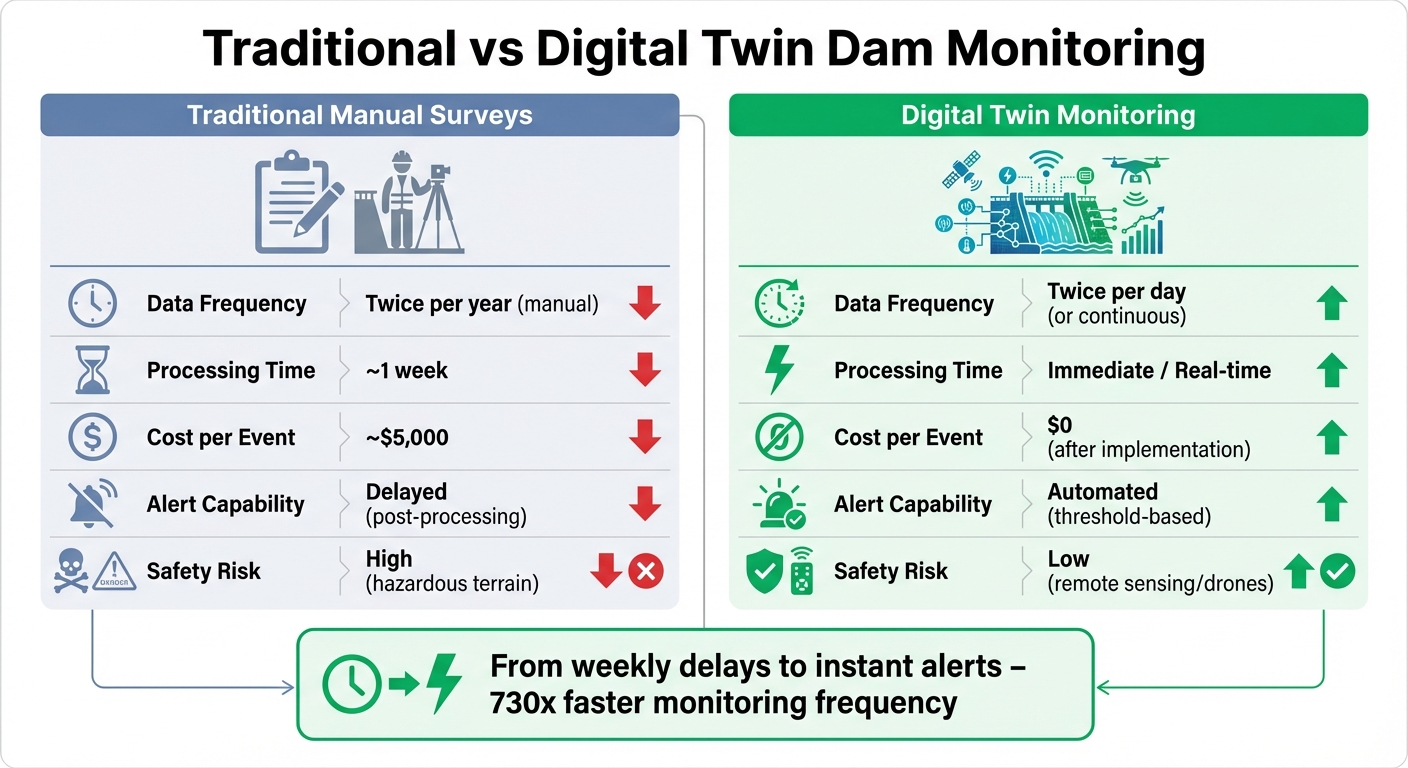
Digital Twin vs Traditional Dam Monitoring: Speed, Cost and Safety Comparison
Digital twins turn sensor data into actionable insights. Instead of waiting weeks for manual survey results, dam operators now have access to continuous updates that show exactly what's happening across their infrastructure.
Live Data Integration for Early Warnings
Real-time monitoring systems replace the slow, costly process of manual inspections with automated, continuous data collection. Take New Bullards Bar Dam in California, for example: Yuba Water Agency installed 83 prisms across its 645-foot structure to track movement in real-time. The system gathers data from over 80 sensors twice daily.
This approach provides what engineers call "situational intelligence" - the ability to assess dam conditions immediately after extreme events without endangering personnel. Tim Truong, Chief Dam Safety Engineer at Yuba Water Agency, highlights the benefit:
"Using iTwin IoT, the dam can be monitored more closely during heavy rainfall and be checked on quickly if earthquakes or other major weather events occur".
The system operates by using preset safety thresholds. If readings related to crack propagation, deflection, or seepage exceed these thresholds, instant alerts are triggered. Engineers can then review sensor data on a 3D reality mesh, making it easy to monitor both the direction and rate of deformation over time. This visualization is especially critical during emergencies, where every second counts. Real-time insights also provide a foundation for historical data analysis, which improves long-term predictions.
Using Historical Data for Predictions
While real-time data offers immediate insights, historical data provides the context needed to detect anomalies accurately. By analyzing past monitoring records, engineers can establish baselines that define normal behavior. These baselines are built using annual averages and standard deviations. For new systems, engineers typically require at least two weeks of average observations to set reliable alarm thresholds.
This historical data is essential for spotting irregularities. Using the Pauta criterion (3σ rule), systems can flag readings that deviate from the 99.7% probability range of normal behavior. For instance, researchers at Salakovac Dam in Bosnia and Herzegovina combined field monitoring data with finite element models in May 2025 to account for the dam's aging condition. This blend of historical and real-time data enabled them to predict failure mechanisms under extreme earthquake scenarios - something that would have been impossible using only current readings.
| Monitoring Approach | Data Frequency | Processing Time | Cost per Event | Alert Capability |
|---|---|---|---|---|
| Manual Surveys | Twice per year | ~1 week | ~$5,000 | Delayed (post-processing) |
| Digital Twin | Twice per day (or continuous) | Immediate | $0 (after implementation) | Automated (threshold-based) |
By breaking down responses into hydrostatic, thermal, and time-dependent components, operators can filter out normal seasonal changes - like thermal expansion in summer - and focus on genuine anomalies. This ensures that data supports both immediate decision-making and long-term analysis.
Better Collaboration Through Centralized Data
Centralized platforms simplify emergency response. Instead of juggling separate spreadsheets, reports, and systems, all teams access the same real-time data through one interface. This unified approach helps agencies track events, send alerts, and communicate with stakeholders without delays caused by fragmented systems.
Platforms like those from Anvil Labs make this possible by hosting 3D models, sensor data, thermal imagery, and LiDAR point clouds in one place. Teams can annotate problem areas, take measurements, and securely share findings across devices - whether they're in the field using a tablet or at a desk reviewing data. This cross-device accessibility ensures that emergency teams can work effectively, no matter where they are.
Simulating Scenarios and Emergency Drills
Digital twins give dam operators a way to simulate high-risk scenarios in a virtual setting, sidestepping the dangers of testing in the real world. These simulations build on the benefits of real-time monitoring, allowing teams to plan for emergencies in advance. Instead of relying on actual crises to expose weaknesses in response strategies, operators can test reactions to events like earthquakes or floods, gaining a clear understanding of how the dam might respond.
Virtual Simulations for Risk Assessment
Using real-time data, digital twins can predict structural risks under different conditions. By combining physics-based numerical modeling with live monitoring data, these simulations provide an accurate picture of aging dam structures. A great example comes from May 2025, when researchers at Salakovac Dam in Bosnia and Herzegovina created a digital twin using the Finite Element Analysis Program (FEAP). They simulated how the dam would handle increasing lateral loads and earthquake scenarios. The model replicated complex structural behaviors and reservoir dynamics, successfully forecasting crack initiation and growth patterns. Factoring in seasonal temperature changes added another layer of precision, as it revealed how thermal stresses could impact the dam. These "what-if" scenarios helped operators pinpoint potential failure points before they became real threats. This is especially important since dams in Bosnia and Herzegovina generate about 25% of the country’s electricity.
Another example comes from Alder Dam in Washington, where the Pacific Northwest National Laboratory (PNNL) and Oak Ridge National Laboratory (ORNL) updated a digital twin platform in September 2024. This system uses real-time data - such as river pressure and turbine speed - to simulate scenarios like low water flow or fluctuating water levels. Scott Warnick, an Electrical and Automation Systems Engineer at PNNL, highlighted the value of these simulations:
"People in operations and maintenance can perform trials on a digital twin instead of risking expensive equipment, making sure decisions can be made with confidence".
Beyond assessing risks, digital twins also help teams practice emergency protocols in a controlled, virtual environment.
Practicing Emergency Protocols
Digital twins act as virtual training arenas where teams can rehearse evacuation plans or resource deployments without disrupting real-world operations. For instance, at Rocky Reach Dam in Washington, the Chelan County Public Utility District partnered with PNNL and ORNL in late 2024 to create a digital twin based on extensive historical operational data. Senior Mechanical Engineer Wenbo Jia used this model to practice high-risk procedures, such as load rejection and over-speed tests, without endangering physical equipment.
These platforms also preserve decades of institutional knowledge, which is especially valuable given that the average U.S. dam is about 60 years old. Digital twins record historical changes and maintenance strategies, providing new staff with a rich resource for learning. As Nathan Fletcher, PNNL’s Senior Hydropower Engineer, pointed out:
"Hydropower facilities are like snowflakes; even individual turbines within a plant are unique due to their individualized construction and varying upgrades over the years".
Tools like Anvil Labs enhance these training exercises by integrating 3D models, thermal imagery, and LiDAR data into a single, easily accessible platform. During simulated drills, teams can annotate problem areas, measure structural changes, and share updates across devices. This ensures everyone - from field responders to command center staff - works with the same up-to-date information. These exercises not only improve coordination but also strengthen overall emergency preparedness.
Improving Decision-Making During Emergencies
In a dam crisis, having quick and consolidated insights can make all the difference. Digital twins bring together data from numerous sensors into a single, real-time view. These sensors include deformation monitors, piezometers that measure water pressure, and strain gauges that track structural stress. The result? A unified, up-to-the-minute snapshot of the facility's condition.
Real-Time Updates for Adaptive Responses
Digital twins go beyond simply displaying data - they actively interpret it. Using advanced pattern recognition algorithms, these systems can determine if an anomaly is a real structural threat or just a faulty sensor. For instance, when multiple sensors in the same area detect unusual activity, the system flags it as a clustered anomaly requiring immediate attention.
These platforms also provide continuously updated safety scores. A five-tier system - ranging from A+ (Normal) to C (Dangerous) - helps operators make decisions under pressure. For example, if anomaly rates climb above 20%–40%, the safety score drops significantly, signaling a potential critical failure. This removes the need for subjective judgment during emergencies, offering operators clear, measurable metrics to act on.
Take the Alder Dam in Washington, for example. Tacoma Public Utilities implemented a digital twin developed by Pacific Northwest National Laboratory (PNNL) and Oak Ridge National Laboratory (ORNL) in September 2024. This system pulls real-time data on river pressure and turbine speed, allowing operators to adjust water levels and flow rates as needed. During sudden demand surges or weather-driven water level changes, the platform even simulates potential impacts before operators make adjustments to the physical equipment.
These real-time insights make it easier to allocate resources and plan evacuations effectively.
Resource Allocation and Evacuation Planning
Digital twins also play a critical role in emergency planning by predicting vulnerable areas for resource deployment. Through "what-if" scenarios - such as simulating a record-breaking flood or an earthquake - operators can anticipate which parts of a dam are most likely to fail and plan evacuations accordingly. These simulations combine physics-based models with historical data, reflecting the dam's current condition rather than just its original design. This is particularly important since the average U.S. dam is around 60 years old, meaning decades of wear and tear have altered how these structures respond to stress.
At Rocky Reach Dam in Washington, Chelan County Public Utility partnered with PNNL and ORNL in late 2024 to analyze years of operational data. Senior Mechanical Engineer Wenbo Jia highlighted how the digital twin improves resource planning:
"The digital twin will help minimize the risk to perform on the real operation, such as load rejection, over-speed test and vibration at the unit start or stop stage".
By testing high-risk procedures virtually, the team can identify maintenance needs and deploy technicians before equipment fails, avoiding last-minute scrambles during an outage.
Platforms like Anvil Labs take this further by integrating 3D models, thermal imagery, and LiDAR data into a centralized system. Accessible across devices, this system allows field teams to annotate problem areas, measure structural changes, and instantly share updates with command centers. This ensures that everyone - from engineers on-site to managers overseeing evacuations - works with the same real-time information, improving coordination when every second matters.
Digital Twin Applications in Dam Management
Digital twins tackle key challenges in dam management by offering real-time insights into flood control, structural health, and water resource management. These tools build on real-time monitoring and simulation capabilities to support smarter operational decisions.
Flood Control and Warning Systems
When heavy rainfall or snowmelt puts a dam at risk, operators face critical decisions about water release. Digital twins allow teams to simulate different water release strategies, testing flow rates and turbine speeds without endangering equipment or nearby communities.
In September 2024, PNNL and ORNL introduced a hydropower digital twin platform. Using live river pressure and turbine speed data from Tacoma Public Utilities' Alder Dam, the platform simulates water release scenarios to balance dam safety with downstream flood risks. Scott Warnick, an Electrical and Automation Systems Engineer at PNNL, described its functionality:
"The digital twins solution enables hydropower operators to simulate different scenarios, such as low water flow or varying water levels, and predict future performance or maintenance needs".
This predictive ability helps operators manage water releases to prevent dam overtopping while minimizing downstream flooding. Additionally, the system aids hydropower generation during grid fluctuations caused by renewable energy sources like solar and wind.
But flood control is just one piece of the puzzle. Digital twins also play a crucial role in monitoring the structural health of aging dams.
Structural Health Monitoring of Dams
With most U.S. dams averaging 60 years old, decades of wear have changed how these structures handle stress. Digital twins can detect cracks, measure deflection, and provide real-time alerts to prevent failures.
For example, at New Bullards Bar Dam in California, automated alerts are triggered when structural movement exceeds set thresholds. This allows operators to remotely assess potential earthquake damage without putting personnel in harm's way. Unlike traditional manual surveys - which often take a week and cost around $5,000 per event - this system provides immediate results and eliminates delays.
| Feature | Traditional Monitoring | Digital Twin Monitoring |
|---|---|---|
| Data Frequency | Twice a year (manual) | Twice a day (automated) |
| Processing Time | ~1 week | Real-time / Immediate |
| Cost per Event | ~$5,000 | Negligible after setup |
| Safety Risk | High (hazardous terrain) | Low (remote sensing/drones) |
This shift to automated, continuous monitoring not only improves safety but also provides the data needed for effective water resource management.
Water Resource Management
Digital twins help balance electricity generation, habitat protection, and reservoir safety. By simulating various release schedules, operators can evaluate how their choices affect infrastructure and downstream ecosystems.
Take New Bullards Bar Dam as an example. Holding approximately 0.29 cubic miles of water, it provides flood protection for the Northern Sacramento Valley. The dam's digital twin enables quick assessments after seismic events and continuous monitoring during heavy rainfall. These simulations inform decisions that maintain minimum water flows for fish habitats, generate electricity during peak demand, and ensure reservoir levels stay within safe limits.
Platforms like Anvil Labs take this a step further by integrating 3D models, thermal imagery, and LiDAR data into a centralized system. Field teams can annotate problem areas, measure structural changes, and share real-time updates with command centers. This coordination ensures rapid, informed responses during emergency water releases.
Conclusion: The Future of Emergency Response with Digital Twins
Key Takeaways
Digital twins are reshaping how dam operators approach emergency preparedness and response. By combining real-time monitoring with physics-based simulations, these tools allow teams to simulate extreme scenarios - like earthquakes, floods, or sudden water level changes - without endangering physical structures or public safety. This predictive capability helps address key challenges tied to aging infrastructure in the U.S., where the average dam is around 60 years old.
Shifting from reactive repairs to predictive maintenance is another game-changer. As Greg Kenyon, Automation Engineering Manager at Tacoma Public Utilities, puts it: "It is one where there are no unplanned outages and lost revenue but rather outages determined by data-driven maintenance schedules and equipment replacements". This proactive approach not only reduces costly downtime but also extends the lifespan of dams while ensuring grid reliability amid fluctuating energy demands from renewable sources like wind and solar.
What's Next
The next wave of digital twins will incorporate AI-powered spatial analysis alongside hybrid models that combine machine learning with physics-based predictions. These advancements will go beyond structural monitoring to tackle environmental challenges, such as managing biological buildup in cooling systems, while helping operators strike a balance between electricity generation and habitat conservation.
Platforms like Anvil Labs are at the forefront of these innovations, offering centralized dashboards that integrate 3D models, thermal imaging, and LiDAR data. These tools allow field teams to annotate structural changes and share updates in real time across devices, making emergency response more dynamic and collaborative. The future isn't just about averting disasters - it's about building resilient systems that evolve with changing conditions and safeguard decades of operational expertise for future engineers.
FAQs
What sensors and data are needed to build a dam digital twin?
Creating a digital twin for a dam involves using a variety of sensors, including accelerometers, strain gauges, and displacement monitors, to measure vibrations, stress, and movement. Tools like LiDAR and thermal imaging add depth to 3D modeling by providing detailed remote sensing data. By combining real-time sensor inputs with historical data and environmental variables - such as weather conditions and water levels - you can enable predictive analytics, issue early warnings, and monitor the dam's structural health. This approach ensures a more thorough and proactive method for managing dam operations.
How are alert thresholds set to avoid alarms during normal seasonal changes?
Digital twin models are used to set alert thresholds, taking into account normal seasonal changes. By leveraging historical data analysis and algorithms that adjust dynamically, this approach ensures that routine variations don’t trigger unnecessary alarms. This balance helps maintain precise monitoring while reducing false alerts.
How can a digital twin support evacuation planning during a flood or earthquake?
A digital twin transforms evacuation planning by offering dynamic, real-time simulations of disaster scenarios. By pulling data from sensors and geographic systems, these models monitor critical factors like infrastructure, terrain, and population movement. This allows emergency responders to pinpoint safe evacuation routes, identify shelters, and designate open spaces, all while adjusting plans as conditions evolve.
Simulating hazards such as flooding or earthquakes enables teams to refine strategies, allocate resources efficiently, and react swiftly to protect lives during emergencies.

.svg)


