

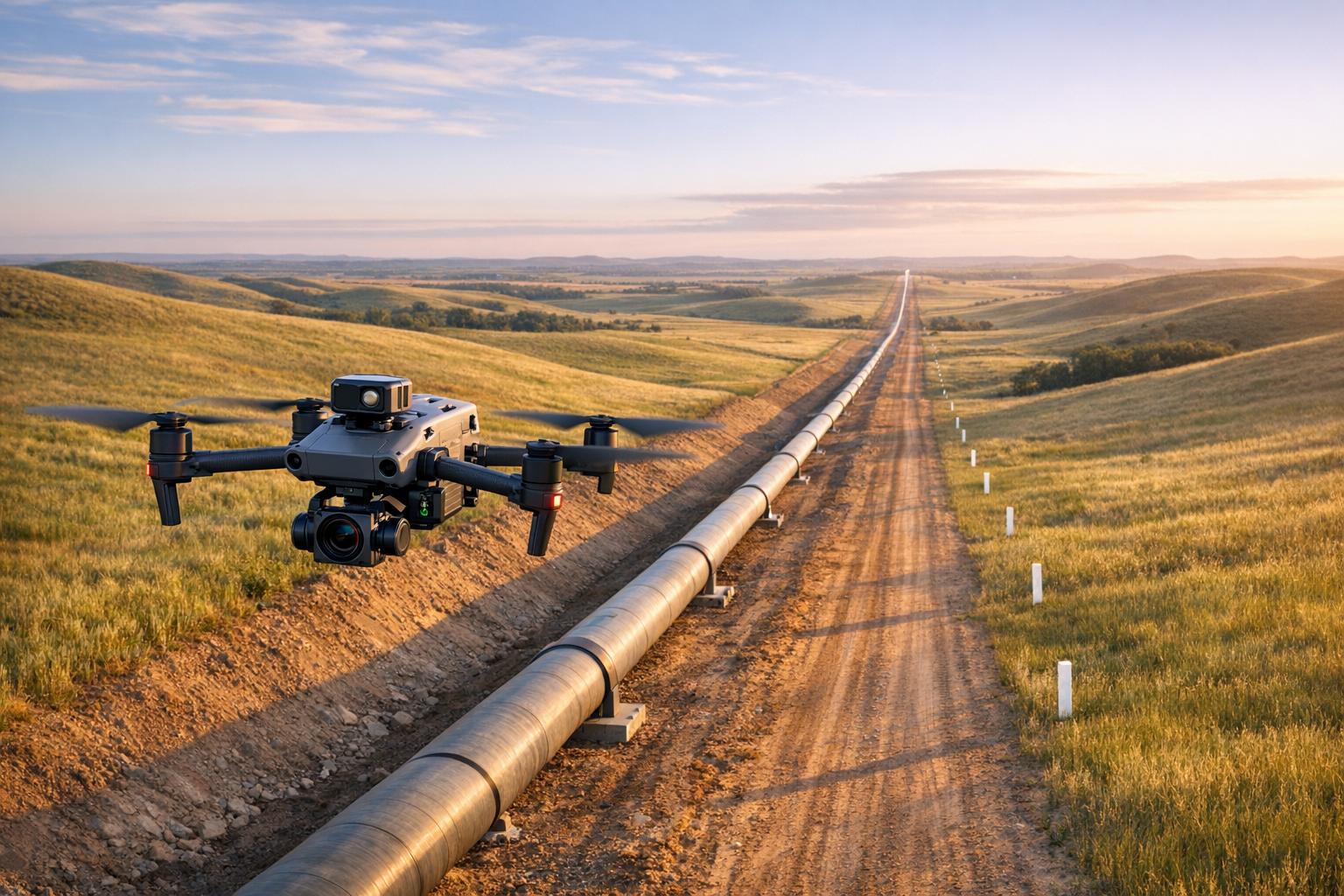
Drone photogrammetry is transforming pipeline construction and monitoring by offering faster, safer, and more precise surveying methods. By using drones equipped with high-resolution cameras, thermal sensors, and LiDAR, teams can create detailed 2D maps and 3D models with centimeter-level accuracy. This approach reduces costs, improves safety, and enhances operational efficiency across the entire pipeline lifecycle - from pre-construction planning to post-construction evaluation.
Key Takeaways:
- Speed & Coverage: Fixed-wing drones can survey hundreds of acres in a single flight, cutting inspection time by over 90%.
- Cost Savings: Drone-based inspections cost 50-70% less than helicopter methods.
- Safety Improvements: Remote inspections eliminate risks associated with hazardous environments.
- Precision: RTK/PPK technology and Ground Control Points ensure centimeter-level accuracy for mapping and monitoring.
- Versatility: Drones detect leaks, monitor construction progress, and document compliance with regulatory standards.
This technology is reshaping pipeline management by delivering actionable insights, reducing risks, and enabling smarter decision-making.
How does Drone Photogrammetry work under the hood? | Hammer Missions

sbb-itb-ac6e058
Required Tools and Technologies
Starting with drone photogrammetry for pipeline projects means having the right mix of drone hardware, photogrammetry software, and data management platforms. These tools work together to capture, process, and share precise spatial data. Let’s break down what’s needed for these projects.
Drone Hardware
Choosing the right drone depends on the pipeline's length and terrain. Fixed-wing drones are great for covering long distances quickly, with speeds exceeding 10 m/s, making them perfect for routine monitoring. On the other hand, multirotor drones excel at slower, more detailed inspections.
Pipeline drones typically come equipped with high-resolution RGB cameras, thermal sensors, and LiDAR technology. For instance:
- High-resolution RGB cameras: These help detect corrosion or cracks in the pipeline.
- Thermal sensors: Useful for spotting temperature changes and leaks.
- LiDAR sensors: Ideal for creating 3D terrain models, which help monitor ground shifts.
Take the JOUAV CW series VTOL drone as an example. It combines a 61MP full-frame CA-103 camera with a PPK GNSS receiver, achieving a ground sampling distance of 5–8 mm and delivering horizontal accuracy of 1 cm and vertical accuracy of 1.5 cm.
Flight time is another critical factor. For example, SoCalGas used a hydrogen-powered DS30 drone capable of 120-minute flights, nearly doubling the endurance of battery-powered models. This extended flight time allowed for efficient aerial mapping and 3D model creation. Many drones also offer features like obstacle detection, weather resistance, and interchangeable payloads to adapt to various inspection tasks.
With the hardware in place, the next step is understanding how photogrammetry software converts the data into actionable insights.
Photogrammetry Software
Photogrammetry software transforms aerial images into orthomosaics, 3D models, and digital twins. Tools like DroneDeploy handle tasks like image stitching and 3D model creation, offering built-in measurement tools for added convenience. High-resolution images - such as those from 61MP cameras - can be processed to achieve precision levels of 1–1.5 cm when ground control points with known GPS coordinates are used.
Manual camera settings play a key role in ensuring consistent exposure and reducing errors during image stitching. Some advanced platforms now include machine learning capabilities for on-device processing. These systems can automatically detect cracks or leaks, improving inspection efficiency by up to 80% with real-time insights. This makes them indispensable for tracking pipeline construction progress and catching issues early.
Anvil Labs Platform Integration
After processing photogrammetry data, a reliable platform is necessary for hosting, visualizing, and sharing the results. Anvil Labs offers a comprehensive solution for managing data captured during pipeline surveys. It supports various formats, including 3D models, LiDAR point clouds, orthomosaics, thermal images, and 360° photos.
Key features include:
- Customizable viewing options: Teams can annotate defects like corrosion or leaks and take precise measurements directly on the digital twin.
- Real-time collaboration: Pipeline models are accessible on any device, with secure sharing and access controls.
- AI integration: Automated anomaly detection tools and task management systems streamline inspection workflows.
For example, during WaterNSW’s 50,000 drone missions over the Warragamba Pipeline, the platform processed 118,000 photos to create a detailed 3D model. This allowed teams to monitor construction progress and detect changes along the pipeline corridor. The platform’s ability to handle large datasets efficiently makes it particularly valuable for remote pipeline sites.
Pipeline Construction and Monitoring Applications
Drone photogrammetry has become a game-changer in pipeline construction and monitoring, enhancing every stage of the process. From pre-construction surveys to post-construction evaluations, drones deliver unmatched efficiency and precision. By combining advanced drone hardware with photogrammetry software, teams can streamline workflows, improve accuracy, and maintain safety standards throughout the lifecycle of pipeline projects.
Pre-Construction Surveys and Planning
Before construction begins, drones are deployed to map the Right-of-Way (ROW) corridor, creating an accurate baseline for planning. Fixed-wing drones are particularly suited for this task, as they can stay airborne for about an hour, making them ideal for covering long, linear pipeline routes efficiently. These flights capture overlapping images with 60% to 80% overlap, producing detailed DTMs (Digital Terrain Models) and DEMs (Digital Elevation Models) for project design.
The generated 3D models and orthomosaic maps help teams address terrain challenges, plan material staging areas, and determine optimal access routes for construction vehicles. Fixed-wing drone systems typically range in cost from $10,000 to $50,000. To achieve measurement accuracy as fine as 1/10th of a foot (3 cm), teams use RTK (Real-Time Kinematic) or PPK (Post-Processed Kinematic) capabilities alongside Ground Control Points. Without these enhancements, standard GPS accuracy is limited to a range of 6.5 to 16.5 feet.
Construction Progress Monitoring
During construction, drones provide regular updates by capturing data that tracks progress and ensures compliance with design plans. This approach allows teams to survey vast stretches of pipeline in just a few hours, cutting inspection costs by more than 90% compared to traditional methods. The high-resolution orthomosaics and 3D models generated can be integrated with BIM (Building Information Modeling) systems, enabling teams to overlay "as-built" progress against "design-build" plans. This helps identify potential conflicts early on.
Traditional manned helicopters, by comparison, cost up to $2,500 per rotor hour, produce lower-quality imagery, and consume 100 times more fuel than drones. Drones employing cross-hatch flight patterns and oblique angles provide superior detail, which is crucial for topographical mapping and calculating the volume of excavated materials.
"Costs for the inspection of an onshore wind turbine can be reduced by 50% per turbine, assessments of large cargo oil storage tanks can be completed several days faster than with manual methods, and chimney flue inspections, which traditionally require days of shutdown, can be performed in hours, with savings of up to 90%." - Roland Berger
Once construction monitoring concludes, drones are used for post-construction evaluations to ensure all project specifications and restoration standards have been met.
Post-Construction Evaluation
After construction is complete, drones are instrumental in verifying that the pipeline adheres to design specifications and that the ROW has been restored to its original condition. By comparing post-construction orthomosaics with pre-construction baselines, teams can document restoration efforts for landowners and regulatory authorities. This geotagged imagery serves as indisputable evidence, helping resolve disputes and ensuring compliance with PHMSA (Pipeline and Hazardous Materials Safety Administration) DOT standards.
Drones equipped with multi-sensor payloads - such as RGB cameras, thermal imaging, and gas detection equipment - can identify issues that ground crews might miss. When paired with AI-driven analytics, these systems achieve 95% accuracy in defect detection, with almost no false positives. The digital twin created during this phase becomes a valuable record for future maintenance and inspections.
"The post construction footage is crucial evidence to verify if the project was completed as per the plan and if the ROW has been replaced as required. It also serves as a record for future maintenance and inspection needs." - Arch Aerial
Benefits and Use Cases

Traditional vs Drone Pipeline Inspection Methods Comparison
Drone photogrammetry isn’t just about capturing aerial images - it’s a game-changer for industries dealing with complex projects like pipeline management. This technology simplifies the challenges of overseeing long, linear infrastructure. By using digital twins, teams gain a clear view of the entire site, making it easier to track progress and spot potential issues before they snowball into costly problems.
One of the standout benefits? Improved safety. Instead of sending workers into hazardous environments or requiring scaffolding and lifts for inspections, drones capture high-resolution visuals and thermal data from a safe distance. This remote approach keeps workers out of harm’s way while still delivering detailed site insights.
Another major advantage is efficiency. Fixed-wing drones can cover hundreds of acres in a single flight, staying airborne for about an hour - double the flight time of many multi-rotor models. For sprawling pipeline projects, this means faster data collection and lower costs. Teams can survey entire corridors in hours, not days, and the resulting data, like orthomosaics and point clouds, integrates seamlessly into tools like BIM, CAD (Civil3D, Revit), and GIS (ESRI ArcGIS) for tasks like clash detection and as-built comparisons.
Main Benefits
Drone photogrammetry delivers benefits across every phase of pipeline work. For instance:
- Accurate earthwork calculations: Precisely measure stockpiles and excavation volumes, aiding inventory management and subcontractor payment verification.
- Thermal leak detection: Specialized sensors can reveal hidden issues like heat leaks or moisture problems that aren’t visible to the naked eye.
- Simplified regulatory compliance: Geotagged imagery and 3D models make it easier to document conditions for authorities such as PHMSA.
Another key advantage is data integration. Outputs like orthomosaics and 3D models flow directly into the software tools pipeline teams already rely on. Engineers can compare as-built conditions to original designs in real time, catching conflicts when they’re still manageable. Platforms like Anvil Labs further enhance this process, offering tools for annotation, measurement, and secure data sharing, which boosts collaboration among field crews, engineers, and stakeholders.
Comparison: Traditional vs. Drone Methods
To understand the impact of drone photogrammetry, let’s compare it to traditional methods:
| Feature | Traditional Methods | Drone Photogrammetry |
|---|---|---|
| Efficiency | Manual, slow, point-by-point surveying | Covers hundreds of acres in a single flight |
| Data Density | Limited to specific measured points | Millions of data points creating a continuous 3D model |
| Safety | Requires workers in hazardous areas | Operated remotely, keeping personnel safe |
| Cost | High labor costs, potential for rework | Lower costs with faster data collection and reduced rework |
| Inspection | Needs scaffolding, lifts, or climbing | High-resolution aerial imagery and thermal sensors |
| Accuracy | High at specific points, but lacks overall density | Centimeter-level accuracy with RTK/PPK and Ground Control Points |
Pipeline Use Cases
Drone photogrammetry’s capabilities shine in various pipeline applications. For example:
- Earthwork volume monitoring: Teams can calculate cut-and-fill quantities with precision, ensuring accurate billing and avoiding disputes over material quantities during trenching and backfilling.
- Thermal imaging for leak detection: Drones equipped with thermal sensors can spot temperature anomalies that signal leaks or insulation issues. Early detection helps prevent small problems from escalating into major incidents or costly repairs.
- Environmental compliance documentation: Drones provide a visual record to demonstrate restoration efforts. By comparing pre- and post-construction orthomosaics, teams can show landowners and regulatory agencies that the Right-of-Way has been returned to its original condition, reducing disputes and ensuring compliance.
"Drone photogrammetry offers a powerful solution, giving you an unprecedented level of control over your site... saving time, reducing costs, and improving safety." - Conner Jones, DroneDeploy
For pipeline projects, the linear nature of the work makes fixed-wing drones particularly effective. They offer an excellent return on investment for operators looking to streamline operations and stay ahead in a competitive industry.
Conclusion
Summary of Benefits
Drone photogrammetry is changing the way pipeline operators handle construction and monitoring. It offers a level of speed that traditional methods simply can't match, cutting inspection times dramatically. This boost in efficiency directly impacts the bottom line, with operators slashing inspection costs by 50-70% compared to helicopter-based methods.
Safety is another major win. Drones eliminate the need for high-risk tasks like helicopter flights, scaffolding setups, or manual inspections in tight, hazardous spaces. Instead, personnel can stay safely on the ground while drones handle the work. On top of that, drones deliver consistent, objective data. When paired with AI, this data achieves 95% defect detection accuracy with almost no false positives.
Platforms like Anvil Labs take these capabilities even further. Their tools for annotation, measurement, and secure data sharing make it easy to integrate drone outputs into existing workflows. This fosters better collaboration between field crews, engineers, and other stakeholders, streamlining the entire process and paving the way for even more advanced applications.
Future of Drone Photogrammetry in Pipelines
The future of drone photogrammetry is pushing the boundaries of pipeline monitoring even further. Thanks to 5G connectivity, real-time operations are now possible, enabling instant data transfer and allowing stakeholders to monitor site conditions live from anywhere. Meanwhile, Edge AI is making drones smarter, allowing them to handle tasks like path planning and navigation on their own, reducing the need for constant manual oversight.
Beyond Visual Line of Sight (BVLOS) operations are becoming increasingly common, expanding the range and efficiency of pipeline inspections over long distances. Drones are also evolving to carry multiple sensors - RGB, thermal, and LiDAR - on a single flight, collecting comprehensive data on asset health in one go. These advancements are even making it possible to survey complex environments, such as underground infrastructure, that were once nearly impossible to access efficiently.
For pipeline operators, the takeaway is simple: start small with pilot projects to prove ROI, then scale up strategically. By integrating drone data with systems like GIS, SCADA, and asset management tools, operators can turn raw imagery into actionable insights. In an industry where efficiency, safety, and informed decision-making are key, adopting this technology is quickly becoming a necessity.
FAQs
What type of drone is best for long pipeline corridors?
The DJI Matrice 300 RTK stands out as a go-to choice for surveying long pipeline corridors. Its precision-focused features, impressive payload capacity, and ability to handle extensive mapping and inspection make it a reliable tool. This drone excels in delivering accurate photogrammetry and thorough monitoring across vast areas.
Do I need RTK/PPK or ground control points for accuracy?
You don’t always need RTK (Real-Time Kinematic) or PPK (Post-Processed Kinematic) systems, or even ground control points (GCPs), to achieve accurate results in drone photogrammetry. However, these tools can significantly boost precision. RTK and PPK systems are capable of delivering centimeter-level accuracy, which often minimizes the reliance on a large number of GCPs. That said, incorporating a few GCPs is still a good practice - even when using RTK/PPK. They help refine both horizontal and vertical accuracy, particularly in large-scale or complex projects where precision is critical.
How do I share and track issues from drone maps in Anvil Labs?
After uploading your drone data to Anvil Labs, you can interact with it in meaningful ways - marking issues, adding annotations, and leaving comments directly on 3D models and maps. The platform also supports secure data sharing through role-based permissions, making it easy for your team to collaborate and monitor issues seamlessly, no matter the device. These tools help simplify workflows and improve how issues are managed.

.svg)


