

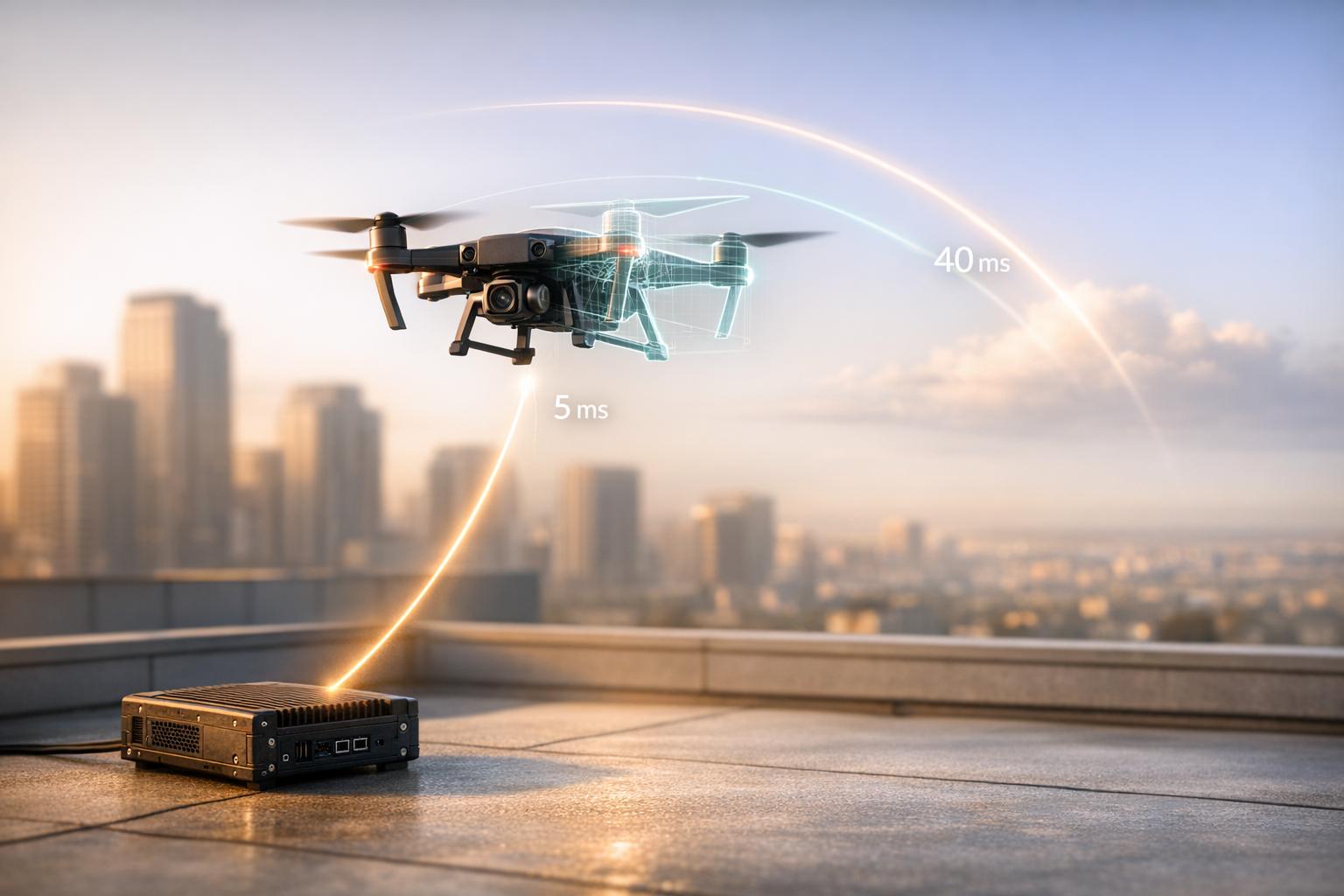
Reducing latency in drone digital twin models is all about speeding up how quickly data from drones is processed and synced with its virtual counterpart. Here's what you need to know:
- What Causes Latency? Large file sizes, slow networks, and inefficient data processing delay updates between drones and their digital twins.
- Why It Matters: Delays can lead to costly errors in fast-moving industries like construction or mining. Real-time updates ensure teams can make timely decisions with high accuracy.
- Key Solutions:
- Edge Computing: Process data near the source (e.g., job sites) instead of sending it to distant cloud servers. This reduces delays caused by long-distance transfers.
- Data Compression: Use techniques like prioritizing critical updates or transmitting only changes (delta syncing) to cut down on bandwidth use.
- Hybrid Cloud-Edge Setups: Combine local (edge) processing for speed with cloud servers for heavy tasks like simulations.
- Low-Latency Protocols: Use efficient communication protocols like MAVLink or MQTT to ensure fast, reliable data transmission.

Latency Reduction Techniques for Drone Digital Twins: Performance Comparison
Using Edge Computing for Real-Time Data Processing
How Edge Computing Works in Drone Operations
Edge computing moves data processing closer to where drones gather information, eliminating the need to send raw data to distant cloud servers. Instead, edge servers located near the drone handle the data immediately. This approach significantly reduces the delays caused by long-distance data transfers.
These edge servers can be positioned right at the job site or mounted on mobile units that follow the drones during operations. For example, after a drone completes a survey pass, edge servers can quickly process LiDAR, thermal imaging, or photogrammetry data. Research on UAV-based Mobile Edge Computing (MEC) servers highlights that optimizing communication and computation parameters - like transmission power and processing rates - meets the ultra-reliable low-latency communication (URLLC) demands of industrial automation. This means digital twin updates can occur faster because the data doesn’t need to travel far before being processed. Such real-time processing capabilities are a game changer for reducing latency, as outlined below.
Benefits of Decentralized Data Processing
Processing data locally at the edge leads to noticeable improvements in responsiveness. Studies show that properly optimized computation resources can cut worst-case latency by about 300 milliseconds compared to cloud-only methods. When transmit power budgets are increased to 23 dBm in setups involving multiple devices and drones, latency can drop by another 100 milliseconds. While these time savings may seem small, they are critical when managing multiple data streams or synchronizing several drones on large-scale industrial projects.
Another advantage of decentralized processing is reduced network strain. Instead of sending large amounts of raw survey data to the cloud, edge servers handle the initial processing on-site and only transmit refined results. This approach not only conserves network bandwidth but also lowers data transfer costs. These efficiencies are crucial for delivering the near-instant updates required for digital twin applications.
Implementing Edge Computing for Drone Digital Twins
Start by identifying the key processing tasks that are ideal for edge computing. Tasks like initial photogrammetry processing, point cloud generation, and basic quality checks are excellent candidates because they involve handling large volumes of data. Deploy edge servers at your busiest locations first, ensuring they are equipped with enough processing power - tasks requiring 800–1,200 megacycles can impact latency.
To achieve the best results, focus on jointly optimizing transmission power, offloading factors, and bandwidth. Adjusting these parameters together leads to better latency outcomes than addressing them individually. For high-precision applications, advanced tracking systems can deliver ±0.2 mm accuracy with latency as low as 8 milliseconds, demonstrating the potential of a well-tuned edge infrastructure. As your drone fleet grows and data volumes increase, make it a priority to monitor latency metrics and adjust resource allocation to maintain optimal performance.
sbb-itb-ac6e058
Optimizing Data Transmission and Synchronization
Data Compression Techniques for Faster Transfer
Handling drone data can be overwhelming - urban digital twin datasets alone can hit a staggering 767 GB. Real-time transmission of such massive volumes often leads to bottlenecks. This is where semantic-based compression steps in. By segmenting and classifying data into categories like "Tree", "Building", or "Road", only object-specific updates are transmitted, significantly cutting down the data load.
Another game-changer is Level of Detail (LoD) management. This technique adjusts the resolution of transmitted data based on the task. For example, low-resolution models (LoD1) are perfect for quick overviews or navigation, while high-resolution models (LoD3) are reserved for intricate architectural tasks.
Change-only updates, or delta syncing, add another layer of efficiency. Instead of re-sending entire models after every drone flight, the system identifies and transmits only what’s changed - like new cracks, moved objects, or structural shifts - by comparing the current data to a "Day 0" base model. This method slashes transmission volumes while keeping the digital twin up-to-date.
By combining these compression techniques, systems can intelligently manage data transfer and focus on what matters most.
Priority-Based Data Transmission
Not all data demands immediate attention. For instance, structural failures need instant reporting, while routine updates - like vegetation changes - can wait. Priority-based transmission uses AI to sort detected changes into categories such as "Low", "Medium", "High", or "Immediate" priority. Critical data, like safety hazards, is sent first to minimize delays in urgent decision-making. This smart queuing ensures that even with limited bandwidth, essential information reaches the right people on time.
Once urgent data is addressed, maintaining an accurate and synchronized digital twin becomes the next challenge.
Synchronization Strategies for Real-Time Updates
Fast data transfer alone isn’t enough to keep digital twins in sync with their physical counterparts. Proper georeferencing, which uses global coordinate systems, ensures that updates align perfectly with the base model. Without this, even the quickest transmission could lead to mismatched or erroneous updates.
Another crucial aspect is bidirectional data flow. According to Mariana Segovia and Joaquin Garcia-Alfaro, this approach allows changes to flow both ways - drone data updates the digital twin, while commands from the virtual model can adjust the physical asset. This continuous feedback loop ensures that both the physical and virtual systems stay aligned, enabling real-time responsiveness and precision.
Cloud-Edge Hybrid Architectures and Anvil Labs Integration
Benefits of Cloud-Edge Hybrid Architectures
A hybrid cloud-edge architecture offers a smart way to cut down latency in digital twin updates by combining the strengths of edge processing and cloud analytics. Unlike cloud-only systems that require data to travel long distances - leading to delays - hybrid setups split the workload. Edge devices handle time-sensitive tasks, such as initial data preprocessing, directly at the source. Meanwhile, the cloud takes on compute-heavy jobs like simulations and long-term analytics.
Studies reveal that hybrid architectures can reduce end-to-end latency by over 60%, slashing response times from 35 milliseconds to just 12 milliseconds. By fine-tuning communication and computation parameters, such as transmit power and processing rates, worst-case latency can drop from 0.87 seconds to 0.6 seconds as computational resources scale from 800 to 1,200 megacycles. Beyond speed, this model enhances control stability by 30% compared to cloud-only methods. Edge nodes also utilize precise timing protocols, like the IEEE 1588 Precision Time Protocol (PTP), to ensure updates stay synchronized with real-world changes. This hybrid approach is a game-changer for integrating platforms like Anvil Labs seamlessly into digital twin workflows.
Anvil Labs: Improving Digital Twin Models
Anvil Labs offers a powerful platform for managing drone data in industrial settings. It supports a variety of data types, including 3D models, LiDAR point clouds, orthomosaics, thermal imagery, and 360° photos. All data is securely hosted with customizable access controls, allowing teams to view, annotate, and measure assets across devices without waiting for time-consuming downloads or local processing.
Centralizing asset hosting and processing simplifies digital twin workflows. With built-in integrations for AI analysis tools and task management systems, Anvil Labs automates tasks like change detection and ensures priority updates are routed to the right people. For operations producing large datasets, an optional data processing service is available at $3 per gigapixel, helping manage costs while keeping models up to date.
Integrating Anvil Labs into Your Workflow
To get started, connect your drone data pipeline to Anvil Labs' hosting platform. After each flight, upload LiDAR scans, orthomosaics, and thermal imagery directly to the platform. Use the annotation tools and secure links to highlight and share important updates instantly.
For even faster updates, combine edge-preprocessed data with Anvil Labs' cloud infrastructure. By uploading only refined, priority-tagged updates, you can keep your digital twin accurate and synchronized without overloading network bandwidth. The platform’s cross-device accessibility ensures decision-makers can review updates in real time, whether they’re in the office or out in the field. This hybrid approach keeps your workflow efficient and responsive.
Adopting Low-Latency Communication Protocols
Overview of Low-Latency Communication Protocols
The communication protocol you choose for drone-to-infrastructure connections plays a huge role in how quickly your digital twin updates. One standout option is MAVLink, a lightweight, binary telemetry protocol specifically designed for drones where every millisecond matters.
"MAVLink is a binary telemetry protocol designed for resource-constrained systems and bandwidth-constrained links." - MAVLink Guide
MAVLink operates in two main modes. Topic Mode uses a publish-subscribe system, ideal for high-frequency telemetry like position and attitude data. By skipping target system and component IDs, it saves bandwidth and allows multiple subscribers - such as ground stations, onboard computers, and cloud-based digital twins - to access the same data stream simultaneously. Meanwhile, Point-to-Point Mode focuses on tasks that need guaranteed delivery, like mission planning or parameter configuration, using specific target IDs and retransmission protocols.
For larger UAV networks, MQTT-based frameworks outperform traditional TCP socket-based communication. Research from 2025 shows that MQTT enhances the Age of Information (AoI) and reduces jitter, making real-time updates more dependable. When it comes to visual tracking, using feature-based communication - transmitting low-dimensional semantic features like Cartesian coordinates instead of raw video - drastically reduces data load and network congestion. For example, a test using a Raspberry Pi Camera V2.1 (640 × 480 resolution at 30 FPS) showed that edge-based feature extraction enabled instant synchronization between physical robots and their digital twins.
This sets the stage for choosing protocols that strike the right balance between speed and reliability for your operations.
Selecting the Right Protocol for Your Needs
Picking the right protocol is essential to keep latency low for digital twin updates. Radio link speed is a key factor. Higher packet rates, like ExpressLRS at up to 1,000 Hz, offer quick responsiveness but may reduce range. A 250 Hz rate often offers a better balance.
End-to-end latency includes delays from encoding, transmission, queuing, and processing. For safety-critical tasks, the protocol must ensure latency stays below a threshold determined by the drones' minimum safe distance and maximum relative velocity. For large-scale operations with frequent updates, MQTT-based frameworks excel in real-time performance. For visual tracking, opt for protocols that transmit compressed trajectory data to cut down on delays.
| Protocol/Method | Key Advantage | Best Use Case |
|---|---|---|
| MQTT (CMQC) | Real-time updates with lower jitter | Large UAV networks with frequent status updates |
| TCP Sockets | Reliable delivery but with higher overhead | General data transfer where latency is less critical |
| Feature-Based | Reduces transmission time by sending coordinates only | Real-time collision avoidance and remote control |
Ensuring Secure and Reliable Data Transmission
Once you've chosen a protocol to minimize delay, securing the data becomes the next priority. The good news? Security and speed can work together. MAVLink v2.0, for instance, includes an optional 13-byte signature to keep communication tamper-proof without adding significant latency. It also uses a CRC-16/MCRF4XX checksum for transmission integrity and a CRC-16-CCITT for data definition consistency. Leveraging the "CRC_EXTRA" constant ensures both sender and receiver are aligned on message definitions, preventing data corruption.
For added safety, apply Lyapunov-based stability analysis to calculate evolving bounds on inter-robot distance errors, ensuring system stability even with delayed feedback. For visual tracking, converting RGB images to HSV color space enhances lighting-invariant object detection, boosting reliability in transmitted data. The goal is to align your security needs with your latency limits. Modern protocols like MAVLink v2.0 show that you don’t have to pick one over the other - you can have both.
Conclusion
Summary of Techniques and Tools
Reducing latency in drone digital twins calls for a layered approach that tackles processing, transmission, and communication challenges. By leveraging edge computing, data processing happens closer to the source, significantly cutting down on transmission delays. For instance, studies indicate that optimizing power and offloading in UAV-aided edge networks can substantially reduce worst-case latency. In smart grid applications, combining edge intelligence with digital twins achieved an average latency of just 12 ms, a stark improvement over the 35 ms seen with cloud-based systems.
Streamlining data transmission is another critical step. Compression methods and priority-based protocols help maintain synchronization without overloading the network. Hybrid cloud-edge architectures offer the best of both worlds: the quick response of edge processing and the centralized intelligence of cloud systems. Platforms like Anvil Labs excel in these setups, providing tools to manage 3D models, thermal imagery, LiDAR data, and orthomosaics. With features like cross-device access and secure sharing, they integrate seamlessly with edge-processed drone data, enabling teams to visualize and analyze updates in real time.
Lastly, reliable communication protocols and fine-tuning transmission power are essential for timely and secure data transfers. Together, these strategies and tools form a solid foundation for keeping digital twins updated in real time.
Final Thoughts on Improving Performance
Sustaining high-performance digital twins requires continuous refinement. The digital twin ecosystem is always advancing, and staying ahead means regularly assessing and improving your systems. Reevaluate UAV trajectories, offloading methods, and power adjustments using advanced optimization techniques to preserve your gains. Keep a close eye on your latency metrics - whether it’s encoding, transmission, queuing, or processing delays, every millisecond counts in real-time performance.
Mastering Digital Twins: Seamlessly Capture, Process, and Share Real-World Replicas
FAQs
How do I measure end-to-end latency in a drone digital twin?
To measure end-to-end latency in a drone digital twin, you need methods that account for delays spanning from data collection to final visualization. One effective technique is pose-to-photon measurement, commonly used in VR rendering, which tracks the time taken for positional data to appear visually. Another approach involves monitoring activation times across system components to pinpoint delays. Additionally, neural network models trained on system-specific data can provide real-time latency estimates. By combining these methods with platforms designed for real-time data processing, you can achieve a precise assessment of latency.
What should run on the edge vs in the cloud for best speed?
For the best performance, tasks requiring instant responses and minimal latency should be handled on the edge - closer to the drone or the data source. This proximity helps cut down delays and supports real-time decision-making.
On the other hand, tasks that aren't time-sensitive, like large-scale data analysis or long-term data storage, are better handled in the cloud. The cloud offers scalability and access to advanced processing capabilities. By blending edge and cloud processing, digital twin models can achieve both quick responsiveness and in-depth analysis.
Which protocol is best for low-latency drone telemetry?
5G stands out as the top choice for low-latency drone telemetry. With response times as fast as 1 millisecond, it ensures commands are executed almost instantly. Plus, its ability to handle high-bandwidth data streams guarantees smooth and reliable performance.

.svg)


