

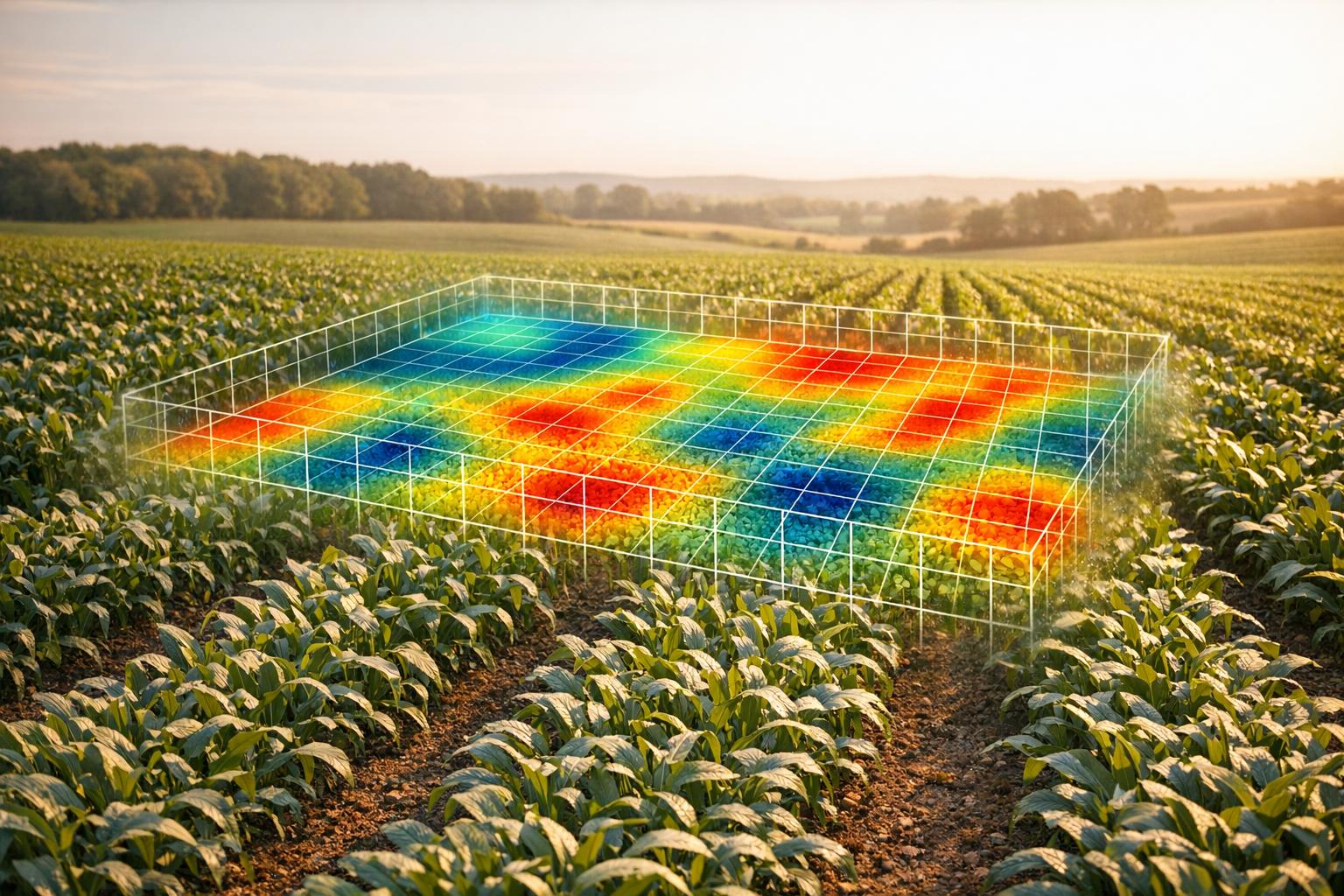
Farming is getting smarter with digital twins and thermal imaging. These tools are changing how crops are monitored and managed by detecting stress early, well before visible symptoms appear. Here's how they work:
- Digital Twins: Virtual replicas of farms that use real-time data from sensors, cameras, and weather stations to simulate field conditions. Farmers can test scenarios and predict outcomes without risking their crops.
- Thermal Imaging: Detects temperature changes in plants, signaling stress from heat, drought, or disease before it becomes visible. This helps farmers take action early.
When combined, these technologies provide precise monitoring, helping farmers optimize irrigation, cooling, and pest control systems. For example, trials in Washington apple orchards used digital twins and thermal data to prevent heat damage, saving resources and improving yields.
Farmers can now make informed decisions using real-time insights, helping to protect crops, save costs, and improve productivity. This approach represents a smarter way to manage agriculture.
DroneCamp 2020: Sensing Crop Water Stress with Thermal Imagery
sbb-itb-ac6e058
How Digital Twins Monitor Crop Health
Digital twins are transforming agriculture by continuously collecting and analyzing real-time farm data, offering insights that help farmers make smarter decisions.
Collecting and Integrating Data
Digital twins pull in data from a variety of sources. IoT sensors monitor critical factors like soil moisture, pH levels, and temperature, while drones provide aerial views of fields. Meanwhile, weather stations contribute by recording atmospheric data every five minutes, generating 12 data points per hour. These datasets, when combined, allow for precise predictions about crop conditions.
One exciting development in data integration is the use of AI tools like Neural Radiance Fields (NeRF). Back in April 2025, Shambhavi Joshi, a doctoral student at Iowa State University, used smartphone-recorded 2D videos of millet plants in a greenhouse. NeRF converted these videos into 3D digital twins, capturing 80 to 90 million data points that detailed each plant's color, shape, and structure. Professor Soumik Sarkar summed it up perfectly:
We are always aligning the digital with the real world.
This rich and integrated data is the foundation for creating simulations that mimic crop growth in real time.
Simulating Crop Growth and Health
Using sensor data, digital twins simulate how crops react to various environmental factors. These models can calculate specifics like light absorption, water usage, and growth patterns - even down to individual plants. In December 2024, a team led by Professor Bedrich Benes at Purdue University began a three-year, $2 million NSF-funded project to develop digital twins for corn and sorghum fields. Their simulations predict plant traits under future conditions, helping identify the best characteristics for adapting to climate changes. Impressively, their GPU-powered algorithms can determine the exact amount of light hitting every leaf in a simulated sorghum field in less than 30 seconds.
These simulations also allow farmers to test "what-if" scenarios, such as how temperature spikes or different planting schedules might affect yields. This enables growers to evaluate options and avoid costly mistakes before making changes in the field.
Using Predictive Analytics for Decisions
Predictive analytics turns the data from simulations into actionable advice. Digital twins can forecast yields, fine-tune planting and irrigation schedules, and even detect anomalies like faulty sensors or sudden temperature changes. In one example, the Quincy orchard project used this technology to activate automated cooling systems when fruit surface temperatures got too high, preventing heat damage.
The National Academies of Sciences, Engineering, and Medicine highlighted the potential of digital twins, stating:
revolutionize scientific research, enhance operational efficiency, optimize production strategies, reduce time-to-market, and unlock new avenues for scientific and industrial growth.
For farmers, this means moving from simply reacting to problems as they arise to proactively managing crops. With insights from digital twins, they can address issues before they escalate and optimize every aspect of their farming operations.
Using Thermal Imaging in Digital Twin Models
Thermal imaging is adding a new dimension to digital twin models by enhancing how crop health is monitored. By capturing infrared data, thermal cameras reveal early signs of crop stress, introducing a layer of temperature insights to these models.
Finding Stress and Disease Hotspots
Thermal imaging can identify temperature patterns that highlight areas of water stress, disease, or pest activity. This is achieved through Robust Principal Component Analysis (RPCA), which breaks down thermal data into two parts: a "low-rank" matrix that represents normal temperature ranges and a "sparse" matrix that isolates anomalies.
These anomalies - temperature spikes - are critical because they signal trouble spots. Instead of manually inspecting entire fields, farmers can focus on these hotspots where issues like disease or pests may be developing. This targeted approach saves time and resources while enabling faster interventions.
Integrating Thermal Maps into Digital Twin Models
To create a thermal-enhanced digital twin, 2D heat maps are layered onto 3D crop models. Here's how it works:
- Data Collection: Drones with thermal cameras, IoT sensors, or even satellites gather detailed temperature data across the field.
- 3D Model Creation: Technologies like LiDAR or Neural Radiance Fields (NeRF) construct a 3D structural model, known as a point cloud, which contains millions of spatial coordinates.
- Data Alignment: The thermal data is overlaid onto this 3D framework, matching temperature readings to specific points - whether it's a leaf, stem, or soil patch.
The result is a "living" digital twin when real-time thermal data is continuously fed into the model. Cloud or edge computing ensures constant updates, keeping the digital twin aligned with the physical crop. As Daniel Menges and his team at NTNU's Department of Engineering Cybernetics explain:
To ensure that a digital twin remains closely synchronized with its physical counterpart and avoids operational drift, it must be continuously fed with real-time data.
This constant synchronization allows for real-time monitoring, enabling farmers to anticipate and respond to potential issues before they escalate.
Case Example: Real-Time Monitoring with Thermal Data
Though still in early stages for agriculture, research trials are already showcasing the potential of this system. At Level 2 (Diagnostic), thermal imaging pinpoints exact locations of diseases. At Level 3 (Predictive), it forecasts how pathogens might spread over the coming week by analyzing temperature trends and environmental conditions.
This predictive ability is a game-changer. By understanding how hotspots are likely to evolve, farmers can act early, preventing small issues from turning into larger, more costly problems. Combining thermal imaging with digital twins offers a powerful tool for proactive crop management, helping to secure healthier yields and reduce losses.
Building a Crop Monitoring System

How Digital Twin and Thermal Imaging Systems Monitor Crop Health
To create a robust crop monitoring system, deploy IoT sensors, weather stations, and thermal cameras across your fields. This setup gathers real-time data, processes it efficiently, and feeds it into a digital twin, providing actionable insights. By integrating real-time thermal data, this system ensures smarter crop management decisions.
Setting Up Sensors and Thermal Cameras
Start by deploying IoT sensors, weather stations, and thermal cameras strategically across your fields. Soil moisture sensors track irrigation needs, while weather stations provide essential data on temperature and humidity. Thermal cameras, such as the FLIR Vue TZ20 or Teledyne FLIR SIRAS, mounted on drones, can detect subtle temperature variations that hint at crop stress before symptoms are visible.
For example, in 2022, John Deere used thermal imaging drones integrated with digital twins to monitor 5,000 acres in Iowa. Weekly drone flights captured thermal images processed with AI, leading to an 18% yield increase and $450,000 saved in water costs. Mount thermal cameras 10–20 feet above the crop canopy, ensuring they operate on solar or battery power. Use LoRaWAN networks for long-range, low-power connectivity. Conduct a 48-hour test to confirm 95% uptime, ensuring reliable data collection.
Processing and Analyzing Data
Once data is collected, process and analyze it promptly. Use median filtering to remove noise and apply convolutional neural networks (via TensorFlow) to identify stress hotspots where temperature differences exceed 5°F. Python, paired with OpenCV, handles image processing, while platforms like AWS IoT or Google Cloud AI scale up analysis for larger farms. For real-time responsiveness, edge computing devices like Raspberry Pi or NVIDIA Jetson can keep latency under one second.
In one case, a 100-acre cornfield reduced false positives by 40% using automated data pipelines in Apache Kafka and machine learning debiasing. To maintain accuracy, calibrate sensors against ground truth data every 30 days. The processed data is then mapped onto 3D crop models created with LiDAR or photogrammetry, using tools like Unity or Unreal Engine for seamless integration.
Using Platforms like Anvil Labs for Implementation
Managing the intricate workflow of thermal data, 3D models, and real-time monitoring becomes more manageable with platforms like Anvil Labs. This platform supports hosting 3D crop models and thermal imagery, including LiDAR point clouds and orthomosaics. Annotation tools allow users to mark disease hotspots directly on the digital twin, while AI integrations automate detection tasks. With cross-device access, farm teams can interact with the digital twin from field tablets or office desktops.
In a California vineyard project, Decagon sensors and DJI Zenmuse H20T thermal cameras collected data processed via Edge Impulse AI, achieving 85% accuracy in disease prediction. Hosted on Anvil Labs, the system provided 3D twin visualization, enabling weekly yield forecasts and 25% water savings. The platform simplifies workflows by centralizing data processing, offering secure sharing with access controls, and integrating with tools like Matterport for enhanced 3D visualization. This streamlined approach eliminates the need for juggling multiple tools, paving the way for effective use of digital twin and thermal imaging technologies in agriculture.
Benefits and Future of Digital Twin-Thermal Imaging Integration
Key Benefits of Integration
The combination of digital twins and thermal imaging brings a host of advantages, particularly in agriculture. Together, they enable early detection of issues, efficient use of resources, and precise forecasting. For instance, integrating thermal sensor data in real time allows farm managers to monitor crop health without disrupting operations. This approach provides a cost-effective way to gather detailed temperature insights.
One of the standout benefits is the ability to identify subtle irregularities that might otherwise go unnoticed. Advanced analytics extract these details from thermal data, equipping farm managers to address problems before they escalate. Additionally, offline analyses make it possible to conduct accurate "what-if" scenarios, helping to fine-tune strategies. As Daniel Menges and his team at NTNU observed:
Digital twin technology is widely regarded as a game-changing innovation, offering the potential to revolutionize how industries manage, monitor, and optimize their assets.
By leveraging these integrated systems, agriculture is primed for the next wave of autonomous technologies.
Future Developments in Agricultural Technology
Looking ahead, these systems are expected to evolve into fully autonomous operations. The goal is to create digital twins that can self-update and independently manage tasks like irrigation or climate control. Importantly, future models aim to move away from opaque "black-box" neural networks, favoring approaches grounded in clear mathematical principles. This shift will improve transparency, especially in critical decision-making processes.
Emerging advancements include virtual reality interfaces that create a more interactive connection between physical fields and their digital representations. Another promising development is the use of digital threads, which archive predictions and data throughout a crop's lifecycle. Techniques like Proper Orthogonal Decomposition and Dynamic Mode Decomposition are already being used to process large-scale thermal datasets more efficiently. These methods allow for faster and more accurate detection of anomalies.
Such innovations not only refine current practices but also build on the successes already achieved with digital twins and thermal imaging in agriculture.
Conclusion: Transforming Agriculture with Technology
Integrating digital twins and thermal imaging is reshaping agriculture by offering real-time insights and predictive solutions. Whether through simulations or thermal hotspot analysis, these technologies empower farmers to monitor crop health, maximize resource efficiency, and boost yields. By addressing potential issues before they escalate, this approach drives measurable improvements in both productivity and profitability.
FAQs
What’s the cheapest way to start using digital twins with thermal imaging on my farm?
To get started without breaking the bank, consider using a drone equipped with thermal sensors, such as the DJI Mavic 3 Thermal, to gather thermal imagery. You can then process and analyze this data using platforms like Anvil Labs, which provide tools for annotation and measurement. Start on a smaller scale by focusing on a specific section of your farm. Additionally, look into government grants or subsidies to help cover costs. This approach keeps your initial investment low while still providing useful insights into your crop health.
How accurate are thermal stress alerts, and how do I reduce false positives?
Thermal stress alerts have proven to be incredibly precise, with AI-powered systems reaching accuracy levels as high as 100% in identifying crop stress and related issues. To minimize false positives, it's crucial to:
- Use high-quality sensors that provide dependable data.
- Ensure sensors are properly calibrated for consistent performance.
- Maintain stable environmental conditions during monitoring.
- Employ advanced AI algorithms capable of analyzing multiple data points, which helps in recognizing patterns more reliably.
These steps can significantly improve the reliability of thermal stress detection systems.
How often should sensors and thermal cameras be calibrated to keep the model reliable?
Regular calibration of sensors and thermal cameras is crucial, ideally done both before and after every flight or data collection session. To maintain accurate results, use stable lighting conditions, reflectance panels, and appropriate calibration tools. This ensures the data aligns with best practices for multispectral sensor calibration.

.svg)


