

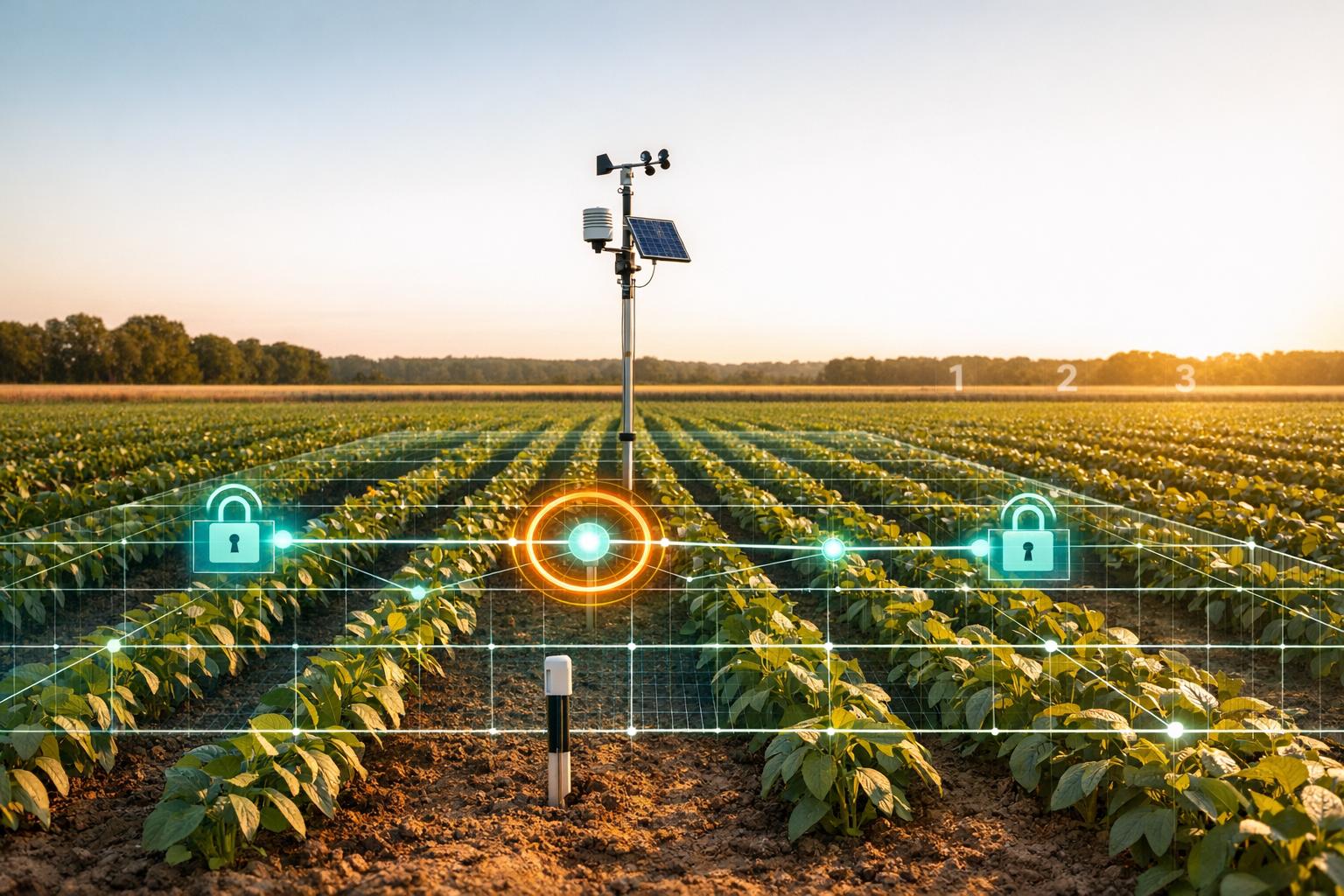
Farms are becoming more data-driven, but this progress comes with risks. Digital twins - virtual models of farms or equipment - paired with IoT sensors are transforming agriculture by providing real-time insights into soil, crops, and machinery. However, these technologies also expose farms to cyber threats, such as data breaches and system disruptions.
Here’s what you need to know:
- Digital twins: Offer advanced analytics and simulate farm operations but require secure data transmission and robust encryption.
- IoT sensors: Collect real-time data from the field but are vulnerable to hacking and tampering if not properly secured.
- Security concerns: Breaches can disrupt irrigation, leak sensitive data, or compromise yield forecasts.
- Costs: Medium-sized farms spend $50,000–$100,000 to implement these systems, with ongoing expenses for updates and maintenance.
- Scalability challenges: Integrating large datasets from diverse sensors requires open standards and reliable infrastructure.
Key takeaway: Combining IoT sensors with digital twins enhances both security and efficiency. Sensors gather data ("eyes"), while digital twins analyze and protect it ("brain"). Farms can start small, focusing on specific areas like irrigation or equipment monitoring, before scaling up.
Quick Comparison:
| Feature | Digital Twin Platforms | IoT Sensor Systems |
|---|---|---|
| Data Security | High; includes threat monitoring | Low; vulnerable to attacks |
| Accuracy | Very high; integrates multiple data sources | High for specific metrics |
| Deployment Costs | High; requires advanced AI and integration | Low to moderate; device-based |
| Scalability | Suitable for any size operation | Adding sensors increases scale |
Combining these technologies can safeguard farm data and improve decision-making. Focus on secure communication, regular sensor calibration, and phased implementation to maximize benefits.

Digital Twin Platforms vs IoT Sensor Systems: Security, Accuracy, Cost & Scalability Comparison
1. Digital Twin Platforms
Data Security
Digital twin platforms bring together virtual farm models and real-world IoT sensors, requiring secure data transmission between field equipment and the cloud. Farms face unique challenges due to their spread-out locations and inconsistent infrastructure. V. S. Manivasagam from Amrita School of Agricultural Sciences highlights:
Successful implementation necessitates substantial adaptation to address challenges such as variability in biological processes, environmental influences, data integration complexities, and infrastructure constraints.
Unlike controlled environments like factories, farms deal with constantly changing data from various sensors - soil moisture monitors, weather stations, and even satellite imagery. Each of these may need specific encryption standards to ensure security. Role-based access controls are essential to restrict access to sensitive field data, while secure communication protocols help prevent tampering during transmission. These measures are critical to maintaining the accuracy of real-time data, which will be explored next.
Data Accuracy
The accuracy of digital twin platforms hinges on their ability to stay synchronized with real-time sensor data. For example, a cattle monitoring system in China achieved 94.97% accuracy in classifying animal behavior across 120 cattle, enabling early disease detection. Similarly, a digital twin project for tangerine orchards on Jeju Island, South Korea, covering 185,000 hectares, achieved 89.6% accuracy in crop forecasts. This led to a 17% reduction in crop losses and a 23% drop in water consumption.
Agriculture presents unique challenges due to the biological variability of crops and livestock. Environmental factors like soil conditions, microclimates, and growth stages affect outcomes differently. Regular calibration of IoT equipment is essential to avoid sensor drift or hardware issues that could compromise data reliability. In greenhouse horticulture, calibrated digital twins have improved fertilizer efficiency by 18% and cut water consumption by 20–25%.
Deployment Costs
Deploying digital twin platforms has proven to reduce operational costs in measurable ways. However, ongoing expenses - such as cloud service fees, software updates, equipment upkeep, and staff training - remain a barrier. Currently, only 27% of small and medium-sized agricultural businesses are prepared to invest in this technology over the next five years. A phased implementation approach can help manage these costs, starting with high-impact use cases and lightweight edge analytics before scaling up to full deployment. Managing costs effectively is critical to encouraging broader adoption.
Scalability
Scaling digital twin platforms involves combining data from multiple systems - such as individual fields or livestock groups - into a unified farm-wide operation. Cloud computing offers the necessary storage and processing power, removing the need for extensive local hardware. The Jeju Island tangerine project demonstrated this by integrating IoT sensors, satellite data, and weather information across 185,000 hectares, resulting in a 12% reduction in logistics and storage costs.
However, data interoperability remains a significant challenge for large-scale operations. Many IoT devices and sensors use incompatible data formats, making open data standards essential for seamless integration. Edge analytics can help by processing data closer to its source, cutting down on bandwidth and computing time. Despite these advancements, the lack of interdisciplinary specialists in IT, engineering, and data management continues to slow the widespread adoption of these platforms in large-scale agricultural settings.
sbb-itb-ac6e058
Is Your Farm a Target for Hackers? Real Cybersecurity Risks in Agriculture
2. IoT Sensor Systems
IoT sensors play a critical role in capturing real-time data, forming the backbone of digital twin platforms that rely on secure and scalable data management.
Data Security
IoT sensors act as the vital link between physical farmland and digital twin models. However, this connection also introduces potential security risks. The effectiveness of agricultural decision-making systems hinges on the reliability and accuracy of sensor data. For example, if a soil moisture sensor is tampered with, the digital twin could deliver inaccurate insights, leading to poor irrigation decisions or even crop losses.
To address these risks, digital twin architectures now double as security systems for IoT networks. They can detect cyber threats in real-time and initiate countermeasures immediately. This evolution transforms digital twins from passive tools into active defenders of the data they rely on.
Data Accuracy
High-quality data from IoT sensors - such as soil monitors, drones, and satellites - feeds into digital twin simulation engines, enabling predictive agriculture. Unlike traditional methods, AI-driven digital twin models can process diverse data sources simultaneously, offering more precise insights. For instance, these systems now integrate environmental data at a 10-meter resolution, allowing them to capture soil and weather conditions with remarkable detail.
This level of precision enables farmers to optimize multiple crop traits, such as yield and disease resistance, without compromise. Brad Zamft, PhD, CEO of Heritable Agriculture, highlights the potential of this technology:
I think we're going to get a new strawberry variety on supermarket shelves in four years from start to finish for a few million dollars, and this is just the beginning.
Deployment Costs
Traditional crop improvement research often exceeds $100 million in costs. By replacing expensive field trials with virtual simulations, digital twin technology can cut these expenses to just a few million dollars. This cost reduction makes advanced agricultural solutions more accessible.
However, challenges remain. The lack of standard frameworks and the security limitations of older systems make widespread adoption difficult. Additionally, farms transitioning to IoT-enabled systems face significant initial expenses due to infrastructure limitations and data integration challenges.
Scalability
Scaling digital twins across extensive farming operations introduces its own set of challenges. Maintaining the integrity of sensor data over large, inconsistent networks is a persistent issue. Emerging autonomous systems address this by integrating historical data with real-time sensor inputs, enabling early detection of diseases or pest infestations.
The stakes are high: the agricultural sector must scale to feed an estimated 10 billion people by the mid-2080s. For IoT sensor systems to support this transformation, infrastructure issues must be resolved to ensure consistent and reliable data flow from the field to the cloud. These scalability concerns add to the broader integration challenges faced by digital twin platforms.
Advantages and Disadvantages
Digital twins and IoT sensors each come with their own strengths and challenges when it comes to securing agricultural data. Weighing these factors is crucial for farmers and agribusinesses looking to make informed decisions about their operations.
IoT sensors are cost-effective and simple to implement. These devices are relatively inexpensive, making them easy to deploy and scale by adding more units across agricultural fields. However, they are also the most vulnerable component in the system. Research has identified 58 distinct threat points in IoT-enabled farming systems, exposing them to risks like spoofing, tampering, and denial of service attacks. For instance, a study on the "Piping Botnet" revealed how 1,355 compromised smart sprinklers could drain an entire water tower in just one hour.
Digital twin platforms, on the other hand, offer enhanced security and analytics but come at a higher price. These systems use AI-driven anomaly detection to validate sensor readings against virtual models, adding a layer of security and accuracy. This capability proved critical during the JBS ransomware attack in May 2021, which forced the shutdown of facilities in the U.S., Canada, and Australia. JBS ultimately paid an $11 million ransom in Bitcoin to regain control of its systems. The following table highlights key differences between digital twin platforms and IoT sensor systems:
| Feature | Digital Twin Platforms | IoT Sensor Systems |
|---|---|---|
| Data Security | High; includes real-time threat monitoring and countermeasures | Low; vulnerable to physical and network-based attacks |
| Accuracy | Very high; integrates data from multiple sources | High for localized metrics but limited to specific parameters |
| Deployment Costs | High; requires advanced AI and data integration | Low to moderate; costs depend on the number of devices |
| Scalability | Suitable for operations of any size | Scaling involves adding more sensors |
This comparison highlights the importance of a balanced approach when integrating digital twins with IoT sensors to protect agricultural data. A major concern lies in sensor integrity. While digital twins provide exceptional insights, they are only as reliable as the IoT data they process. If sensors are compromised - through integrity attacks or falsified readings - the digital twin's output can become unreliable. Veronica from Agrifi sums up the challenge well:
Every new connected device, whether it's a drone, irrigation controller, or greenhouse monitor, becomes a potential entry point for cyberattacks.
Conclusion
Choosing between digital twins and IoT sensors isn't about picking one over the other - it’s about combining their strengths. IoT sensors shine when it comes to gathering real-time data, whether it’s soil conditions, weather changes, or livestock health. These devices are often more affordable and easier to scale, but they come with risks, like cyber threats, if not properly managed. On the other hand, digital twins bring advanced analytics and security tools to the table, validating sensor data, identifying anomalies, and simulating risks before they affect real-world operations. Together, they create a system that not only safeguards data but also boosts farm productivity and smarter decision-making.
Different farming needs call for varying levels of integration. Digital twins have already shown their worth in areas like yield prediction, resource allocation, and disease monitoring.
The strongest security comes from combining these technologies. IoT sensors act as the "eyes", collecting data, while digital twins function as the "brain", offering context, predictions, and a secure environment for testing. This layered approach helps tackle vulnerabilities that hackers could exploit. As INCIBE-CERT highlights:
Digital twins are the critical vulnerability points as their security breach can lead to serious consequences for the operation of all industrial equipment and the safety of workers.
To combat these risks, farms should use robust encryption, secure communication channels, and role-based access controls. Regularly calibrating sensors also helps maintain the integrity of digital twin systems. For those not ready to dive in completely, starting small - perhaps with irrigation management or equipment maintenance - can be a smart way to ease into this technology.
As these systems evolve, their combined security and efficiency are reshaping the agricultural industry. By blending IoT sensor data with the analytical capabilities of digital twins, farms can protect their operations while optimizing performance. Platforms like Anvil Labs are leading this charge, enabling farms to adopt secure and scalable digital solutions for the future.
FAQs
What’s the first farm system to secure with IoT and a digital twin?
The first agricultural system to integrate IoT and a digital twin focuses on disease monitoring. This method enables the early identification and management of crop diseases, allowing farmers to take timely action to safeguard yields and minimize potential losses.
How do digital twins detect hacked or spoofed sensor data?
Digital twins rely on AI-powered tools to maintain data accuracy and reliability by spotting hacked or falsified sensor data. These tools include features like real-time validation, anomaly detection, and error-checking models that flag any irregularities or unexpected deviations in sensor activity.
What are the must-have security controls for farm IoT data?
To keep farm IoT data safe, it's crucial to have the right security measures in place. Start with end-to-end encryption, which ensures data remains protected during transmission. Pair this with role-based access control to limit access based on user roles, and add multi-factor authentication for an extra layer of security.
Other key practices include:
- Network segmentation: This separates critical systems from less sensitive ones, reducing potential exposure to threats.
- Secure API practices: Protect data exchanges between devices and systems by securing APIs.
- Regular security audits: Routine evaluations help identify vulnerabilities before they become problems.
- Real-time threat monitoring: Stay ahead of cyber threats by detecting and addressing risks as they occur.
These steps work together to protect agricultural data from unauthorized access and cyberattacks, ensuring systems remain safe and reliable.

.svg)


