

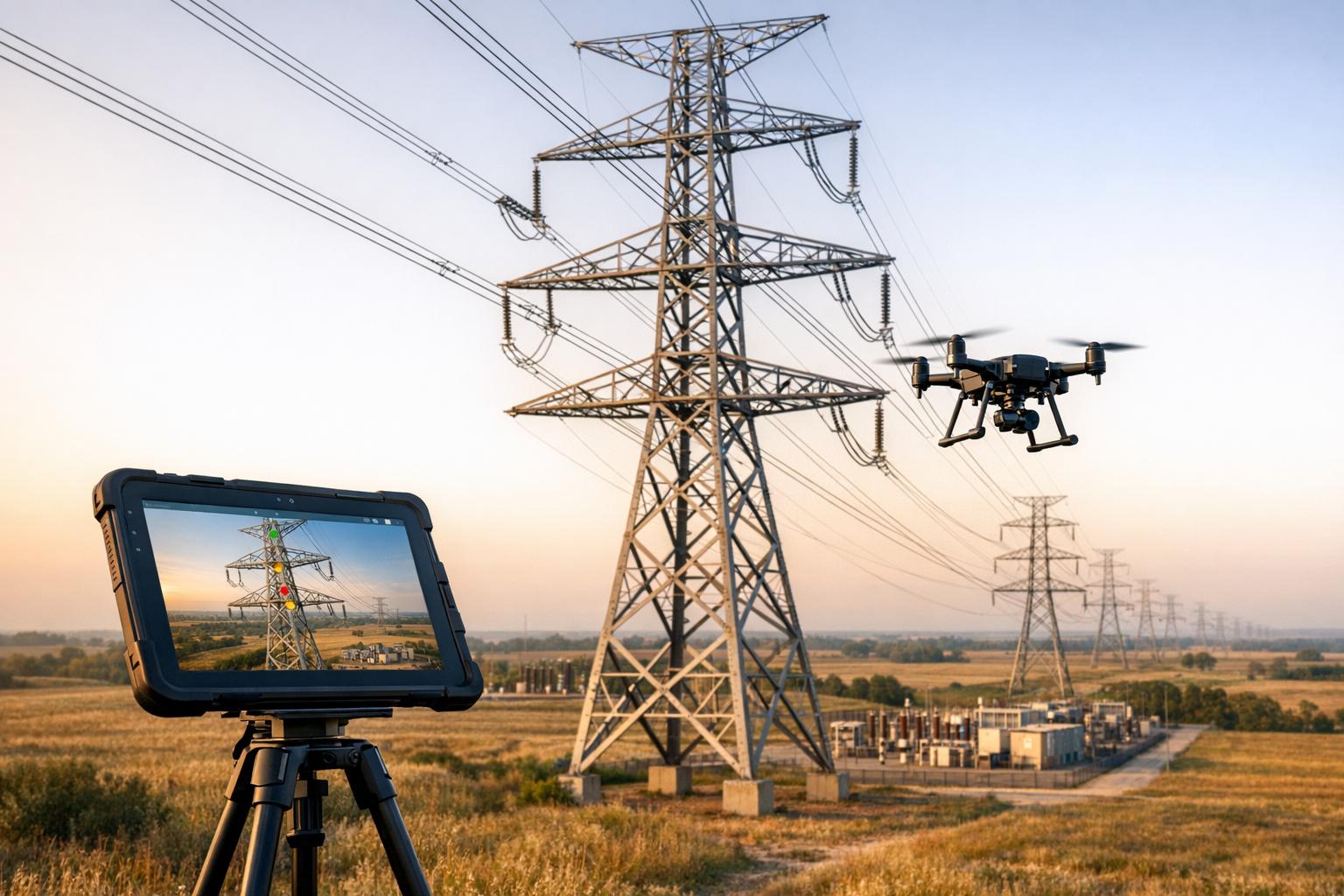
Digital twins are transforming how utility companies manage inspections and maintenance. These virtual models of physical assets, created using data from drones and sensors, allow operators to detect issues, predict failures, and plan repairs without physical inspections. Here's why digital twins matter:
- Efficiency Gains: Inspection times drop by up to 70%, and repair workflows integrate seamlessly with task management systems.
- Cost Savings: Companies like Duke Energy save millions annually by identifying defects earlier and reducing outages.
- Improved Safety: Workers avoid hazardous areas, cutting accident risks by up to 80%.
- Enhanced Precision: LiDAR and thermal imaging provide sub-millimeter accuracy, helping detect issues like corrosion and structural damage.
- Proactive Maintenance: Predictive models reduce unplanned downtime by 20–50% and extend asset lifespans.
With a market expected to hit $48.2 billion by 2026, digital twins are becoming a key tool for utilities aiming to improve reliability and cut costs.

Digital Twin Benefits for Utility Inspections: Key Statistics and ROI
Reimagining Utility Operations with Digital Twins and Lean Workflows Webinar
sbb-itb-ac6e058
How Drones Capture Data for Digital Twins
Drones follow pre-planned routes over utility assets to collect raw data for creating digital twins. For power lines, these flights typically operate at altitudes of 50–100 feet, producing point clouds with centimeter-level accuracy. When it comes to substations, drones generate orthomosaic maps and 360° panoramas, offering complete visual coverage of the area.
This process relies heavily on advanced sensor systems. RGB cameras capture high-resolution images, while LiDAR systems emit up to 1 million laser pulses per second to create dense 3D maps. At the same time, thermal cameras record surface temperatures. All of this data is georeferenced to align with real-world coordinates, ensuring precise mapping.
Why Drone Data Improves Utility Inspections
The data collected by drones is a game-changer for utility inspections. Compared to manual measurements, which are typically accurate only to within inches, LiDAR and photogrammetry deliver sub-millimeter precision. For example, in 2022, Xcel Energy used DJI Matrice 300 RTK drones equipped with LiDAR to inspect 500 miles of transmission lines in Colorado. This approach cut inspection time by 50% and identified 15% more defects, such as insulator cracks, helping the company avoid $1.2 million in outage costs.
Drones also bring major safety benefits. By eliminating the need for workers to climb towers or enter hazardous zones, they reduce accident risks by up to 70%, according to OSHA guidelines. In 2023, Pacific Gas & Electric utilized FLIR Vue TZ20 thermal drones to inspect 1,200 substations. These drones detected 28 corrosion hotspots, preventing potential failures during heatwaves. This method improved inspection efficiency by 75% and saved 4,500 man-hours.
Types of Data Used in Digital Twin Models
The data collected by drones feeds directly into digital twin models, enhancing the ability to detect defects and predict maintenance needs. Each type of data serves a unique role in creating a comprehensive model.
- 3D models from photogrammetry allow volumetric analysis and visual defect detection.
- Thermal imagery pinpoints temperature anomalies, such as corroded insulators, which often show temperatures 20–50°F higher than the ambient temperature. Overloaded transformers exhibit similar heat patterns.
- LiDAR point clouds provide precise structural measurements with 1–5 cm accuracy, enabling the analysis of pole lean, wire sag, or vegetation encroachment. These measurements are critical for maintaining FAA-regulated clearances of 10 feet from power lines.
Anvil Labs integrates all these data types - 3D models, 360° photos, thermal images, LiDAR scans, and orthomosaics - into unified digital twins. These models are easy to access for measurements, annotations, and secure sharing, streamlining utility management and maintenance efforts.
Processing and Hosting Digital Twins with Anvil Labs

How Anvil Labs Processes Raw Drone Data
Anvil Labs takes raw drone data and transforms it into detailed 3D models using an automated data processing pipeline. The platform supports a variety of input formats, including photogrammetry images, LiDAR scans, thermal imagery, 360° photos, and orthomosaics. By applying advanced spatial analysis algorithms, it produces highly accurate digital twins.
This automated system not only speeds up model creation but also ensures spatial precision. It’s designed to handle massive datasets, such as those from utility networks stretching across hundreds of miles. The result? Inspection-ready models that utility teams can access almost instantly. This streamlined process enables teams to manage assets collaboratively and on-demand.
Secure Hosting and Team Collaboration Tools
Once the models are processed, Anvil Labs ensures secure hosting, allowing utility teams to collaborate on these 3D models in real time. By converting drone data into actionable digital twins, utilities can move away from traditional inspection methods and adopt a more efficient, proactive approach to maintenance.
The platform includes strict access controls to safeguard sensitive data. Organizations can decide who can view or interact with specific models, which is essential for protecting critical infrastructure like transmission lines and substations.
Inspectors can use any device to access and annotate high-resolution 3D models, simplifying the process of identifying issues and coordinating repairs. Built-in tools make it easy to add annotations, take measurements, and tie findings directly to the digital twin. This creates a detailed, spatially-referenced record of infrastructure conditions.
Additionally, the platform integrates seamlessly with task management systems. This means inspection findings can flow directly into maintenance workflows, ensuring repair teams have immediate access to the spatial details they need to act quickly and effectively.
Using Digital Twins to Improve Inspections
With the detailed digital twins generated by Anvil Labs' advanced processing pipeline, utilities now have the tools to refine their inspection processes and streamline maintenance efforts.
Detecting Corrosion and Structural Damage
Digital twins give utility teams a powerful way to identify corrosion and structural damage by combining thermal imaging and spatial analysis. For example, drones equipped with thermal cameras can detect heat anomalies that point to potential problems - like hotspots on transformers or hidden corrosion on power poles long before rust appears. On the other hand, LiDAR and 3D modeling offer millimeter-level precision in spotting deformations, cracks, and thinning walls.
Take Duke Energy, for instance. In 2022, they used drone LiDAR data to create digital twins for 500 miles of transmission lines. The results? Corrosion was found on 15% of towers that had been overlooked during ground inspections. This early detection saved the company $4.2 million in outage costs within a year. Similarly, Pacific Gas & Electric leveraged thermal data in 2023 to pinpoint structural weaknesses across more than 200 substations. This approach reduced failure incidents by 35% - from 28 to 18 - and saved $1.8 million in emergency repairs.
Thermal imaging alone can uncover 85% more defects compared to manual visual inspections. Meanwhile, spatial models help identify critical issues like foundation cracks in substations, preventing potential collapses during severe weather. With interactive 3D views, inspectors can measure defects instantly and assign severity scores, enabling faster and more accurate decision-making. In fact, this process has been shown to cut decision times from days to hours while boosting accuracy by 30%.
Beyond identifying existing problems, these models provide ongoing insights that support proactive maintenance strategies.
Real-Time Monitoring for Predictive Maintenance
By integrating periodic drone flights and IoT sensor data, digital twins can be continuously updated, creating a foundation for predictive maintenance. AI algorithms analyze trends - such as the progression of corrosion - and predict failures up to six months in advance. This allows teams to address issues before they escalate.
Utilities adopting digital twins for predictive maintenance have reported a 20–25% reduction in repair costs and a 35% drop in unplanned outages. For example, a grid operator in the Midwest saved $1.2 million annually by detecting tower failures early. In another case, a California utility used weekly thermal scans to update digital twins and identify insulation wear through temperature changes. The system’s AI triggered automated alerts and work orders, which ultimately extended asset lifespans by 18%.
Adding Digital Twins to Maintenance Workflows
When digital twins detect issues like corrosion, structural damage, or thermal irregularities, they can be seamlessly woven into daily maintenance workflows. These 3D models act as a bridge, connecting field crews, managers, and contractors through shared data and automated work orders. The result? Better collaboration and more efficient task execution.
Improving Team Collaboration with Shared Models
Digital twins take the guesswork out of the equation. Instead of relying on static photos or written reports, teams can access the same interactive 3D model. With role-based permissions, drone operators can upload data, supervisors can add annotations, and field technicians can view models directly on their mobile devices.
Take Duke Energy as an example. In Q2 2023, they integrated drone-based digital twins into their IBM Maximo CMMS. This move cut their transmission line maintenance response times from 48 hours to just 4. Under the guidance of Asset Management Director Mark Reynolds, they linked 3D models to 1,200 work orders. The impact? A 28% reduction in outages and $1.2 million in annual savings.
These shared models don't just improve communication - they directly connect with task management systems, streamlining repair workflows.
Connecting Digital Twins to Task Management Systems
When paired with task management platforms, digital twins turn inspection results into actionable work orders. For example, if a hotspot like a corroded pole or thermal anomaly is flagged in the model, it can automatically generate a task, complete with priorities, deadlines, and assigned crew members. This approach replaces rigid calendar-based maintenance with condition-based scheduling, ensuring repairs happen when they're actually needed.
Southern California Edison offers a compelling case. In 2024, they integrated digital twins with their UpKeep task system, analyzing 3,500 substation inspections. Led by Maintenance Supervisor Lisa Tran, this effort reduced site visits by 35%, achieved a 95% task completion rate, and saved 12,000 man-hours annually. Similarly, Anvil Labs has supported integrations with task management systems and AI tools. By 2024, 68% of surveyed utility companies had connected digital twins with their CMMS platforms, resulting in a 25% faster task resolution rate.
This seamless connection between digital twin insights and task management systems is driving a shift toward more proactive and efficient utility maintenance.
Conclusion
Digital twins are reshaping the way utilities handle infrastructure inspections and maintenance. By using drone data to create precise 3D replicas, companies are achieving up to 70% efficiency gains, slashing inspection times from days to mere hours and enabling teams to collaborate remotely. The accuracy speaks for itself - AI-driven analysis of digital twins detects corrosion and structural issues with a 95% success rate, compared to just 70% with manual inspections.
The safety improvements are hard to ignore. Virtual inspections eliminate the need for workers to climb transmission towers or navigate live electrical environments, reducing accident rates by 80%. This not only protects workers but also ensures compliance with OSHA standards before any physical tasks are undertaken.
The financial benefits are equally compelling. Utilities are cutting operational costs by 25–40%, with some reporting annual savings exceeding $1 million. For instance, Pacific Gas & Electric managed to reduce inspection cycles from two weeks to just two days across over 500 transmission towers, slashing costs by 35% while catching corrosion early enough to prevent outages.
These advancements are powered by the integration of digital twin technology with advanced analytics. Anvil Labs plays a key role in this process, converting raw drone data into hosted digital twins enriched with LiDAR, orthomosaics, and thermal imagery. Their platform’s annotation tools, secure sharing options, and task management features make it easy for teams to collaborate seamlessly, no matter where they are.
FAQs
How often should drones update a utility digital twin?
Drones play a crucial role in keeping a utility digital twin accurate in real-time or near-real-time. By automating updates, they enable continuous monitoring, ensuring the digital twin reflects the latest conditions. Plus, when drone data is paired with digital twin technology, inspections become much faster - up to 75% more efficient - saving both time and resources.
What data do I need to build an accurate digital twin?
To build a precise digital twin, start by gathering high-quality data using sensors mounted on drones. Key inputs include high-resolution RGB images for visual details, thermal scans to capture heat patterns, and LiDAR data for creating accurate 3D models. Ensure you use the right tools, such as high-resolution cameras and advanced LiDAR scanners, and carefully plan flight paths to achieve full coverage and accurate georeferencing. By combining these diverse data sources, you can create detailed digital twins that streamline inspections and maintenance tasks.
How do digital twins connect to CMMS work orders?
Digital twins work hand-in-hand with CMMS work orders by delivering real-time, detailed data about assets. This connection allows for predictive maintenance, simplifies the process of creating work orders, and helps prioritize tasks more effectively. Additionally, by automating reports and presenting actionable insights, digital twins optimize maintenance workflows and boost overall efficiency in operations.

.svg)


