

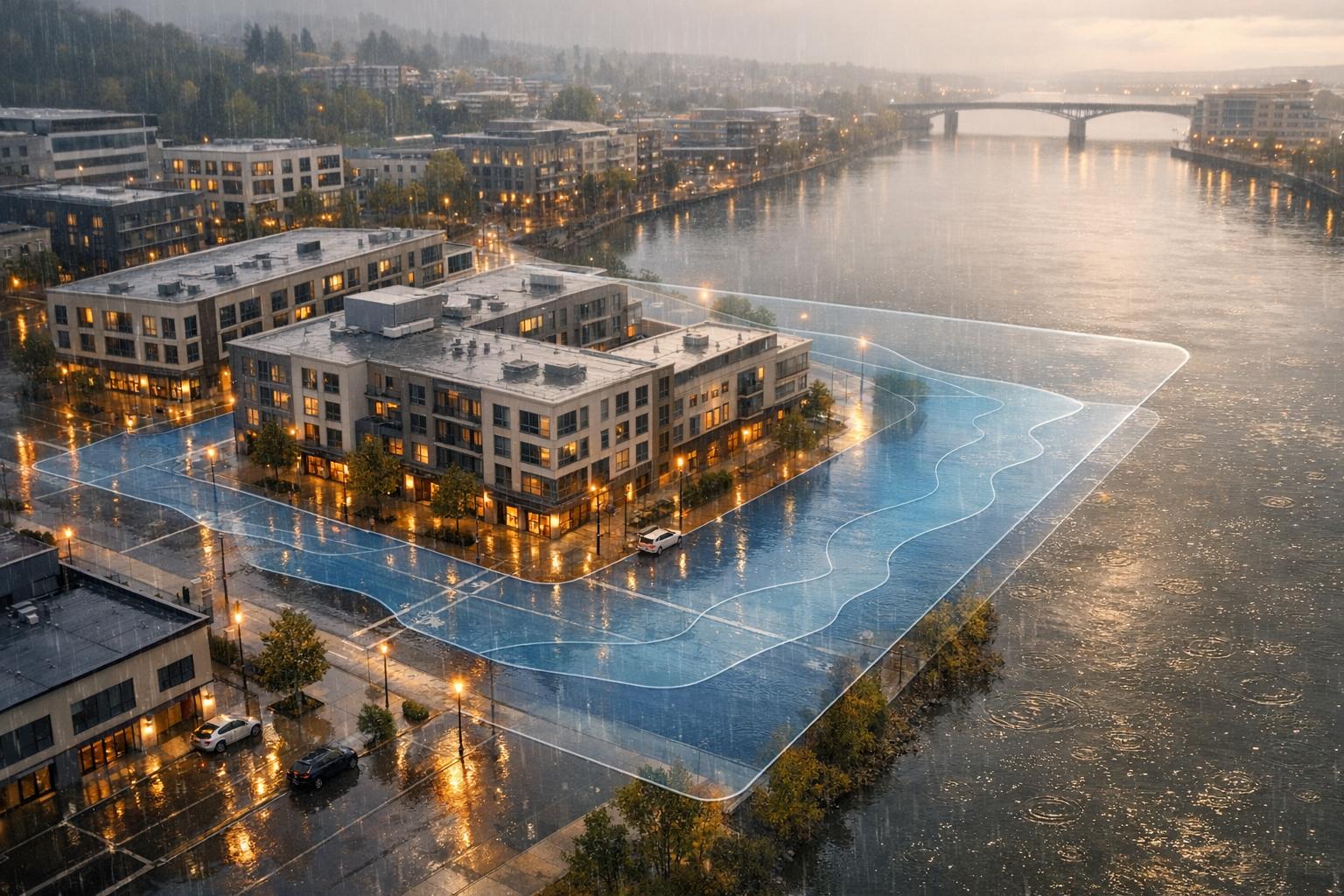
Digital twins are transforming how industries handle precipitation-related challenges by creating virtual replicas of physical environments. These systems use real-time data from sensors, forecasts, and historical records to simulate and predict weather impacts like flooding or droughts. Key benefits include:
- Flood Risk Assessment: Simulate heavy rainfall to predict damage and plan mitigation strategies.
- Infrastructure Planning: Test how structures perform under extreme weather before construction.
- Operational Efficiency: Use real-time data to optimize maintenance and emergency responses.
For example, Dresden's 3D digital twin models rainfall impacts, while platforms like K-Twin SJ monitor water systems to reduce costs and improve response times. By integrating advanced tools like LiDAR, thermal imaging, and AI, digital twins provide actionable insights, helping industries safeguard infrastructure and improve resource management.
Qian Chayn Sun - Advancing Flood Resilience: A Responsive Digital Twin Framework for Real Time Flood
sbb-itb-ac6e058
Key Components of a Digital Twin for Precipitation Monitoring

Three Key Components of Digital Twins for Precipitation Monitoring
Creating a digital twin for precipitation monitoring hinges on three main elements. Together, these components transform raw data into actionable insights, helping safeguard infrastructure and maintain smooth operations.
Data Sources and Integration
A digital twin for precipitation monitoring pulls data from various sources to build a complete picture of rainfall and its impact. Satellite Earth observation systems track large-scale precipitation trends, while ground-based sensors measure rainfall intensity, water levels, and flow rates at specific points. Historical weather data provides a baseline, and real-time forecasts support predictive planning . By combining these inputs, the system creates a unified framework for decision-making.
LiDAR technology adds another layer, offering high-resolution 3D maps of the site, including elevation, infrastructure, and drainage details critical for understanding storm water flow. Thermal imaging pinpoints temperature shifts caused by pooling water or flooding, helping identify potential risks to equipment or structures. Orthomosaics, or detailed aerial images, complement ground-level data to provide a comprehensive view.
The real challenge lies in merging these diverse data types. Differences in formats, timing, and storage can create inefficiencies. Companies like Anvil Labs tackle this by standardizing the integration of 3D models, LiDAR, thermal imagery, and orthomosaics. Their AI-powered tools ensure seamless workflows and automatic updates, eliminating the need for manual intervention.
When fully integrated, these data sets support the creation of precise 3D models that capture spatial dynamics in detail.
3D Models and Spatial Analysis
3D models are central to visualizing how precipitation impacts a site. These models, built using LiDAR scans, orthomosaics, and 360° imagery, allow for physics-based simulations to study water flow across infrastructure, identify flood-prone zones, and assess drainage system upgrades before construction.
Spatial analysis tools bring these models to life by simulating real-world scenarios, such as heavy rainfall or extended storms. The ECMWF Climate Digital Twin project is a prime example, producing climate projections from 1990 to 2050 with a resolution of 5–10 km. By integrating Earth-system and water management models on high-performance computing systems, the project enables precise, location-specific precipitation analysis that accounts for local topography and infrastructure.
These simulations aren't static; real-time monitoring ensures the digital twin remains an accurate and up-to-date reflection of actual conditions.
Real-Time Monitoring and Updates
To keep the digital twin aligned with real-world conditions, continuous data feeds are essential. IoT sensors provide real-time updates on rainfall, water levels, and equipment status, while weather APIs supply the latest forecasts. This enables quick decisions, such as activating pumps to prevent flooding .
Machine learning further enhances the system by processing real-time data to improve predictions. For example, the K-Twin SJ smart watershed platform integrates rainfall, river levels, and flow rates with hydraulic models in real time, ensuring reliable operations. Such systems have been shown to cut maintenance time by up to 30% and reduce costs by up to 25% in water management systems through real-time optimization.
Use Cases for Digital Twins in Precipitation Monitoring
Industrial sites face unique challenges when dealing with precipitation risks. Digital twins offer a way to simulate these conditions, identify vulnerabilities, and adjust operations proactively. These tools turn precipitation data into actionable strategies that safeguard infrastructure and streamline operations.
Flood Risk Assessment
Digital twins can simulate heavy rainfall to predict water accumulation and evaluate potential damage to buildings and infrastructure. For example, in March 2026, Dresden and TUD Dresden University of Technology introduced a 3D digital twin capable of modeling rainfall levels of 30–50 L/m²/h (1.2–2 in/h). This tool, developed by Dr. Katja Maerker and Lars Backhaus, integrates data from the Dresden City Drainage Authority to stress-test critical infrastructure and visualize potential damage. The project aims to strengthen urban planning against severe weather events.
In another instance, researchers in Terrebonne, Quebec, created a digital twin in July 2024 for a 1.25 km² (0.48 mi²) area of Ile St. Jean. Using LocalFloodNet, a Graph Neural Network, they analyzed 21 years of historical data (2000–2021) from Environment and Climate Change Canada. This tool helps simulate flood scenarios, such as placing concrete barriers to redirect river flow, enabling stakeholders to allocate resources more effectively during emergencies.
The importance of such tools is clear. For example, in 2024, heavy rainfall and flooding caused damages across Germany totaling EUR 2.6 billion (around $2.8 billion). Beyond forecasting flood impacts, digital twins are also shaping how infrastructure is designed to endure extreme weather.
Infrastructure Resilience Planning
Digital twins allow engineers to test how infrastructure performs under extreme precipitation conditions - before construction even begins. For instance, the Dresden project uses these simulations to identify potential weak points in critical infrastructure, such as railway underpasses, which are highly susceptible to flooding. Plans are underway to incorporate an early warning system with sensors to enhance safety further.
"Bundling complex city data into a single platform and making it usable for heavy rainfall prevention is an exciting challenge. This allows us to integrate previously abstract information into a tool with powerful capabilities that provides clear guidance to both administrators and citizens."
– Lars Backhaus, Developer, Institute of Hydraulic Engineering and Technical Hydromechanics at TUD
Virtual landscapes can also be altered - adding drainage channels, adjusting vegetation, or repositioning barriers - to see how these changes influence water flow during storms. This approach eliminates the need for costly physical trials, saving both time and resources while improving safety outcomes.
Once infrastructure is built, digital twins continue to play a role in optimizing operations during extreme weather.
Operational Efficiency Optimization
Digital twins assist operators in making quicker decisions during severe weather and improving maintenance schedules. Between May 2021 and December 2022, the Korea Water Resources Corporation (K-Water) developed the K-Twin SJ platform for the Sumjin Dam and river system. Operational since April 2023, this platform monitors real-time rainfall and water levels across a 4,913 km² (1,897 mi²) watershed and 173 km (107 mi) of river. It uses three hydraulic simulation models to support flood response and optimize dam operations.
Similarly, in September 2024, Tacoma Public Utilities (TPU) upgraded its digital twin platform for the Alder Dam on the Nisqually River. This project, led by Nathan Fletcher and Scott Warnick from Pacific Northwest National Laboratory, incorporated real-time data on river pressure and turbine speed. The platform simulates normal and extreme water flow conditions, helping operators predict maintenance needs and maximize energy production without additional costs.
"The digital twins solution enables hydropower operators to simulate different scenarios, such as low water flow or varying water levels, and predict future performance or maintenance needs."
– Scott Warnick, Electrical and Automation Systems Engineer, Pacific Northwest National Laboratory
These systems reduce the need for on-site inspections during hazardous weather and help determine optimal equipment operation schedules based on precipitation trends and energy demand.
How to Implement a Digital Twin for Precipitation Monitoring
Building a digital twin for precipitation monitoring involves three key steps: assessing the specific needs of your site, gathering and processing data, and deploying a management platform.
Assess Site-Specific Needs
Start by mapping your site's topography, drainage patterns, and historical precipitation data. This helps identify low-lying areas and infrastructure that may be at risk. By conducting this type of risk mapping, you can focus your monitoring efforts where they matter most and decide which sensors and data sources are necessary. The World Economic Forum highlights that simulating water levels and flow rates during this stage can cut maintenance costs by as much as 25%, as resources are directed toward high-risk areas.
Collect and Process Data
Gather data using rainfall sensors, IoT devices, and drone surveys equipped with tools like LiDAR, 360° cameras, and thermal imaging. Supplement this with weather forecasts from APIs for a more comprehensive view. A great example of this approach is Tacoma Public Utilities' work at Alder Dam on the Nisqually River. They combined real-time data on rainfall, water levels, flow rates, and CCTV footage with hydraulic models. This allowed them to simulate various scenarios, such as droughts and turbine adjustments, enabling proactive issue detection and smoother operations.
Once data is collected, process it using algorithms to identify patterns, predict trends, and test different scenarios. This involves cleaning raw data, merging inputs from various sources like LiDAR and weather feeds, and creating 3D flood simulations. These refined datasets are essential for integrating everything into a unified platform.
Use Anvil Labs for Implementation
After processing the data, the next step is deploying a management platform. Anvil Labs provides a powerful system for managing the diverse data types required for precipitation monitoring. You can upload 3D models, LiDAR point clouds, thermal images, and orthomosaics to build a comprehensive digital twin of your site. The platform's spatial analysis tools allow you to overlay precipitation data on your 3D models, making it easier to visualize how water moves across your site during different rainfall scenarios.
With tools for annotations and measurements, you can mark areas that are vulnerable, track drainage improvements, or document infrastructure changes. The platform's cross-device compatibility ensures your team can monitor conditions from anywhere - whether in the office or in the field during emergencies. Secure sharing features with access controls make collaboration seamless, allowing stakeholders like operations managers and emergency responders to work from the same data without security concerns. Additionally, integration with AI tools and task management systems lets you automate maintenance alerts or trigger workflows when rainfall exceeds certain thresholds, much like how digital twins are used to optimize water systems in real time.
Future Developments in Digital Twin Technology
Thanks to advancements in real-time monitoring, AI is now sharpening the capabilities of digital twins, particularly in predicting precipitation and assessing its impacts.
AI and Predictive Analytics
AI is changing the game for digital twins when it comes to forecasting precipitation patterns and their consequences. Take the hybrid model NeuralGCM, for example. It blends physics-based fluid dynamics with neural networks, cutting multi-year precipitation errors by 40% and keeping mean errors below 0.5 mm/day. Even more impressive, it accurately predicts extreme weather events by simulating critical processes like cloud formation and radiation.
"By training the AI component of NeuralGCM directly on high-quality satellite observations instead of relying on reanalyses, we are effectively finding a better, machine-learned parameterization for precipitation." - Janni Yuval, Research Scientist, Google Research
In mid-2025, a pilot program led by the University of Chicago and the Indian Ministry of Agriculture and Farmers' Welfare successfully used the NeuralGCM model to forecast monsoon onset. This breakthrough aimed to improve agricultural planning and water management. By integrating such advanced predictive tools, digital twins are becoming even more effective at delivering actionable insights. These refined forecasts not only help manage large-scale events but also tackle persistent issues like the overrepresentation of light rainfall in traditional models.
AI is also solving the "drizzle problem", where older models often exaggerate light rain while failing to account for heavy downpours. As Google Research highlights, "NeuralGCM more accurately captured heavy precipitation intensities... Capturing these most extreme, damaging precipitation events is an important step for applications ranging from climate science to public safety".
Conclusion
Digital twins are transforming how industries manage precipitation-related challenges, shifting the focus from reactive measures to proactive solutions. By using detailed digital replicas that combine real-time sensor data with weather forecasts, managers gain critical situational awareness and can simulate mitigation strategies before taking action.
Machine learning enhances forecasting accuracy by up to 11% compared to traditional methods. Additionally, IoT sensor integration minimizes the need for site visits and shortens response times.
These advancements directly contribute to stronger operational resilience.
"Digital twin technology has emerged as a paradigm-shifting solution, offering real-time virtual replicas of physical urban systems that enable comprehensive monitoring, predictive analytics, and proactive intervention strategies." - Springer Nature
Beyond weather prediction, digital twins offer industrial managers a centralized, real-time data hub that ensures all stakeholders are on the same page. This shared access to accurate data enables quicker, more coordinated decision-making during extreme weather events, enhancing safety protocols and operational efficiency.
Anvil Labs provides an all-in-one digital twin platform that supports 3D modeling, thermal imagery, LiDAR, and real-time data integration. Their tools for annotations, measurements, and secure data sharing make it easier to create monitoring systems that protect industrial sites from precipitation-related risks. With this integrated platform, industries can better safeguard their assets while streamlining response strategies.
FAQs
What data do I need to build a precipitation digital twin?
To build a precipitation digital twin, you’ll need a mix of detailed spatial data - such as LiDAR scans and point clouds to map terrain - along with real-time sensor data like rainfall measurements, water levels, and temperature readings. Additionally, satellite precipitation estimates provide a broader view for comprehensive coverage. By integrating these data sources into a platform like Anvil Labs, you can achieve precise modeling, real-time updates, and predictive insights into how precipitation affects industrial sites.
How accurate are flood predictions from a digital twin?
Flood predictions with a digital twin are approximately 30% more accurate when it comes to identifying risks. These tools also allow for real-time simulations, which enhance forecasting capabilities and streamline response efforts for industrial sites.
How long does it take to deploy this on an industrial site?
Deployment times for digital twin models on industrial sites usually fall between a few days and several weeks. The timeline largely depends on the complexity of the project and the specific data integration needs.

.svg)


