

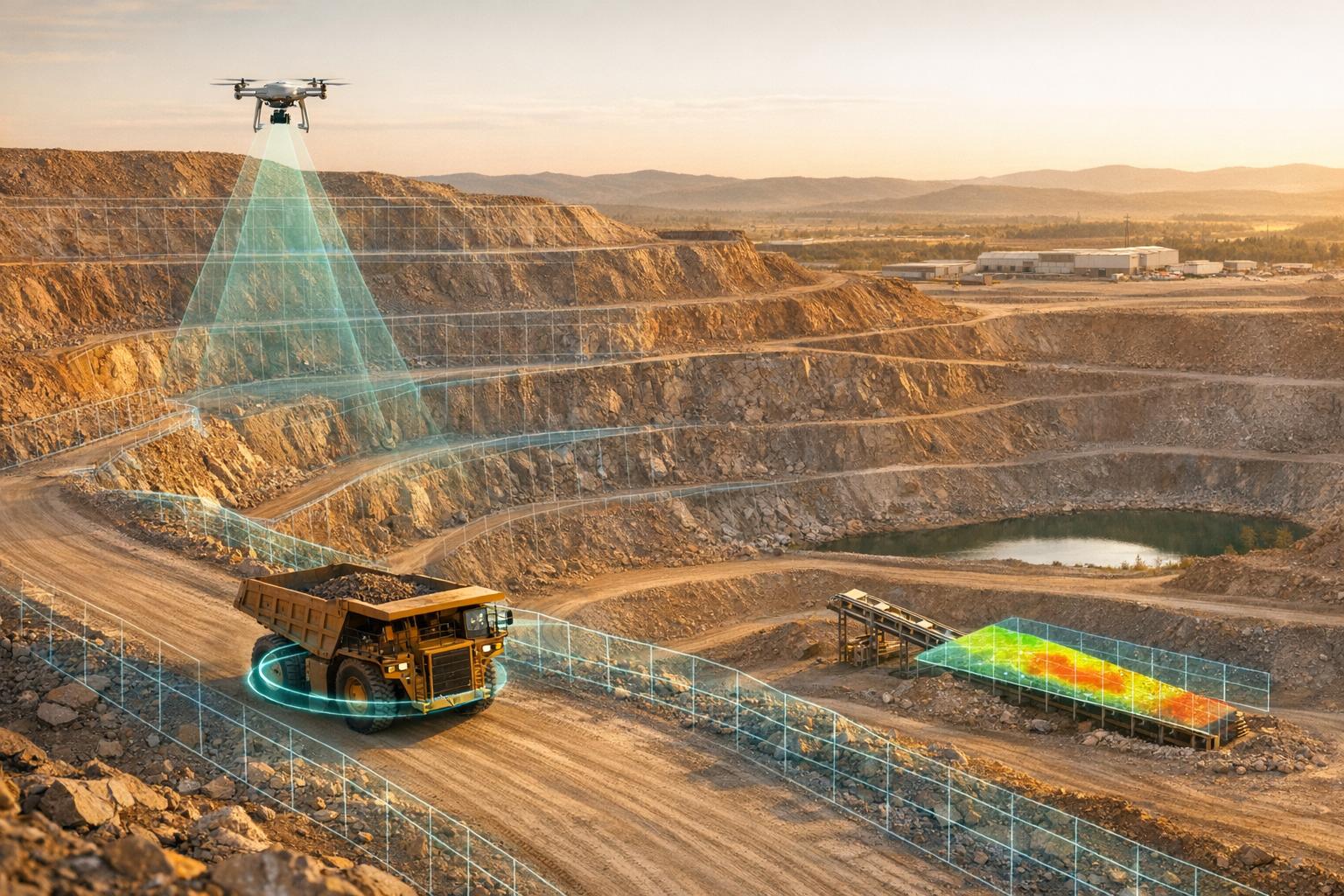
Digital twin models are transforming mining by creating virtual replicas of physical assets and processes. These models enable real-time data analysis, predictive maintenance, and process optimization, addressing challenges like declining ore grades and operational inefficiencies. By integrating IoT sensors, AI, and drone-based data, digital twins enhance resource estimation, ore grade control, and equipment monitoring. They also support sustainability efforts by reducing energy use and improving waste management. With investments in digital twin technology expected to exceed $48 billion by 2026, this approach is reshaping how mining companies improve productivity and decision-making.
Key takeaways:
- What they do: Digital twins provide real-time insights for mining operations, simulating equipment and processes.
- Applications: Used for ore grade control, resource estimation, and equipment maintenance.
- Technology: Combines IoT, AI, GIS, and drone data for precise modeling and analysis.
- Benefits: Improves efficiency, reduces costs, and supports sustainability goals.
Platforms like Anvil Labs are pushing these advancements further by offering tools for 3D modeling, real-time monitoring, and AI-powered insights, making mining operations smarter and more efficient.

Digital Twin Technology in Mining: Key Statistics and Benefits
Digital Twin Applications for Mining Processes
sbb-itb-ac6e058
How Digital Twin Models Are Used in Mining
Digital twins bring together data from IoT sensors, Geographic Information Systems (GIS), and Building Information Modeling (BIM) to create a virtual representation of mining operations. In mining, these models are divided into two main types: asset digital twins, which focus on equipment and layouts, and process digital twins, which simulate the chemical and thermal processes involved in ore refining. This combination helps improve ore grade control, resource estimation, and equipment monitoring.
Ore Grade Control
Process digital twins use real-time data from SCADA systems, control systems, data historians, and laboratory information management systems (LIMS) to track ore characteristics. By simulating the chemical and thermal variations during ore refining, these twins provide a real-time view of ore quality.
For example, a process digital twin can perform 720 plant-wide mass balance calculations in a single day, with updates every two minutes. This capability ensures that the mineral entering the plant matches the output plus any losses in tailings. Additionally, by overlaying real-time chemical analysis data from drills onto 3D geological models, operators can stay within high-grade zones and quickly adjust extraction strategies when ore quality changes. This approach is critical for addressing the ongoing challenge of declining ore grades.
Resource Estimation
Asset digital twins combine 2D and 3D models with mine-planning systems, offering continuous updates on pit design, haul routes, and mine layouts. By incorporating data from drone-based photogrammetry and LiDAR, these models provide frequent updates to 3D spatial representations, which are essential for accurate volume and resource calculations. This creates a "closed-loop" system where field data continuously refines resource estimations.
Process digital twins also track inventory changes over time, reflecting material accumulation or removal in the digital model. They can even simulate data for material streams where physical sensors are unavailable, filling in crucial gaps. By syncing "as-planned" geological models with "as-mined" data, operators can immediately adjust extraction strategies based on the latest information.
Beyond resource estimation, digital twins play a key role in ensuring equipment reliability and operational efficiency.
Equipment Monitoring and Maintenance
Asset digital twins monitor equipment health and location by integrating real-time data on vibration, temperature, and pressure. This allows them to simulate wear and predict potential failures. By connecting to Fleet Management Systems (FMS) and SCADA systems, digital twins provide a complete view of equipment performance, enabling a shift from reactive to proactive maintenance.
In mining's harsh environments, this is especially important. Continuous monitoring helps detect anomalies that could signal equipment issues, allowing maintenance teams to address problems during scheduled downtime instead of dealing with unexpected breakdowns that disrupt operations. This proactive approach ensures smoother workflows and minimizes costly interruptions.
Technology Integration with Digital Twins
Digital twin platforms bring together drone data, 3D modeling, and AI-driven analytics to turn raw field data into meaningful insights for the mining industry.
Drone-Based Data Collection
Drones equipped with advanced tools like LiDAR sensors and multispectral cameras gather detailed spatial data from mining sites. This data feeds directly into digital twin systems. For example, LiDAR point clouds deliver accurate elevation and volumetric measurements, while orthomosaics provide high-resolution aerial imagery, helping operators monitor stockpile volumes and track pit development. Additionally, thermal imaging from drones can identify temperature fluctuations in equipment or stockpiles, offering an extra layer of monitoring within the digital twin system.
3D Modeling and Spatial Analysis
By combining 3D models, LiDAR data, and orthomosaics, digital twin platforms offer mining teams a clear, visual representation of operations. Tools for annotation and measurement make it easy to mark zones, calculate distances, and assess volumes with precision. Real-time updates are accessible across devices, ensuring field geologists and planners stay informed. At the same time, role-based access controls safeguard sensitive geological data, allowing secure collaboration.
AI and Machine Learning Applications
AI and machine learning take digital twin functionality to the next level by streamlining data processing. For instance, deep learning models like Convolutional Neural Networks (CNNs) and 3D-CNNs automate the identification of intricate geological features, which is essential for accurate resource evaluations. These models also integrate multiple data types - such as LiDAR point clouds, multispectral drone imagery, and GIS layers - into a unified 3D framework. Algorithms like Random Forest and Support Vector Machines further enhance analysis by estimating volumes and grades, blending sensor data with historical records. Between 2021 and 2025, interest in multimodal geospatial AI has grown significantly, with 77% of related peer-reviewed articles published during this period. Together, these technologies create dynamic digital twins that support better, data-driven decision-making in mining.
Benefits of Digital Twin Models in Mining
Digital twin models offer more than just technical perks - they provide mining operations with a way to address declining productivity. Over the past decade, mining productivity has dropped by about 28%. Digital twins present a way forward, using data to optimize processes and improve decision-making, operational efficiency, and environmental practices across the board.
Better Decision-Making
With digital twins, decision-making becomes proactive and grounded in real-time data. Instead of reacting to problems after they occur or relying on fragmented information, operators gain a clear, daily snapshot of operations.
These systems also integrate seamlessly with ERP and MES systems through Resource Planning Scheduling (RPS). This integration allows for accurate long-term forecasting of mineral needs and revenue, while visually mapping the value chain to pinpoint bottlenecks and measure their impact on performance.
Increased Efficiency
Efficiency gets a significant boost with digital twins. They identify inefficiencies early, automate routine reporting, and free up staff to focus on more strategic tasks.
For example, process digital twins have been shown to deliver returns on investment between 20 to 40 times the current output. They also allow companies to test new equipment in virtual simulations before installation, avoiding unnecessary expenses. With investments in digital twin technology in mining expected to surpass $48 billion by 2026 - and 70% of technology executives at large enterprises already exploring this innovation - it's clear these efficiency gains are becoming a competitive necessity.
Environmental Impact Reduction
Digital twins also play a crucial role in reducing the environmental footprint of mining operations. By optimizing resource use and energy management, they help companies make data-driven changes that lead to more sustainable practices. For instance, digital twins enable the design and simulation of energy systems, helping operators shift to renewable energy sources and fine-tune hybrid energy setups to cut down on fossil fuel reliance. This is critical in an industry that accounts for roughly 11% of global energy consumption.
These models also allow for better mine design by simulating various extraction scenarios. This reduces the energy needed per unit of material extracted. In addition, they provide tools to measure and track environmental metrics like water usage, carbon emissions, and biodiversity impacts against established benchmarks.
"Virtual twins drive sustainability and the circular economy at speed and scale. They help companies reduce their costs, resource use and carbon footprint." - Accenture Report
Beyond that, digital twins assist with land management by using geospatial data to ensure compliance with regulations and improve planning for site decommissioning and rehabilitation. By breaking down silos within operations, they help minimize rework and resource waste, reducing unnecessary environmental disruptions.
Anvil Labs Features for Mining Operations
Anvil Labs takes digital twin technology to the next level for mining operations. By combining 3D modeling with spatial analysis, the platform creates highly accurate virtual replicas of mine sites. These models, paired with real-time monitoring and collaboration tools, help streamline ore grade control and resource estimation while improving team coordination and decision-making.
Data Management Capabilities
Anvil Labs supports a wide range of data crucial for mining, including 3D models, LiDAR point clouds, orthomosaics, thermal imagery, and 360° photos. For instance, drone-captured LiDAR data delivers precise topographic mapping in feet and yards, while thermal imagery is automatically processed to aid ore grade analysis. By overlaying these different data types, geologists can achieve a deeper understanding of site conditions.
The platform also features automated data processing, which aligns LiDAR scans with orthomosaics, saving teams from manual prep work. It includes secure asset hosting with role-based access controls, ensuring compliance with mining regulations. Teams can easily update digital twins with new survey data after each drone flight. For additional support, data processing services are available at $3.00 per gigapixel, offering flexibility for teams with larger data needs.
These advanced data management tools feed directly into the platform’s visualization and collaboration features.
Viewing and Collaboration Tools
Anvil Labs offers interactive 3D viewing that works seamlessly across desktops, tablets, and mobile devices. This allows site managers to inspect digital twins on the go, while engineers can analyze the same data from their offices. Real-time collaboration is further enhanced with annotation tools, enabling teams to mark ore veins, equipment locations, or safety concerns directly on the models. Measurement tools also allow for precise volume calculations in cubic feet, aiding pit planning and material estimation.
Secure sharing options let teams collaborate with external partners through controlled access links, ensuring sensitive geological data stays protected. During shift changes, geologists and engineers can remotely review annotated digital twins to maintain operational continuity. For surface mines, these tools are invaluable for tracking equipment wear on LiDAR scans and monitoring dimensional changes over time, helping to predict maintenance needs and minimize downtime.
This seamless collaboration paves the way for deeper workflow integrations.
Technology Integrations
Anvil Labs integrates with AI analysis tools, Matterport, YouTube, and task management systems to simplify mining workflows. AI tools analyze thermal and LiDAR data to identify mineral signatures and estimate ore volumes. Machine learning models, trained on historical mine data, offer predictions on grade variability within digital twins, delivering 15-25% more accurate estimates compared to traditional methods, according to industry benchmarks.
The platform keeps digital twins up to date by automatically incorporating new aerial data, eliminating the need for manual imports. Matterport integration allows for hosting 360° underground photos, ideal for areas where traditional surveying is difficult. Teams can also embed video walkthroughs via YouTube for training and documentation purposes. Additionally, task management tools let supervisors assign work orders directly from annotated points on the digital twin, seamlessly connecting spatial data with daily operations.
Conclusion
Digital twin models are reshaping how mining operations handle ore grade control and resource estimation. Instead of relying on static spreadsheets, mining companies now use real-time, two-way data flows to create accurate virtual replicas of mine sites. This shift is tackling long-standing industry challenges, improving both operational efficiency and resource management.
These benefits aren't just theoretical - they're delivering real results. For example, in February 2026, an open-pit gold mine in Brazil cut ore misrouting by 98% using digital twin tracking systems. This improvement prevented $500,000 in annual losses and uncovered 100,000 tons of misrouted, higher-grade ore. Similarly, a gold operation producing 100,000 ounces per year saw a 1.6% boost in recovery rates and a 30% drop in reagent costs by replacing static dosing methods with predictive controls informed by digital twin data.
Anvil Labs is driving these changes with advanced tools like robust data management, interactive 3D visualizations, and AI-powered insights. By processing data from sources like LiDAR, thermal imagery, and orthomosaics, the platform delivers the precision needed for detailed ore body analysis. Its cross-device accessibility ensures that geologists, engineers, and site managers can access the same up-to-date digital twin data, whether they're in the office or on-site.
The mining industry is moving toward a future where ore variability becomes a manageable asset instead of an unpredictable problem. With cloud-based analytics, AI-driven predictions, and platforms like Anvil Labs, the standard for mine tracking, planning, and optimization is being redefined. This transformation is setting a new benchmark for efficient mining operations and smarter resource management.
FAQs
What data do we need to build a mine digital twin?
To build a mine digital twin, you’ll need high-resolution spatial data - think 3D models generated by drone photogrammetry or LiDAR scans - and sensor data from IoT devices tracking variables like temperature, vibration, and surrounding conditions. Ensuring the data is accurate requires careful collection, proper calibration, and smooth integration of all sources. LiDAR stands out as a tool for capturing intricate terrain details in challenging environments.
How do digital twins improve ore grade control day to day?
Digital twins improve ore grade control by allowing real-time monitoring and seamless data integration from sources like sensors and drones. By combining this data with predictive analytics, operations can refine blast designs, reduce ore loss, and achieve more accurate resource estimates.
How fast can a digital twin deliver ROI in a mining operation?
Digital twins in mining operations have shown the potential to deliver a return on investment (ROI) in roughly one year. This swift payoff is largely attributed to cost savings, enhanced safety measures, and more informed decision-making.
Industry reports emphasize that these benefits stem from streamlined workflows and lower operational expenses, making digital twins an attractive option for mining companies looking to optimize their processes and improve efficiency.

.svg)


