

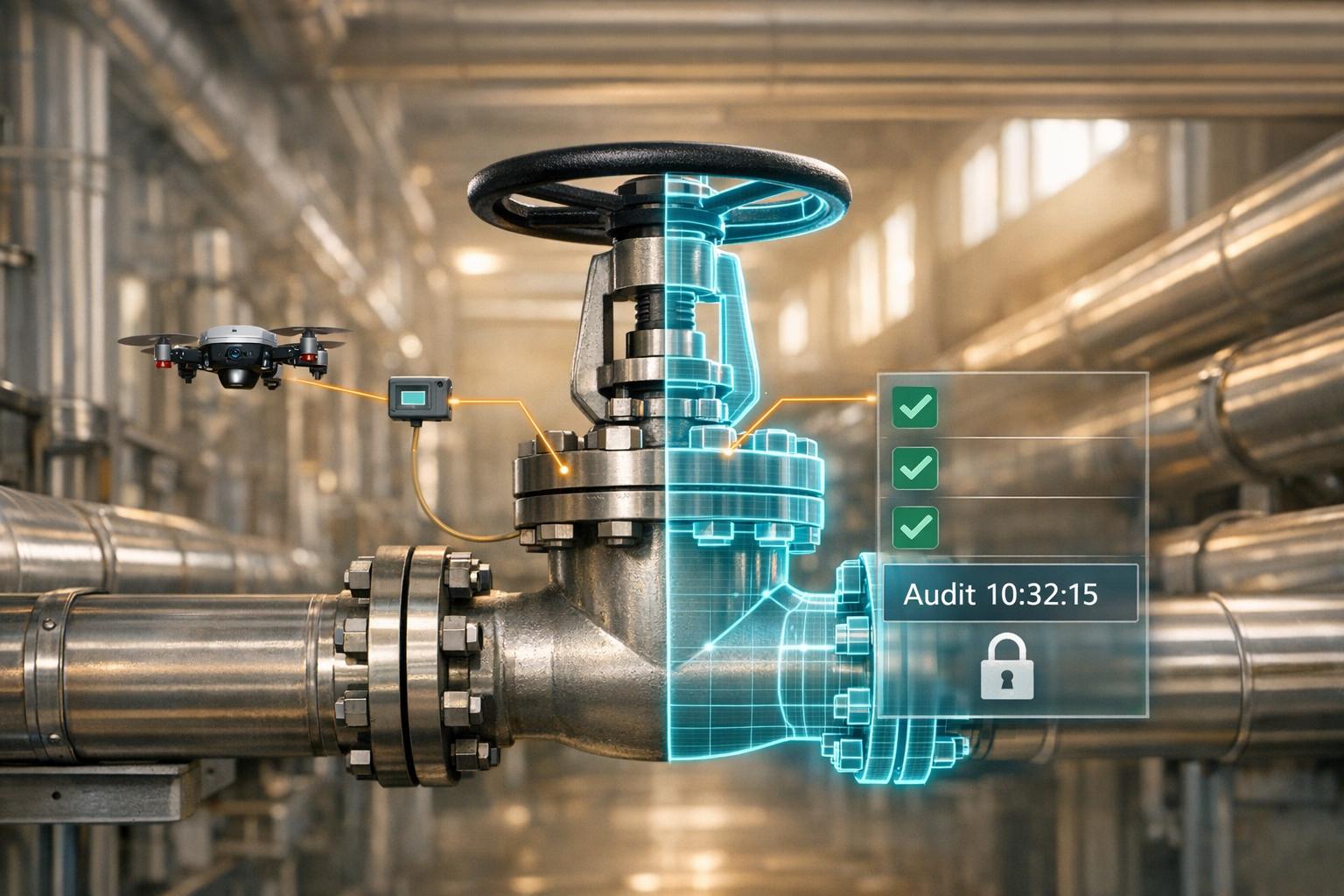
Digital twin audits are transforming how industries meet regulatory standards. By creating virtual replicas of physical systems, these tools automate compliance processes, reduce risks, and improve efficiency. Here's what you need to know:
- What they do: Digital twins provide real-time monitoring, automated record-keeping, and historical data for audits.
- Key benefits: Over 95% accuracy in compliance checks, faster audit cycles (from weeks to hours), and reduced costs by 30–40%.
- Who uses them: Industries like manufacturing, healthcare, and construction leverage digital twins to meet standards like ISO 23247 and HIPAA.
- How they work: Using IoT sensors, drones, and AI, digital twins simulate operations, detect issues, and maintain compliance records.
Platforms like Anvil Labs simplify this process with centralized tools for data management, analysis, and secure sharing. With growing regulatory demands, digital twin audits are a practical solution for staying compliant while improving operations.

Digital Twin Audit Benefits: Key Statistics and ROI Metrics
What Are Digital Twin Audits?
Definition and Technology
Digital twin audits rely on virtual replicas that stay up-to-date through IoT sensors, drones, and connected devices. These replicas allow organizations to verify compliance without interrupting operations. For example, in network environments, digital twins offer real-time dashboards displaying configuration data and maintaining transparent historical records. Auditors can access these records anytime for review, streamlining the process.
This technology is versatile and finds use across various industries. In manufacturing, digital twins simulate production lines to test safety protocols. In healthcare, they help run virtual breach simulations to ensure compliance with HIPAA regulations. Construction teams, on the other hand, use drone-generated 3D models of job sites to verify safety standards. According to NIST frameworks, tracking assets in real time through digital twins can cut compliance costs by 30–40%.
Beyond compliance, these tools offer operational improvements that make them a valuable asset.
Benefits of Digital Twin Audits
Digital twin audits bring a new level of accuracy and efficiency to compliance monitoring. With AI-driven simulations and continuous updates, these audits achieve over 95% accuracy - far surpassing the 70–80% accuracy typical of manual audits, which rely on human observation and occasional spot-checks. Automated metrics ensure data integrity and enable early detection of potential issues.
Another key advantage is speed. Traditional audit cycles, which often take weeks, can now be completed in hours using digital twins. Certification processes confirm that these virtual models accurately reflect real-world conditions, even predicting issues like cybersecurity risks. The Digital Twin Consortium highlights their role in advancing compliance monitoring to meet modern demands.
The benefits don’t stop there. Surveys reveal that 47% of organizations report better proactive problem-solving, while 45% note improvements in product and service quality. By automating data collection and analysis, digital twins eliminate the delays caused by manual reporting, delivering reliable, real-time compliance data that aligns with today’s regulatory requirements.
sbb-itb-ac6e058
Standards and Regulations for Compliance
ISO Standards for Digital Twins
The ISO 23247 series lays the groundwork for standardizing digital twin technologies in manufacturing. ISO 23247-1:2021, for instance, introduces the core principles, terminology, and requirements for digital twin frameworks. This serves as a key reference point for assessing the structural soundness of digital twin implementations.
For more intricate systems involving multiple digital twins, ISO 23247-6 provides guidelines for integration, communication, and collaboration across these systems. As of February 20, 2026, this standard is in its Final Draft International Standard stage, signaling its near-finalization. It aims to streamline how multiple digital twins operate together within larger ecosystems.
By addressing fragmentation in digital twin development, these standards establish shared terminology and reference models. This not only reduces development costs but also improves system integration - both essential for meeting regulatory requirements in industrial environments. These ISO guidelines act as a foundation to tackle the specific needs of various industries.
Industry-Specific Requirements
While the ISO 23247 series provides a standardized approach, industries often face compliance challenges unique to their operations. For example, manufacturing facilities rely on these standards to validate digital twin systems used for monitoring operations and maintaining system integrity. On the other hand, sectors like energy and healthcare must adapt these frameworks to meet their operational requirements while adhering to data protection regulations.
Standardization also benefits smaller enterprises by encouraging the use of modular, reusable components. This approach simplifies the auditing process, making it easier to meet compliance requirements. Adopting these standards helps industries carry out smoother digital twin audits and ensures they remain aligned with regulatory expectations.
How to Implement Digital Twin Audits
Creating Digital Twins from Drone Data
Drone data is the backbone of digital twins. Using LiDAR scans, drones produce detailed point clouds that map physical structures with precision. Thermal imagery helps detect temperature variations, which can reveal equipment wear or energy inefficiencies. Meanwhile, photogrammetry combines high-resolution images to build detailed 3D models of entire facilities.
To gather this data, drones follow carefully planned flight paths. The raw data is then processed into formats like point clouds, orthomosaics, and 3D meshes, which are uploaded to a centralized platform. For example, Anvil Labs simplifies this process by accepting LiDAR point clouds, thermal images, 360° panoramas, and orthomosaics directly - removing the need for separate conversion tools.
Compared to traditional manual surveys, drone-based data collection drastically reduces preparation time. A facility that might take weeks to survey manually can be captured in just hours with drones. Plus, the resulting digital twin serves as a lasting reference point, making it easier to monitor changes over time. This automated, efficient approach provides the foundation for advanced metrics and smoother compliance processes.
Metrics and Automation for Auditing
Digital twin audits depend on specific metrics to ensure compliance. For example, asset integrity scores evaluate equipment condition using visual data and sensor inputs. Compliance checkpoints highlight any deviations from standards, such as inadequate clearance distances or safety violations. By embedding these metrics into the digital twin, organizations create a continuous audit record.
Automation takes these metrics and turns them into actionable insights. Instead of manually inspecting hundreds of assets, automated systems can scan the digital twin for compliance issues and generate detailed reports. Platforms like Anvil Labs enhance this process by integrating with AI analysis tools and task management systems, ensuring flagged issues are routed to the right teams. Additionally, the platform’s annotation and measurement features allow auditors to highlight problem areas and track fixes - all without needing to revisit the site in person.
Using Anvil Labs for Digital Twin Audits
Anvil Labs Platform Features
Anvil Labs offers a centralized platform tailored for managing industrial sites through 3D models and spatial analysis. It supports a variety of data types - like LiDAR point clouds, thermal imagery, 360-degree photos, and orthomosaics - bringing all drone data together in one place. Even better, there’s no need for extra conversion tools, as the platform handles it all seamlessly and securely.
The platform’s annotation and measurement tools make it easy for auditors to pinpoint compliance issues directly on the digital twin. Whether it’s highlighting safety concerns or documenting equipment wear, these tools create a permanent, accessible compliance record. Plus, the models can be reviewed on desktops, tablets, or mobile devices, making the process smooth and adaptable. These features combine to make compliance checks more efficient and reduce the potential for errors.
Simplifying Compliance Workflows
Anvil Labs takes compliance workflows to the next level by building on its powerful features. Auditors can conduct visual, data-driven compliance reviews from anywhere, eliminating the need for on-site visits in many cases. The platform’s secure sharing capabilities ensure that sensitive compliance information only reaches authorized individuals - whether they’re internal team members, regulators, or external auditors.
With Anvil Labs, teams can upload drone data, set viewing permissions, and mark critical audit checkpoints directly within the platform. Integrations with AI tools and task management systems streamline the process further by automatically assigning flagged issues to the right people. This setup saves time by reducing travel, speeding up issue identification, and maintaining an up-to-date compliance record with every new data capture. It’s no wonder that 49% of leaders highlight improved efficiency and 46% point to reduced risk as key benefits of using digital twin platforms.
Best Practices for Digital Twin Audits
Audit Preparation Steps
Before diving into data collection, map out your compliance requirements. Whether you're navigating GDPR, HIPAA, or industry-specific rules, understanding which standards apply to your operations can save time and help you avoid costly mistakes. Once you've pinpointed these requirements, ensure all audit team members are trained on the digital twin tools they'll be using.
Accurate data collection is a must for creating reliable digital twin models. Use tools like drones, sensors, and IoT devices to gather detailed site information. Regularly calibrate and maintain these devices to ensure data quality. You can even simulate compliance scenarios within your digital twin to spot and fix potential issues ahead of time.
Collaboration across departments is another critical step. When teams from operations, safety, IT, and compliance work together, they can catch issues that might slip past if each department worked in isolation. This kind of teamwork not only smooths the audit process but also helps prevent expensive compliance failures. Once your data is collected and your team is aligned, shift your focus to safeguarding your digital twin data.
Security and Data Integrity
After preparation, securing your digital twin data becomes essential to maintain compliance and avoid penalties. Use encryption for data both at rest and during transmission, and enforce strict access controls so only authorized personnel can view or modify sensitive compliance-related information. Network digital twins add an extra layer of protection by capturing historical data, which can be invaluable for legal strategies or regulatory reporting if problems arise.
Data integrity ensures your digital models accurately reflect the physical systems they represent, which is crucial for running reliable compliance simulations. To minimize risks, validate your models by comparing them against real-world data. Following protocols like those outlined in ISO/IEC 27001 risk assessments can further strengthen your approach. Real-time dashboards that track changes can also demonstrate proactive risk management to auditors. Make integrity checks a regular part of your maintenance routine.
Keep your digital twins up to date with the latest configuration and operational data. This practice not only supports audit readiness but also provides a time-stamped record of your facility's condition, which can be critical in litigation or regulatory reviews. Beyond compliance, there’s an operational upside - 44% of current digital twin users report improved collaboration, compared to just 19% of non-users. This 25-point gap highlights how solid security and data integrity measures can enhance overall efficiency.
Digital Twin Technology for evaluation of machine safety in Industry 4 0
Conclusion
Digital twin audits are reshaping how organizations tackle standards compliance. By simulating risks, monitoring operations in real time, and preventing potential violations, they help reduce legal penalties, strengthen governance, and ensure operations align with ever-changing regulations like GDPR, HIPAA, and ISO/IEC 27001 .
The numbers speak for themselves: 92% of organizations tracking returns from digital twin technology report gains exceeding 10%, with nearly half seeing impressive returns of 30–40%. These tools also deliver practical benefits, such as improved efficiency (49%), proactive problem-solving (47%), and reduced risk (46%). These advantages translate into faster incident response, better documentation, and stronger forensic capabilities - key components for staying compliant.
Platforms like Anvil Labs make adopting digital twin audits more accessible. They handle 3D models, process spatial data, and ensure secure sharing through access controls, simplifying compliance workflows. Plus, their integration features allow seamless connection with existing task management and AI tools, creating a streamlined system to maintain audit readiness.
Looking ahead, digital twins are expected to drive even more advanced auditing practices. Experts anticipate a future where continuous auditing and real-time synchronization between virtual and physical operations become the norm .
To stay ahead, focus on mapping your compliance requirements, safeguarding your data with encryption and strict access controls, and embedding digital twins into your cybersecurity strategy. These steps will help you navigate both current and future regulatory landscapes with confidence.
FAQs
What data do I need to build a reliable digital twin for audits?
To build a dependable digital twin for audits, it's essential to gather precise and secure data from various sources, such as sensors, drones, LiDAR, thermal imaging, and 3D models. Maintaining data integrity and ensuring compliance is equally important. Use measures like encryption, role-based access controls, and regular data validation to support real-time updates effectively.
How do digital twin audits prove data integrity to regulators?
Digital twin audits play a crucial role in maintaining data integrity by focusing on security, accuracy, and compliance. They employ tools like encryption, routine data validation, and comprehensive audit trails to ensure the digital data mirrors real-world conditions accurately. These audits also help organizations adhere to regulatory frameworks such as GDPR, HIPAA, and ISO/IEC 27001, offering assurance to regulators that the data is both trustworthy and compliant.
How do I start using Anvil Labs for compliance workflows?
Begin by reviewing your current workflows to pinpoint what you need - whether that's real-time monitoring, automated reporting, or something else entirely. Once you've identified your priorities, leverage the tools Anvil Labs provides. These include encrypted data hosting, role-based access controls, and automated validation tools to help you align with standards like GDPR, HIPAA, or ISO/IEC 27001.
You can also customize your digital twin setup to integrate sensors, IoT data, and analytics. This allows for continuous compliance monitoring, streamlining the entire process while keeping you aligned with regulatory requirements.

.svg)


