

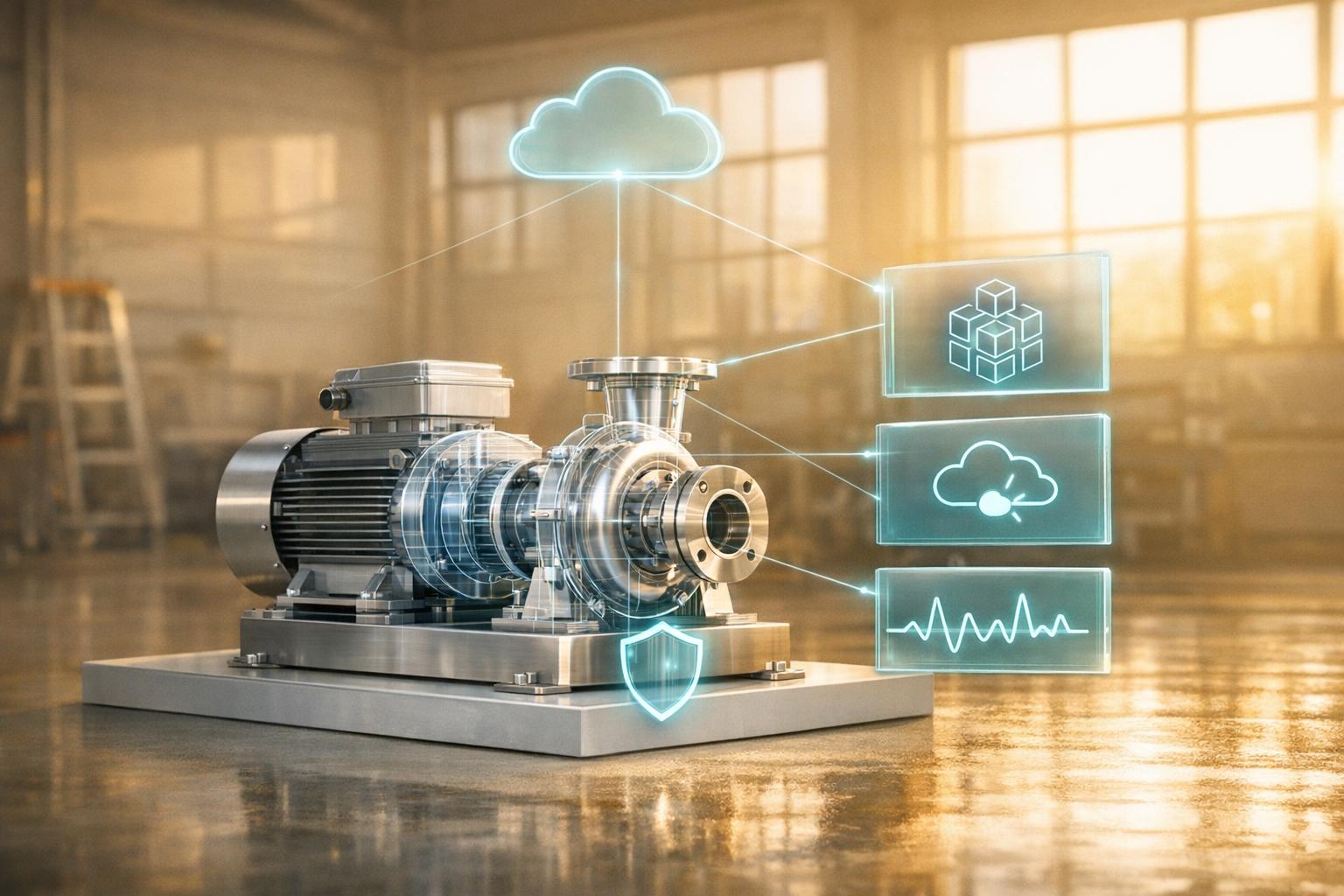
AI deployment for cloud digital twins is reshaping industries by enabling data-driven insights, automation, and predictive analysis. Here's what you need to know:
- Digital twins are virtual replicas of physical assets or environments, integrating data from sensors, CAD files, and 3D scans to simulate and analyze real-world conditions.
- AI-powered twins process massive data streams, offering real-time monitoring, predictions, and optimization for industries like construction and manufacturing.
- Key strategies for AI deployment include:
- Containerized deployment for scalability and cost-efficiency in high-volume workloads.
- Serverless execution for handling unpredictable, event-driven tasks.
- Real-time data streaming to maintain synchronization and accuracy.
By combining these approaches with secure, scalable cloud platforms, businesses can improve efficiency and reduce costs while staying aligned with physical operations. Tools like Anvil Labs streamline this process by hosting and analyzing diverse data types - such as 3D models and LiDAR scans - without requiring expensive hardware.
Key takeaway: AI and digital twins are transforming how industries analyze, predict, and optimize complex systems.
Building Agentic AI-Powered Digital Twins for Manufacturing Operations
sbb-itb-ac6e058
Core Components of Cloud Digital Twin Architecture

Four-Layer Cloud Digital Twin Architecture for AI Deployment
Creating an effective digital twin platform is essential for deploying AI models efficiently. A cloud-based digital twin designed for AI deployment relies on four interconnected layers. These layers work together to gather data, organize it, run AI models, and present results in a meaningful way.
The Spatial Data Plane handles the ingestion of physical asset data. It processes spatial data like LiDAR, CAD files, and point clouds, transforming them into real-time 3D assets such as glTF or USD formats. This layer uses spatial data pipelines to version-control and manage these assets, ensuring a reliable base for AI models. Data storage is typically managed through services like Amazon S3, while API Gateway oversees data access and distribution. By establishing a solid foundation for data ingestion, this layer sets the stage for effective semantic organization.
The Industrial Data Fabric focuses on organizing data from IoT sensors, industrial equipment, and monitoring devices. It enriches raw data by creating interconnected representations using knowledge graphs, with tools like AWS IoT TwinMaker playing a central role. These graphs are essential for context-aware AI analytics, as they link assets, processes, and operational conditions. This interconnected data structure allows for advanced analytics that go beyond isolated data points, enabling AI models to understand and analyze context effectively. Once the data is structured, the system moves seamlessly into AI processing.
The Simulation Compute Environment is where AI and machine learning models are executed. This layer uses High-Performance Computing (HPC) clusters and services like AWS Batch to run predictive models and conduct large-scale scenario analysis. Tools such as TwinFlow or Ray handle model orchestration, enabling the system to self-calibrate using IoT data. This adaptability ensures that AI models can respond to changing conditions instead of relying on static assumptions. The environment also includes "hot" storage for real-time processing and "cold" storage for cost-efficient long-term retention of training data. Outputs from this layer feed directly into visual dashboards, making insights immediately actionable.
The Visualization and Presentation Layer translates AI outputs into clear, actionable visualizations. Results are displayed on 3D dashboards using tools like Amazon Managed Grafana, cloud-rendered streams from platforms like Nvidia Omniverse, or immersive AR/VR interfaces. Increasingly, this layer also integrates generative AI chatbots, allowing operators to interact with the digital twin through natural language queries instead of navigating complex systems. Elastic cloud infrastructure, serverless execution with AWS Lambda, and Infrastructure as Code tools like AWS CDK ensure consistent and scalable deployments. Together, these layers form a cohesive system that simplifies AI deployment and delivers valuable operational insights.
Effective AI Deployment Strategies for Cloud Digital Twins
When it comes to deploying AI for cloud digital twins, three main strategies stand out: containerized deployment, serverless execution, and real-time data streaming. Each method caters to specific operational needs, from workload patterns to budget and performance demands. Let’s break these down.
Containerized Deployment for Scalability
Using Docker containers to package AI models and managing them with tools like Kubernetes or AWS ECS offers precise control over the deployment environment. This setup ensures predictable scaling and low latency, which are critical for handling high-volume production workloads. In fact, studies show that containerized microservices can achieve synchronization latencies of just tens of milliseconds, compared to hundreds of milliseconds with serverless options.
Cost-efficiency is another advantage. Self-hosted containerized models become more economical with scale, breaking even at 1–2 million monthly requests. Beyond 10 million requests or $5,000 in API costs, this approach can reduce expenses by 10x–100x. Additionally, containerization supports horizontal replication, allowing multiple replicas of a digital twin to operate across different environments - from edge nodes for safety-critical tasks to cloud datacenters for CPU-heavy AI processes. This flexibility makes it easier to integrate with simulation compute environments.
"DTs should be containerized and dynamically orchestrated." - Paolo Bellavista, Nicola Bicocchi, Carlo Giannelli, Marco Mamei, and Marco Picone
Serverless AI Deployment for Event-Driven Applications
Serverless platforms like Google Cloud Run and AWS Lambda excel in handling bursty workloads. They scale automatically from zero to thousands of requests, and you’re only charged for the actual execution time. This eliminates the need to manage infrastructure. However, there are trade-offs: cold starts can take 1–5 seconds when scaling from zero, and execution time limits (e.g., AWS Lambda’s 15-minute cap) may pose challenges for real-time digital twin updates.
For GPU-based serverless inference, optimizing concurrency is key. A useful formula for determining maximum concurrency is:
(Number of model instances × parallel queries per model) + (number of model instances × ideal batch size).
To enhance performance, techniques like quantizing models and using optimized formats (e.g., GGUF) can lower loading times and improve concurrency. Additionally, configuring Direct VPC with "all-traffic" egress and Private Google Access helps maximize network throughput when loading models from Cloud Storage.
Many production systems combine serverless with other approaches. For example, cloud APIs handle complex tasks, self-hosted containers manage high-volume simple operations, and edge deployments take care of latency-sensitive interactions. This hybrid strategy balances cost and performance for varied use cases.
Real-Time Data Streaming and Processing
For digital twins to function effectively, they need to stay in sync with their physical counterparts in real-time. Tools like Pub/Sub enable continuous data pipelines, ensuring that AI models work with up-to-date information for accurate predictions. The quality of this synchronization plays a direct role in the reliability of AI-generated insights.
Implementing semantic caching can further optimize operations, cutting API costs by 30% to 60%. By storing embeddings of past queries, similar requests can be served from the cache instead of triggering new computations. Additionally, creating a routing service that directs tasks to the appropriate deployment type - based on complexity, cost, and latency - can streamline operations.
For early-stage projects or prototypes, hosted cloud APIs provide a quick way to get started without the hassle of managing infrastructure. As traffic grows, transitioning to containerized deployments becomes more cost-effective. These strategies not only improve efficiency but also set the stage for secure and scalable AI systems in the long run.
Security and Scalability in AI Deployments
Deploying AI models on cloud-based digital twins requires a strong focus on both security and scalability. As systems grow - from managing just a handful of sensors to overseeing thousands of devices simultaneously - the infrastructure must handle this expansion seamlessly while safeguarding data integrity. Here's how you can achieve secure and scalable AI deployments for digital twin platforms.
Using a microservices architecture is a smart move. It allows AI components to scale independently, ensuring flexibility and security. Tools like scalable message brokers, such as Kafka, play a key role here. They efficiently manage real-time data streams between perception modules and analytics services, keeping performance levels high. When scaling across an enterprise, multi-tenancy becomes essential. Platforms with built-in tenant isolation ensure that workloads from different departments remain securely separated. This approach not only prevents unauthorized access but also maximizes the benefits of shared, centralized resources. Additionally, optimizing real-time data placement in storage layers reduces latency for AI inferencing. This ensures GPUs stay busy processing data instead of idling while waiting for inputs.
For organizations dealing with high data volumes, parallel data processing is critical. Data platforms capable of handling terabytes-per-second throughput eliminate GPU bottlenecks during data ingestion. Pairing this with tools like PipeTuner - designed to automate accuracy tuning for high-dimensional parameter spaces - helps maintain both efficiency and precision, even as systems scale.
On the deployment side, Docker Compose simplifies the process. With just one click, it enables secure deployments across major cloud providers. This streamlines prototyping in development environments and smooths the transition to production. Encryption and access controls are applied consistently at every stage, ensuring sensitive industrial data remains protected.
Integrating AI with Platforms like Anvil Labs

Anvil Labs takes AI deployment to the next level by combining secure, scalable solutions with essential asset data on cloud platforms. It simplifies the management of cloud-based digital twins by hosting and analyzing data like 3D models, LiDAR scans, thermal imagery, 360° photos, and orthomosaics. This integration allows for real-time spatial data analysis without the need for expensive on-premises hardware upgrades. By keeping digital twins aligned with real-world conditions, AI continuously provides predictive insights that help businesses stay ahead.
Asset Hosting and AI Analysis
Anvil Labs supports a wide range of asset types - 3D models, LiDAR point clouds, thermal imagery, and more - enabling AI to identify patterns, track changes, and predict potential issues. This streamlined process can cut product development timelines by up to 50%. With API integrations, AI can analyze uploaded 3D models to detect anomalies, measure variations, and flag potential concerns. The platform’s annotation and measurement tools enhance this process by marking areas of interest, such as machinery components showing signs of wear, and feeding this labeled data back into AI training systems for improved accuracy.
The benefits extend to containerized AI deployments, which ensure precise, up-to-date analysis while allowing remote access for teams to review insights across devices. For example, manufacturers can use Anvil Labs to host 3D models of production line equipment. AI models can then analyze vibration data from sensors, predicting equipment failures up to 50% faster than traditional methods. Secure sharing options ensure that proprietary industrial data remains protected while maintenance teams access AI-driven predictions.
Processing LiDAR and Thermal Data
LiDAR point clouds can be uploaded to Anvil Labs, where AI tools register the data, detect anomalies, and simulate changes to assets. For thermal imagery, AI identifies temperature variations across equipment surfaces, spotting hotspots that could indicate potential failures before they occur.
Real-time sensor data can also be streamed to Anvil Labs for immediate AI processing, ensuring digital twins remain accurate without delays. The platform automates the entire workflow - from data ingestion and processing to visualization - while its annotation tools allow experts to validate AI findings and refine models over time. This integration ensures the real-time precision needed for dynamic digital twin operations.
Conclusion
Implementing AI within digital twins requires a well-thought-out approach that integrates architecture, security, and real-time data processing strategies. These methods can cut downtime by as much as 30–50%, shifting maintenance practices from reactive to proactive modes. By continuously learning and adapting, AI-powered digital twins ensure that operational insights stay in sync with real-world conditions.
Tools like Anvil Labs simplify this process by handling diverse data types - such as 3D models, LiDAR point clouds, thermal imagery, and orthomosaics. They also offer integrated AI analysis tools, secure sharing options, and accessibility across devices. This eliminates the need for expensive on-site upgrades while ensuring digital twins remain tightly connected to their physical counterparts.
Adopting agile, collaborative development and ongoing model training allows digital twins to evolve alongside operational needs. Companies that embrace these methods transform their digital twins into actionable intelligence, improving efficiency by 20–40% in both design and maintenance processes. Using a unified platform with proven strategies paves the way for predictive operations, reducing risks and enhancing performance across even the most complex industrial environments.
FAQs
When should I use containers vs. serverless for a digital twin AI model?
When dealing with bursty or unpredictable traffic, serverless solutions can be a smart choice. They automatically scale to handle demand and reduce management overhead, making them perfect for event-driven tasks such as real-time monitoring. However, keep in mind that serverless options often come with execution time limits and may experience cold starts, which can affect performance for certain use cases.
On the other hand, containers are better suited for scenarios requiring long-running processes, greater control, or cost-efficient scaling for complex tasks. For example, they excel at handling detailed simulations or large-scale data processing. Containers offer the flexibility needed for persistent, resource-heavy applications, making them a reliable option for more intensive workloads.
How do I keep a cloud digital twin synchronized with real-time sensor data?
To keep a cloud digital twin aligned with real-time sensor data, leverage IoT sensors and cloud platforms for continuous data flow and integration. IoT sensors gather real-time information, which is then processed in the cloud to update the digital representation. Adding edge computing into the mix can enhance synchronization by handling quick, local processing while still relying on the cloud for storage and deeper analysis. Using secure, standardized protocols like MQTT or OPC UA ensures smooth and reliable updates.
What security controls are most important when scaling digital twins across teams?
Key security measures for scaling digital twins revolve around encryption, strict access management, and continuous monitoring. Encryption safeguards sensitive data, whether it's being transferred or stored. At the same time, Role-Based Access Control (RBAC) ensures that only authorized individuals can access critical systems and information.
To strengthen these defenses, organizations can implement regular security audits, deploy real-time intrusion detection systems, and leverage edge computing. These steps not only help minimize vulnerabilities but also maintain data integrity and support compliance as digital twin environments grow and more users gain access.

.svg)


